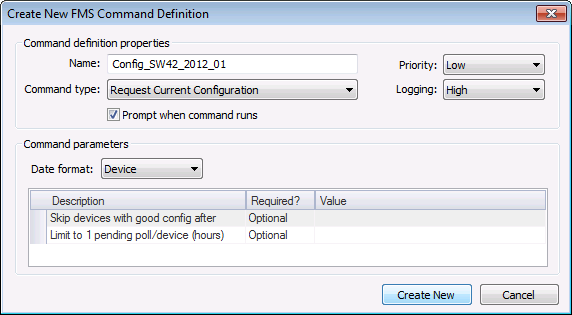
For each eligible device the Request Current Configuration command resolves to, the service will request the current configuration record from each resolved device.
See FMS Commands and Request Current Configuration for more information about this command.
See Scheduling FMS Command Tasks in the MSS for more information about scheduling commands.
See FMS ActiveX Controls and CxHmiFms for more information about using commands via FMS ActiveX controls on CygNet Studio or CygNet Vision screens.
See CxFms for more information about scripting commands.
To Configure a Request Current Configuration Command
The following command definition properties apply to Request Current Configuration commands.
| Property | Description |
|---|---|
|
Name |
Type in a Name for the new command. |
|
Command type |
Select the desired Command type from the drop-down menu. See FMS Commands for more information about available command types. |
|
Priority |
Select a processing queue Priority for the command from the drop-down menu. Options from least to greatest priority are as follows.
Default value is Low level processing queue priority. |
|
Logging |
Select a Logging level for the command results from the drop-down menu. Options are as follows.
Default value is Low level logging when scheduling a command in the MSS. Default value is High level logging when creating or running an ad-hoc command in FMS Explorer. |
|
Prompt when command runs |
Click to select/clear the check box to Prompt when command runs. Selecting this option means you will receive a prompt asking if you want to modify the parameters before the command is executed. |

The following command parameters apply to Request Current Configuration commands when creating or editing commands via FMS Explorer.
| Description | Value |
|---|---|
|
Date format |
Select the desired date format from the drop-down menu. Options are as follows.
Default value is Device time. |
|
Skip devices with good config after |
If used, will not execute poll on devices that have a successful ReqConfig (Request Current Configuration) message after the given timestamp. Click ... to Select Date and Time. See Selecting Date and Time for more information. See Note below this table. This parameter is optional. |
|
Limit to 1 pending poll/device (hours) |
If used, enter the number of hours to limit the queue to 1 pending poll/meter. This limits the number of requests in the queue for a specific device. Example The parameter is set to 1 hour and you poll at 8:00 a.m. If you poll again at 8:05 a.m., but the original request in still in the queue, the second message will be discarded since the pending time has not been exceeded. Click OK. This parameter is optional. |
Note: When using relative (rather than absolute) date/time, if both the start and end date/time have hour, minute, and second values of 00 (or if both are set to midnight), an additional day will be added to the date at the end of the range. This occurs because the service assumes the start of the day for the starting date/time and the end of the day for the ending date/time in these circumstances. Therefore requesting a time range from T to T will yield one day of data, and from T-1 to T will yield two days of data. If only one day of data is desired when using relative date/time, the start and end date/times must therefore be the same. If any of the start or end date/time hour, minute, or second values are specified as a value other than zero (or midnight) however, the range will be used as specified.
See Managing Node Commands for information about editing or deleting this command.
When device configuration is requested for the first time, the data will be copied back to be effective as of the device install date.
See Running Node Commands for information about running this command.
|
|
|

