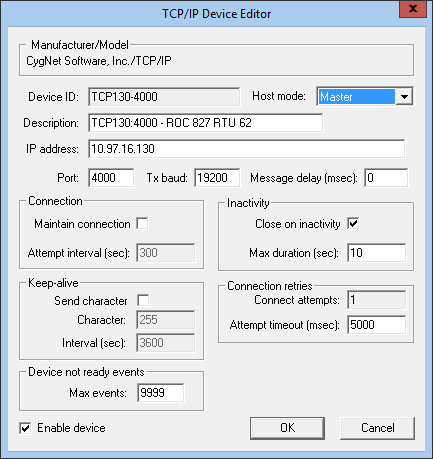
The TCP/IP EIE communication device provides point-to-point RTU communication based on IP address and port.
Click the following image to see an example Device Editor:
A 64-bit version of this EIE is available. See 64-bit Device Drivers.
The following tables list and describe properties from the TCP/IP Device Editor dialog box.
| Property | Description |
|---|---|
|
Device ID |
The unique identifier of an instance for this device. This free-form name must be unique in the DDS and the FAC. That is, it must be a name not used by any other communication device, import/export device, remote device, or facility. Valid characters are A-Z, 0-9, dash (-), underscore (_), and tilde (~). No spaces are allowed. 20 character maximum. Note: Tilde (~) is a valid character for both devices and facilities, but its use is not recommended. |
|
Host mode |
Listen This mode is remote device EIE specific and data group specific. This mode indicates that the communications device can only listen to a data stream from an external source. The supported listen mode data groups are a small subset of the overall capabilities of the EIE. NonMaster This mode is remote device EIE-specific. It is not designed to allow write messages to be sent to an RTU. However, because each remote device EIE specifies what a write message is, you might still be able to send some write messages. Master This default mode allows any message to be sent. |
|
Description |
A free-form description of the device. 32 character maximum. |
|
IP address |
The address of the remote IP device. Number and name formats are acceptable. |
|
Port |
The socket number of the remote IP comm device. |
|
Tx baud |
The transaction baud used to format messages. |
|
Message delay (msec) |
The delay (in milliseconds) to wait before sending a message to the remote IP device. If the remote IP device also has a message delay, the greater value takes precedence. |
| Connection | |
|
Maintain connection |
Check this box to maintain connection with the remote IP comm device. Note: Maintain connection and Close on inactivity work independently of each other. If both are set, then Maintain connection takes precedence. |
|
Attempt interval (sec) |
Defines the interval (in seconds) between attempts to connect with an unconnected remote IP device if Maintain connection is enabled. Note: Do not set the value of this property below the default unless you have a good metric for changing it. If you do lower this value, take into account the Attempt Timeout. |
| Inactivity | |
|
Close on inactivity |
Check this box to close connection to remote IP comm device when no activity has occurred for the period of time specified by Max Duration. |
|
Max duration (sec) |
The maximum duration (in seconds) to allow for inactivity. Be aware that the remote IP device may have its own duration for inactivity. If the remote IP device's period is shorter, then the connection will be closed by the remote IP device. |
| Keep-alive | |
|
Send character |
Applicable only when Maintain connection is enabled. Check this box to send a character to the remote IP comm device when necessary to maintain a connection. This ensures that the field device on the other end does not terminate the connection. Use of this property is dependent upon the remote IP device. |
|
Character |
The character (ASCII value) to send to keep the connection alive. |
|
Interval (sec) |
The interval (in seconds) at which to send the Keep Alive Character. |
| Connection retries | |
|
Connect attempts |
Number of attempts to try to connect to the remote IP comm device. The value of this property is always 1. |
|
The time (in milliseconds) to wait when attempting the connection before marking the attempt as failed. |
|
| Device not ready events | |
|
Max events |
The Device not ready events field sets the maximum number of failed attempts to connect to a field device before the communication device reaches a "Not Ready" state. If a communication device reaches a "Not Ready" state, the existing queue is emptied and new messages are not queued. You can reset the communication device by disabling and then re-enabling it, or you can enable the communication device using script. |
|
Enable device |
Check to enable or disable the device. The default setting is disabled. The device will automatically disable if an invalid configuration is detected. The device can be re-enabled after the invalid configuration is fixed. |

|
|
|

