
A point record may contain up to 48 status bits, which are used to provide status information about a point record in a Current Value Service (CVS). The StatusBits element of the CvsMetadata defines all status bits for a specified CygNet point scheme. The point state is based on the status bits, which are associated with point types. Status bits are stored in blocks.
There are three types of status bits:
See Status Bit Blocks below for information about the bit positions of each of these status bits.
There are 17 system bits, displayed in the CvsMetadata with a calculation type of SYSTEM. Each system status bit performs a specific role in a CygNet system. The bit IDs for these status bits are predefined within CygNet and should not be changed.
Basic Point Information — four status bits provide information on the basic state of the point:
Basic Alarm Information — four status bits provide basic information about the state of alarms for the point:
Alarm Priority Category Bits 1-3 designate which Alarm Priority category the point currently falls under. Because there are three bits there can be a total of eight (0-7) possible categories for a point to fall under. Category 0 represents a point that does not have an Alarm Priority Category. Categories 1-7 correspond to the configured AlarmPriorityCategories. See Alarm Priority Categories for more information.
Point Type — three status bits identify with which point type the point is associated.
The first two status bits, STRING_ENUM and DIGITAL_ANALOG, work in tandem to define the point type:
- If both DIGITAL_ANALOG and STRING_ENUM bits not set = Analog
- If only DIGITAL_ANALOG bit set = Digital
- If both DIGITAL_ANALOG and STRING_ENUM bits set = Enumeration
- If only STRING_ENUM bit set = String
Point Scheme — the four Point Scheme status bits, SCHEME1-4, identify with which point scheme the point is associated. These bits are a binary representation of the available point scheme IDs 0-15. A CvsMetadata file can define up to 16 custom point schemes (Schemes 0 -15). If the CygNet Standard point scheme is used, its default is Scheme 0.
VHS Information — Two VHS information status bits are used by the VHS to track if a VHS entry has been edited or deleted by a user:
Configurable bits are used to facilitate CVS alarm calculations as well as CAS and GNS reporting. They are the only status bits that support CVS alarm calculations. Each alarm listed on the Analog/Digital/Enumeration/String Alarm Settings page of the PNT Editor corresponds to a configurable bit.
There are 15 configurable bits available, CONFIG1 - CONFIG15, and each bit can have its own associated calculation type and parameters. In addition to supporting CVS alarm calculation types, configurable bits also support the EXTERNAL calculation type. This lets you configure a status bit to be set externally, yet still have the option of reporting to the CAS or GNS in the same way as CVS alarm calculation types.
See Config Bit State Page for more information.
There are 16 user bits available, User Bit 1 – User Bit 16, which are configurable by a user to associate special status information about a point. These bits only support the EXTERNAL calculation type. A user can set these bit types manually or through an API.
Each point record in a Current Value Service has 48 associated status bits. These status bits are stored in one 16-bit block and one 32-bit block. The Status Bit Details field of the Point Properties dialog box displays the Set state, Description, and Bit Name ("bitid" attribute) of each status bit.
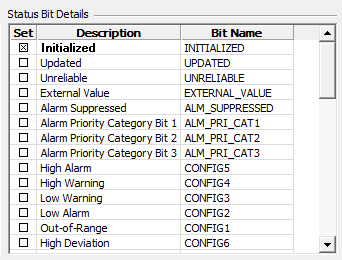
The following table shows the bit positions of each status bit. The 16-bit block section, also described as the Base Status bits, contains a 16-bit block of status bits 0 to 15, including system and configurable status bits. The 32-bit block section, also described as the Extended Status bits, displays a 32-bit block of status bits, including user, system, and configurable status bits.
| 16-Bit Block | |||
|---|---|---|---|
| # | Status Bit Name | Description | Bit Type |
| 0 | INITIALIZED | Initialized | SYSTEM |
| 1 | UPDATED | Updated | SYSTEM |
| 2 | UNRELIABLE | Unreliable | SYSTEM |
| 3 | CONFIG1 | Out-of-Range | CONFIG |
| 4 | CONFIG2 | Low Alarm | CONFIG |
| 5 | CONFIG3 | Low Warning | CONFIG |
| 6 | CONFIG4 | High Warning | CONFIG |
| 7 | CONFIG5 | High Alarm | CONFIG |
| 8 | CONFIG6 | High Deviation | CONFIG |
| 9 | CONFIG7 | Unused 1 | CONFIG |
| 10 | STRING_ENUM | Reserved 1 | SYSTEM |
| 11 | CONFIG8 | Unused 2 | CONFIG |
| 12 | DIGITAL_ANALOG | Reserved 2 | SYSTEM |
| 13 | IN_OUT | Reserved 3 | SYSTEM |
| 14 | CONFIG9 | Unused 3 | CONFIG |
| 15 | CONFIG10 | Unused 4 | CONFIG |
| 32-Bit Block | |||
| # | Status Bit Name | Description | Bit Type |
| 0 | USER1 | User Bits 1 | USER |
| 1 | USER2 | User Bits 2 | USER |
| 2 | USER3 | User Bits 3 | USER |
| 3 | USER4 | User Bits 4 | USER |
| 4 | USER5 | User Bits 5 | USER |
| 5 | USER6 | User Bits 6 | USER |
| 6 | USER7 | User Bits 7 | USER |
| 7 | USER8 | User Bits 8 | USER |
| 8 | USER9 | User Bits 9 | USER |
| 9 | USER10 | User Bits 10 | USER |
| 10 | USER11 | User Bits 11 | USER |
| 11 | USER12 | User Bits 12 | USER |
| 12 | USER13 | User Bits 13 | USER |
| 13 | USER14 | User Bits 14 | USER |
| 14 | USER15 | User Bits 15 | USER |
| 15 | USER16 | User Bits 16 | USER |
| 16 | SCHEME1 | Reserved 4 | SYSTEM |
| 17 | SCHEME2 | Reserved 5 | SYSTEM |
| 18 | SCHEME3 | Reserved 6 | SYSTEM |
| 19 | SCHEME4 | Reserved 7 | SYSTEM |
| 20 | ALM_PRI_CAT1 | Alarm Priority Category Bit 1 | SYSTEM |
| 21 | ALM_PRI_CAT2 | Alarm Priority Category Bit 2 | SYSTEM |
| 22 | ALM_PRI_CAT3 | Alarm Priority Category Bit 3 | SYSTEM |
| 23 | EXTERNAL_VALUE | External Value | SYSTEM |
| 24 | VHS_USER_EDITED | Reserved 8 | SYSTEM |
| 25 | ALM_SUPPRESSED | Alarm Suppressed | SYSTEM |
| 26 | CONFIG11 | Unused 5 | CONFIG |
| 27 | CONFIG12 | Unused 6 | CONFIG |
| 28 | CONFIG13 | Unused 7 | CONFIG |
| 29 | VHS_VALUE_DELETED | Reserved 9 | SYSTEM |
| 30 | CONFIG14 | Unused 8 | CONFIG |
| 31 | CONFIG15 | Unused 9 | CONFIG |
Examples of user and config status bit usage include:
|
|
|

