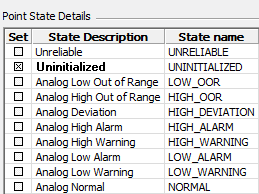
The PointStateInstances element is the parent node that defines all point state instances for the specified point scheme. A point state instance defines the actual point states used by a point and displayed in the Point State Details section of the Point Properties dialog box. Point state instances use Point State Definitions and Status Bits to assign the proper point state details to a point.
For more information, see Point State and Alarm Condition.
The following example displays the point state instance assigned to all point types (as designated by the "*" in the “pointtypes” attribute) of the point scheme.
|
<PointStateInstances> <PointStateInstancesForScheme pointschemes=""> <PointStateInstanceDefinitions pointtypes="*"> </PointStateInstanceDefinitions> </PointStateInstancesForScheme> </PointStateInstances> |
The following table lists and describes the properties of the PointStateInstances element.
| Property | Description |
|---|---|
|
Case Sensitive |
Yes |
|
Required |
Yes |
|
Number of Instances Allowed |
1 |
|
Requires End Tag |
Yes |
|
Parent Element |
|
|
Child Element |
The PointStateInstancesForScheme element is the parent node that defines all point state instance definitions for the specified point scheme.
The following table lists and describes the properties of the PointStateInstancesForScheme element.
| Property | Description |
|---|---|
|
Case Sensitive |
Yes |
|
Required |
Yes |
|
Number of Instances Allowed |
1 |
|
Requires End Tag |
Yes |
|
Parent Element |
|
|
Child Element |
|
|
Attribute |
pointschemes |
The following table lists and describes attributes generally applicable to the PointStateInstancesForScheme element.
| Attribute | Description |
|---|---|
|
pointschemes |
Specifies the point scheme used for the CygNet domain. |
The PointStateInstanceDefinitions element is the parent node that defines all point state instance definitions for all supported point types.
The following table lists and describes the properties of the PointStateInstanceDefinitions element.
| Property | Description |
|---|---|
|
Case Sensitive |
Yes |
|
Required |
Yes |
|
Number of Instances Allowed |
Unlimited |
|
Requires End Tag |
Yes |
|
Parent Element |
|
|
Child Element |
|
|
Attribute |
pointtypes |
The following table lists and describes attributes generally applicable to the PointStateInstanceDefinitions element.
| Attribute | Description |
|---|---|
|
pointtypes |
Specifies the point type(s) to be applied to the point state instance definitions for the PointStateInstanceDefinition element. pointtypes="*" indicates that the PointStateInstanceDefinitions apply to all point types. |
The PointStateInstanceDefinition element defines the status bits for the point state instance definition.
The following table lists and describes the properties of the PointStateInstanceDefinition element.
| Property | Description |
|---|---|
|
Case Sensitive |
Yes |
|
Required |
Yes |
|
Number of Instances Allowed |
Unlimited |
|
Requires End Tag |
Yes |
|
Parent Element |
|
|
Child Element |
|
|
Attributes |
pointstateid pointstatename precedence matchmethod ovrdesc ovrtoken ovrsinglecolor ovrfgcolor ovrbgcolor ovralarmcondition ovrext-status |
The following table lists and describes attributes generally applicable to the PointStateInstanceDefinition element.
| Attribute | Description |
|---|---|
|
pointstateid |
Links the point state definition id to the point state. |
|
pointstatename |
Links the point state instance to a point state definition using the point state definition name. |
|
precedence |
Determines which point state instance definition takes priority if more than one point state instance definition is active. This is reflected in the order of the point states in the Point State Details field of the Point Properties dialog box. Note: Lower value numbers take precedence over higher value numbers. |
|
matchmethod |
Specifies the bit matching method used to determine if a point state instance is active. Options include MATCH_ALL, MATCH_NOTALL, MATCH_ANY, or MATCH_NONE. |
|
ovrdesc |
Specifies a description that overrides the "desc" attribute of the PointStateDefinition element. |
|
ovrtoken |
Specifies a token that overrides the "token" attribute of the PointStateDefinition element. |
|
ovrsinglecolor |
Specifies a singlecolor that overrides the "singlecolor" attribute of the PointStateDefinition element. |
|
ovrfgcolor |
Specifies a fgcolor that overrides the "fgcolor" attribute of the PointStateDefinition element. |
|
ovrbgcolor |
Specifies a bgcolor that overrides the "bgcolor" attribute of the PointStateDefinition element. |
|
ovralarmcondition |
Specifies whether to override the "alarmcondition" attribute of the PointStateDefinition element. Value:
|
|
ovrext_status |
Specifies a value that overrides the "ext_status" attribute of the PointStateDefinition element. |
|
<PointStateInstances> <PointStateInstancesForScheme pointschemes=""> <PointStateInstanceDefinitions pointtypes=""> <PointStateInstanceDefinition pointstatename="" precedence="" ovrdesc="" matchmethod=""> <StatusBit bitid="" mustmatch=""/> <StatusBit bitid=""/> </PointStateInstanceDefinition> </PointStateInstanceDefinitions> </PointStateInstancesForScheme> </PointStateInstances> |
The StatusBit element specifies the bitid that defines the status bit and the match parameter for each point state instance definition.
The following table lists and describes the properties of the StatusBit element.
| Property | Description |
|---|---|
|
Case Sensitive |
Yes |
|
Required |
No |
|
Number of Instances Allowed |
Unlimited |
|
Requires End Tag |
No |
|
Parent Element |
|
|
Attributes |
bitid mustmatch mustnotmatch |
The following table lists and describes attributes generally applicable to the StatusBit element.
| Attribute | Description |
|---|---|
|
bitid |
Defines the status bit and is referenced from the StatusBit section of the metadata file in order to use it with a match method. |
|
mustmatch |
When set to "true", indicates that the specified bitid must be set for the parent PointStateInstanceDefinition to be applied. For example, if the "matchmethod" is "MATCH_ANY", and "CONFIG1" bitid has a "mustmatch" value of "true", then CONFIG1 must be set for this instance to be applied to a point. Value:
|
|
mustnotmatch |
When set to "true", indicates that the specified bitid must not be set for the PointStateInstanceDefinition to be applied. For example, if the "matchmethod" is "MATCH_ANY", and "CONFIG2" bitid has a "mustnotmatch" value of "true", then CONFIG2 must not be set for this instance to be applied to a point. Value:
|
The following example defines the point state instance that is used when a point is uninitialized. The "pointstatename" attribute references the "UNINITIALIZED" name from the point state definition. This links all the settings such as color, token, and alarm condition from the "UNINITIALIZED" point state definition to this point state instance. The referenced status bits determine when this instance is applied to a point. The instance uses the match method "MATCH_NOTALL", meaning this state is active if any of the dependent status bits are not set. In this example, the point state is active if the "INITIALIZED" status bit is enabled and the "UPDATED" status bit is not, or if the "UPDATED" status bit is enabled and the "INITIALIZED" status bit is not.
|
<PointStateInstanceDefinition pointstatename="UNINITIALIZED" precedence="1" <StatusBit bitid="INITIALIZED"/> <StatusBit bitid="UPDATED"/> </PointStateInstanceDefinition> |

|
|
|

