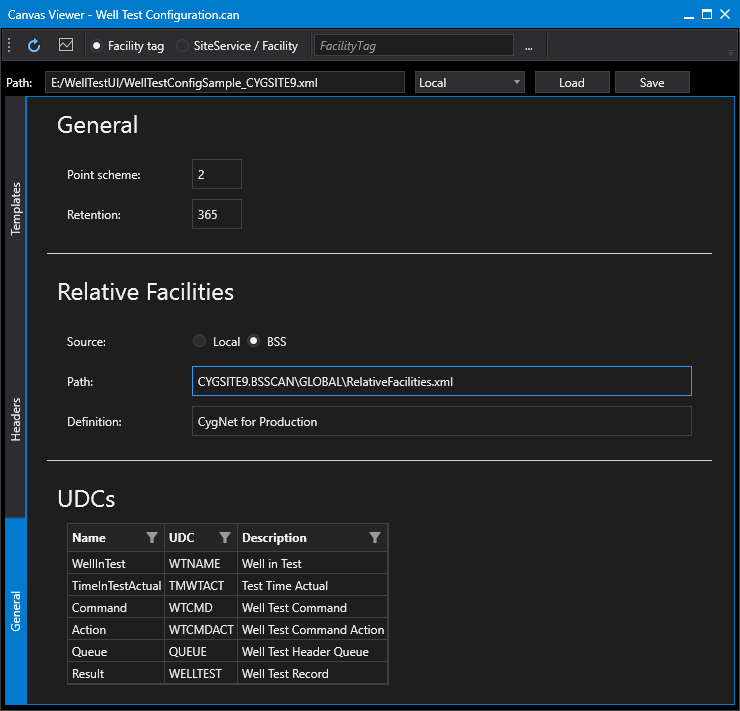
The General page of the well test configuration control defines general properties required by the CygNet Well Test Module, and consists of the following sections:
Click the following image for more information:
|
|
| Sample General Page Configuration |
To configure General Well Test properties
Perform the following steps to configure the general well test properties, referring to the property definitions below:
The General configuration section of the General page defines the point scheme used by the CygNet Well Test Module and the length of time to retain well test records.
| Property | Description | XML |
|---|---|---|
| Point scheme |
Specifies the point scheme used by the CygNet Well Test Module. |
|
|
Retention |
Specifies the number of days to retain the well test records. |
The Relative facility configuration section of the General page defines the location of the relative facilities file and name of the definition set.
Note: See Creating the Relative Facilities File for instructions on how to get relative facility settings from a Canvas installation.
| Property | Description | XML |
|---|---|---|
|
Source |
Specifies the path type for the relative facility file. Supported options include Local or BSS. |
|
|
Path |
Specifies the path to and filename of the relative facility file. |
|
|
Definition |
Specifies the relative facility definition set to use for the configuration. This is only needed if there are multiple definition sets in the relative facility file. |
The UDC configuration section of the General page defines the UDCs where the CygNet Well Test Module will post well test values to well-known points.
| Property | Description | XML | ||
|---|---|---|---|---|
|
Name |
Specifies the nice name for the UDC. There are six possible UDC name types:
|
|||
|
UDC |
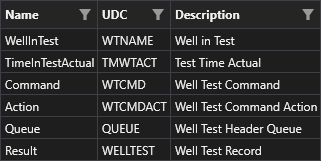
Specifies the UDC of each UDC type. When you create a new configuration in the Canvas Well Test Configuration control six default UDCs will be provided. These default UDCs correspond to the UDCs used in the sample Canvas screens. You can choose to keep the same UDCs or specify others as necessary. The default UDCS are as follows:
|
|||
|
Description |
Specifies the description of each UDC type. |
Note:  The columns in the UDC configuration grid can be filtered.

|
|
|