Change Value Alarm Calculations
There are four variations of the Change Value alarm calculation that can be implemented with the CygNet Enhanced Point Scheme. See Understanding the CVS Metadata File for more information about the elements and attributes that define a CygNet Point Scheme.
See the following subsections for details:
The number of entries stored for this calculation is specified by the histvaluecount attribute in the CvsMetadata file for a CygNet Enhanced Point Scheme.
For more information, see Alarm Calculation Types.
Change Value
The Change Alarm uses the Change Value (CHANGE_VAL) calculation. On each update, the system will set the alarm bit if the point’s value is changed. It is cleared every time a point is updated with the same value. There are no calculation parameters for this calculation type.
- If the previous value ≠current value, the alarm is set.
- If the previous value = current value, the alarm is not set.
Example
- Previous value = 10
- Updated value = 11 (alarm is set)
Change Value Percent
The Rate of Change Alarm uses the Change Value Percent (CHANGE_VAL_PCT) calculation. On each update, the system calculates the percentage change between the new value and the newest value older than the time interval, divided by the time interval in seconds, and sets the alarm bit if the absolute value of the percentage change exceeds the threshold.
Calculation Parameters
The calculation parameters for this alarm are user-provided:
- Maximum Percentage Change Allowed (calcparm1) — maximum allowed percentage change over the specified time interval before the alarm bit is set.
- Time Interval (sec) (calcparm2) — the time span during which the maximum percentage change is allowed.
Preliminary Calculations
|
Maximum Percentage Change Allowed = calcparm1/calcparm2
Percentage Change = ((Updated Value)/(Newest Val Older than Time Intvl) -1) X 100 |
Equation
|
Rate Change = Percentage Change/calcparm2 |
- If the (ABS) Rate Change > maximum allowed percentage change, the alarm is set.
- If the (ABS) Rate Change ≤ maximum allowed percentage change, the alarm is not set.
Example
- calcparm1 = 10%
- calcparm2 = 60 seconds
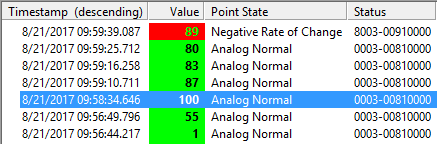
In this example, the newest value older than the time interval is 100 and the updated value is 89. The Rate of Change bit is set because the absolute value of the percentage change is 18.33%, which exceeds the calcparm1 value (10%).
|
Maximum Percentage Change Allowed = 10/60 = 0.16667 = 16.67%
Percentage Change = ((89/100) -1) X 100 = -11%
Rate Change = -11/60 = - 0.18333 = -18.33% (absolute value exceeds the maximum percentage change allowed, so alarm bit is set) |
Change Value Positive Percent
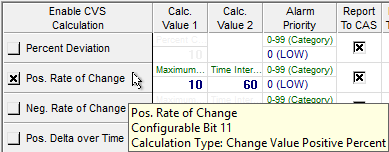
The Positive Rate of Change alarm uses the Change Value Positive Percent (CHANGE_VAL_POS_PCT) calculation. On each update, the system calculates the percentage change between the new value and the newest value older than the time interval, divided by the time interval in seconds, and sets the alarm bit if the value is positive and exceeds the threshold.
The following image shows the area of an Analog Alarm Settings page of a PNT Editor with an enabled Positive Rate of Change alarm using the Change Value Positive Percent calculation type:
|
Alarm Calculation Configuration — Change Value Positive Percent |
Calculation Parameters
The calculation parameters for this alarm are user-provided:
- Maximum % difference allowed (calcparm1) — maximum allowed positive percentage change over the specified time interval before the alarm bit is set.
- Time Interval (sec) (calcparm2) — the time span during which the maximum percentage change is allowed.
Preliminary Calculations
|
Maximum Percentage Change Allowed = calcparm1/calcparm2
Percentage Change = ((Updated Value)/(Newest Val Older than Time Intvl) -1) X 100 |
Equation
|
Rate Change = Percentage Change/calcparm2 |
- If the Rate Change is positive and > maximum allowed percentage change, the alarm is set.
- If the Rate Change is positive and ≤ maximum allowed percentage change, the alarm is not set.
Example
- calcparm1 = 10%
- calcparm2 = 60 seconds
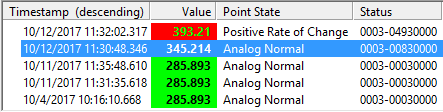
In this example, the Positive Rate of Change bit is set because the rate of change is positive (23.17%) and exceeds the calcparm1 value (10%).
- Updated Value = 393.21
- Previous Value (newest older than time interval) = 345.214
|
Maximum Percentage Change Allowed = 10/60 = 0.16667 = 16.67%
Percentage Change = ((393.214/345.214) -1) X 100 = 13.903%
Rate Change =13.903/60 = 0.2317 = 23.17% (value is positive and exceeds the maximum percentage change allowed, so alarm bit is set) |
|
Alarm Calculation Results — Change Value Positive Percent |

Change Value Negative Percent
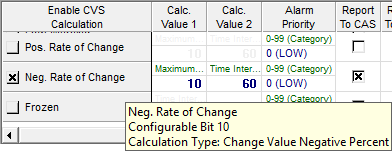
The Negative Rate of Change alarm uses the Change Value Negative Percent (CHANGE_VAL_NEG_PCT) calculation. On each update, the system calculates the percentage change between the new value and the newest value older than the time interval, divided by the time interval in seconds, and sets the alarm bit if the value is negative and exceeds the threshold.
The following image shows the area of an Analog Alarm Settings page of a PNT Editor with an enabled Negative Rate of Change alarm using the Change Value Negative Percent calculation type:
|
Alarm Calculation Configuration — Change Value Negative Percent |
Calculation Parameters
The calculation parameters for this alarm are user-provided:
- Maximum % difference allowed (calcparm1) — maximum allowed negative percentage change over the specified time interval before the alarm bit is set.
- Time Interval (sec) (calcparm2) — the time span during which the maximum percentage change is allowed.
Note: The threshold (calcparm1) must still be represented as a positive percentage.
Preliminary Calculations
|
Maximum Percentage Change Allowed = calcparm1/calcparm2
Percentage Change = ((Updated Value)/(Newest Val Older than Time Intvl) -1) X 100 |
Equation
|
Rate Change = Percentage Change/calcparm2 |
- If the Rate Change is negative and > maximum allowed percentage change, the alarm is set.
- If the Rate Change is negative and ≤ maximum allowed percentage change, the alarm is not set.
Example
- calcparm1 = 10%
- calcparm2 = 60 seconds
In this example, the Negative Rate of Change bit is set because the rate of change is negative (-18.33%) and exceeds the calcparm1 value (10%).
- Updated Value = 89
- Previous Value (newest older than time interval) = 100
|
Maximum Percentage Change Allowed = 10/60 = 0.16667 = 16.67%
Percentage Change = ((89/100) -1) X 100 = -11%
Rate Change = -11/60 = - 0.18333 = -18.33% (value is negative and exceeds the maximum percentage change allowed, so alarm bit is set) |
|
Alarm Calculation Results — Change Value Negative Percent |