Image Tool - Selecting an Image
The Image Tool enables you to associate at least one image with a point. Different images may be configured to represent different bit states, point states, or alarm states. If you select images for various states, you must know the point type (Analog, Digital, String, or Enumeration) that the image is to represent and select the image(s) accordingly.
If an object is only meant to be static, assign it a default image. The default image is the image that is always displayed. If the object is dynamic, the default image is the image shown in Edit mode and is also displayed when a bit state, point state, or alarm state occurs for which no image has been assigned. Otherwise, the image configured for the particular bit state, point state, or alarm state appears. For instance, you could assign a default image of a gray pump to a point. The point could be assigned a red pump image that appears only when the pump is in high alarm.
Note: Only .jpg, .bmp, .ico, and .dib file types are supported by this tool.
To Associate an Image with a Point
- Using CygNet Studio in Edit mode, locate the Graphics Tools palette, click the desired tool icon, then click on the TheView. This places the tool on TheView.
- Right-click the newly added tool to open its Property Sheet.
- On the Normal page, locate the [Images] property and click its Browse button.
- In the Point State Image Configuration dialog box, configure the Scheme, Type, and Mode options:
- Click the Scheme drop-down menu and select the appropriate option. The Point Scheme determines the options listed under the State column. Most installations will be CygNet Standard.
- Click the Type drop-down menu and select the appropriate point type. Set it to the type of point associated with the object. Once set, the appropriate State options for the type appear. If using only a default image, use * or any point type.
- Click the Mode drop-down menu and select the appropriate option. Which option you select determines which state(s) become available for configuration. Unavailable State options appear dimmed. Always add a default image, even if the object is going to be dynamic. This is because the only image shown in Edit mode is the default image. The Mode options are as follows:
- Default Only: This mode enables only the specification of a default image.
- Alarm Condition: This mode enables the association of images with the alarm states relevant to the type specified in the Type field.
- Point State: This mode enables the association of images with the point states relevant to the type specified in the Type field.
- Bit State: Enables you to set bit states for various configurable point Status Bits. Different images can be used to represent the different bits states. See Point State/Status Bit Details or contact CygNet Support for more information.
|
Point State Image Configuration |
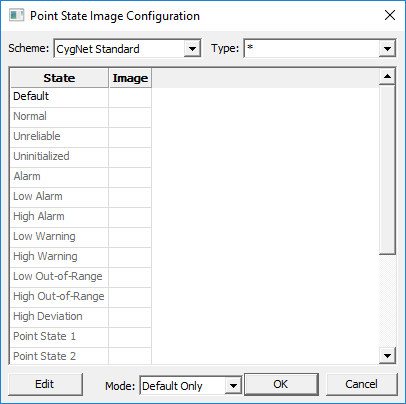
- To associate an image with a State, select the state, and type the path and file name of the image you want to associate with this selected state directly into the Image cell. Remember that only .jpg, .bmp, .ico, and .dib file types are supported by this tool.
- Alternately you can browse to find the desired bitmap. Double-click the Image cell for the selected state or click Edit. Unavailable State options are dimmed.
- On the Bitmap Dialog dialog box that opens, click Load.
|
Bitmap Dialog |
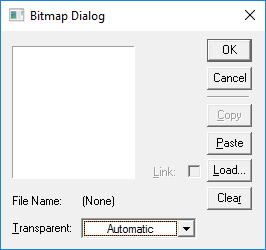
- Select the file system where the desired image is stored and click OK.
- Browse to the location of your desired image and select it. Only .jpg, .bmp, .ico, and .dib file types are supported by this tool. You have two options depending on the file system specified:
- Standard File System: Use the Windows Explorer to locate and select the desired image.
- Blob File System: Specify a Blob Service, select a Folder, then select the File Name and click OK. Folders and images in the Blob must be preexisting. For information about adding images to or retrieving images from the BSS, see Opening Files from or Saving Files to the BSS.
|
Image Preview |
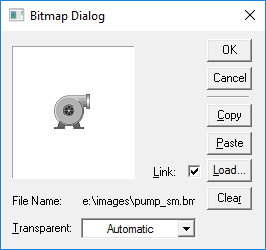
- If you want to copy the image to the clipboard and paste it to the screen, use the Copy and Paste buttons. These options are only available if an image is loaded.
- If you want to select a different image, click Clear to clear the loaded image from the Bitmap Dialog dialog box.
- If you want part of the loaded image to be transparent, click to check Transparent, then use the relevant drop-down menu to select which color you want to be transparent. The transparency mask has 0% tolerance, so only pixels that exactly match the selected color will be transparent.
- If you want to link the image rather than embed it, click to check Link.
Note: A linked image is accessed from the file system each time the screen is opened. To link, all users of the screen must have read access to the image's storage location. If the source is unavailable, an  is shown in its place on the screen. Linking can reduce the size of the CygNet Studio file. The amount of reduction depends upon the number of images on TheView and the size of the images. With just a few images the difference might be slight, so you might want to do a comparison before selecting one method over the other. Embedding the image is the recommended method for most screens. When the image is embedded, it is saved with the screen. Embedding the image in the TheView makes the file self-contained.
- If you are finished configuring this image, click OK. When you return to the Point State Image Configuration dialog box, you will see that the specified image appears in the Image column beside the corresponding State.
|
Image Column |
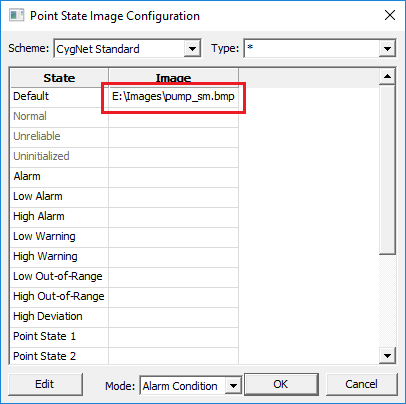
- If you are satisfied with the results, click OK. If you want to configure more images for states, repeat steps 5 to 9 above.


