Configuring Array-Related Data Groups
The BSAP EIE offers the ability to add data groups on an ad hoc basis to a device instance without configuring them first in the device template file. This functionality is handled through the "Configurable Data Group" (cfgBSAP) data group. Any number of device-level data groups can be added. This task is simplified if you have loaded one or more ACCOL Load Files into the device. Otherwise, the edit mode will be limited.
Note: The data group type name of cfgBSAP cannot be changed by the user.
Three array-related data group types can be configured using the "Configurable Data Group" (cfgBSAP) data group.
- AArray — handles sets of analog data group elements (floating points) and is identified by dgStruct="AArray".
- DAArray — handles sets of analog data group elements (floating points) with the date displayed in the first column and is identified by dgStruct="DAArray".
- LArray — handles sets of logical data group elements (bits) and is identified by dgStruct="LArray".
For more information about these and other data groups, see Data Groups.
To Configure an Array-Related Configurable Data Group
- Using CygNet Explorer, in the DDS pane, open the remote device to which you want to add a "Configurable Data Group".
- In the remote device Properties editor, select the Data Group page and click Add.
- Select Configurable Data Group from the list and click OK.
- In the Data Group Properties dialog box, configure the data group’s description, facility, etc.
- Click Configure. The Configurable Data Group Definition dialog box displayed is the first screen of a wizard that steps through the process of defining the data group.
|
Configurable Data Group Definition |
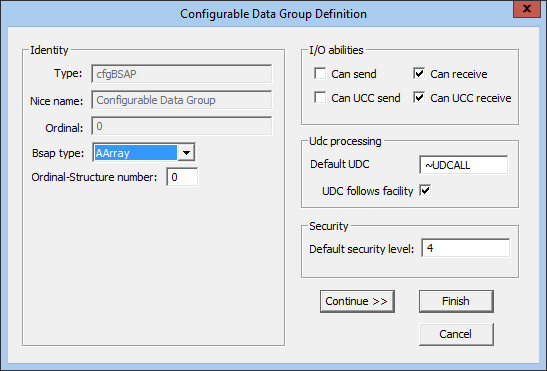
- Configure the following general properties for the data group, then click Continue.
| Property | Description |
|---|---|
|
Type |
The field pre-populates with the cfgBSAP data group. |
|
Nice name |
The field pre-populates with Configurable Data Group and cannot be changed. |
|
Ordinal |
Ordinal pre-populates based on the sequence in which the data group is being added. |
|
Bsap type |
The data group type. |
|
Ordinal-Structure number |
Defines the source of the array in the Ordinal-Structure Number field. |
|
I/O abilities |
Check to enable the data group read/write options:
|
|
UDC processing |
Default UDC — the name of the UDC category used by default when mapping UDCs to data group elements. UDC follows facility — when selected, the UDC mapping follows the facility assigned to the data group. |
|
Security |
Default security level — The security level for the data group. Level 4 is the default. |
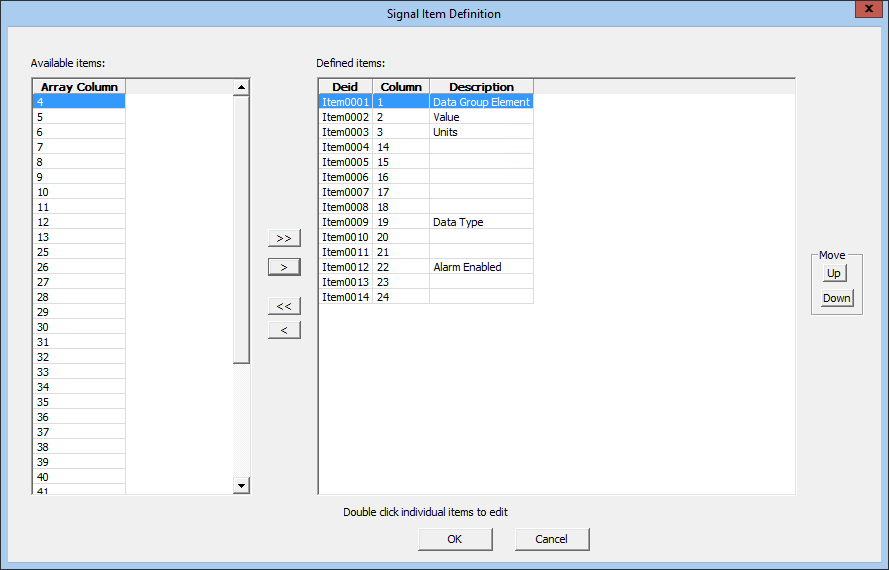
- In the Signal Item Definition dialog box, select the items to include in the data group. Array-related data group types will include the items from the structures defined for the ordinal-structure number.
- Use the < and > navigation buttons to move individual items (Ctrl+Click to select multiple) between the Available items and Defined items lists. To select all items, click the << or >> navigation buttons. Use the Up and Down buttons to reorder the list.
- Double-click the item name in the Defined items list to access the Array Item Attributes dialog box. Set the Hidden attribute, if desired, which hides the column in the data group's View Data dialog box.
- Click OK in the Signal Item Definition dialog box to finish the data definition. After creating the definition, the Modify Configurable Data Group dialog box is used to access the individual screens of the wizard. This includes an XML view button that shows an XML representation of the data group as currently defined in the device template file format. Changes can be made directly to the XML.
- Click Finished to save the data group.
|
Modify Device Specific Data Group Dialog Box |

Signal Item Definition
The Signal Item Definition dialog box defines the data group elements for the "Configurable Data Group" (cfgBSAP) data group. You can select any items from the ACCOL file for the data group’s type and structure(s). For example, if the data group represents a specific list, you can add any of the elements from that list. If the data group represents three lists, you can add any element from any of the three lists.
The elements are listed top to bottom in the data group's View Data dialog box in the order in which they are listed in the Defined items field of the Signal Item Definition dialog box.
|
Click the thumbnil to see the |
Array Item Attributes
| Attribute | Description |
|---|---|
|
Column DEID |
The data element ID. Valid characters (maximum of 10 characters) are A-Z, 0-9, dash (-), and underscore (_). Cannot contain spaces and must start with an alpha character. |
|
Column description |
A description for the item in the data group's View Data dialog box. |
|
Column label |
The name assigned to the "colLabel" attribute in the XML view. |
|
Column ID |
The ID number assigned to the column. This field cannot be edited. |
|
Hidden |
If set, the column is hidden in the data group's View Data dialog box. |


