Command-Type Data Groups
The IoT CygNet Link EIE allows a user to write a MQTT payload using a Sparkplug command manually through the CmdDev "Command – Device" or CmdNode "Command – Edge Node" data groups using the data group editor or via a UIS command. The commands are defined in the device template file and include commands such as DgHist (Data Group Transaction History), History (History Backfill), Rebirth, Reboot, ScanRate (Scan Rate), and UisCmd (Send UIS Command).
See UIS Command Component Parameters for more information.
| "Command - Device" Data Group | "Command - Edge Node" Data Group |
|---|---|
|
The CmdDev "Command – Device" data group sends a device-level Sparkplug command (DCMD). Commands are defined in the device template file in the <commands> section for a data group. The MQTT topic for a device-level Sparkplug command takes the form:
|
The CmdNode "Command – Edge Node" data group sends an Edge node-level Sparkplug command (NCMD). Commands are defined in the device template file in the <commands> section for a data group. The MQTT topic for a node-level Sparkplug command takes the form:
|
|
See IoT CygNet Link EIE Data Groups for more information about these properties. |
|
|
IoT CygNet Link EIE – CmdDev "Command - Device" |
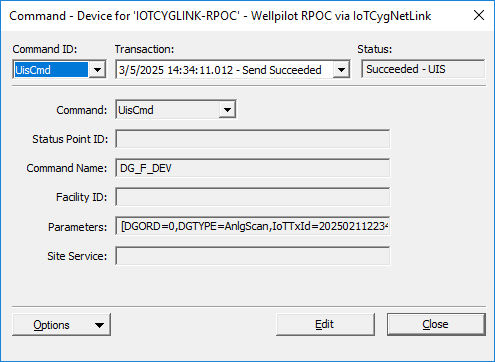
Command Type Properties
To configure the command for a CmdDev "Command – Device" or CmdNode "Command – Edge Node" data groups, make selections from the fields below the Command drop-down menu on the data group's View Data dialog box.
| Property | Description |
|---|---|
| Command |
The type of command. Select an option from the drop-down menu. Commands are defined in the device template file, and include the following options:
Each command type includes further required and optional properties. The properties displayed under the Command drop-down menu will change depending on the command type selected. |
|
Command Name |
The Command Name on the device receiving the UIS command, e.g., the UIS command on the Edge device. |
|
Description |
Displays the Description of the command from the device template file, e.g., DgHist, Rebirth, UisCmd, etc. |
|
Data Group Filter |
The name(s) of any Data Group(s) used to Filter (limit) the data group transaction history, e.g., DynaCard. |
|
End Date |
The End Date for the data in the payload in ISO 8601 format, e.g., YYYY-MM-DD Th:mm:ss.sss or 2024-01-01T18:00:00.000Z. ISO 8601 date and time format is the only accepted timestamp format. Note: Data group transaction history for DynaCards and point history timestamps must use ISO 8601 format. The EIE is very specific in the timestamp format it accepts — the ISO 8601 format is the only accepted string, e.g., 2024-01-01T05:45:15.123Z. |
|
Facility ID |
The Facility ID of the facility on the device receiving the command, e.g., the Edge device. |
|
Facility ID.UDC |
Facility.UDC for Point Processing provides a means to specify a UDC to which to map the specified data point; it requires a corresponding point in the Point Service (PNT). |
|
Parameters |
Specify any optional command parameters and values used by the UIS command in a comma-separated list inside square brackets. For example, Use this format when sending send a UIS command with multiple command parameters from the Data Group dialog box, a pre-configured command in the UIS Command dialog box, or via the API. See UIS Command Component Parameters for more information. |
|
Point Tag Filter |
The Point Tag Filter used to limit the point tags to publish in the history backfill command. This matches the pointFilter member specified in the publish object of the CVS endpoint in the Link appsettings.json file. For example, Note: When including a facilityid in a Point Tag Filter, the |
|
Site Service |
The name of the Site.Service on the device receiving the command, e.g., the Site Service on the Edge device. |
|
Start Date |
The Start Date for the data payload in ISO 8601 format, e.g., YYYY-MM-DD Th:mm:ss.sss or 2024-01-01T18:00:00.000Z. ISO 8601 date and time format is the only accepted timestamp format. Note: Data group transaction history for DynaCards and point history timestamps must use ISO 8601 format. The EIE is very specific in the timestamp format it accepts — the ISO 8601 format is the only accepted string, e.g., 2024-01-01T05:45:15.123Z. |
|
Status Point ID |
The Status Point ID for the command, if used. A Status Point is a special CygNet point that is used to monitor the status of a UIS command. When a command is in progress (that is, it’s in the communications queue), the value of the Status Point is set to "1:In Progress". Once the command fails or succeeds, the value of the Status Point is set to "2:Failed" or "3:Succeeded," respectively. |
|
Time Zone |
The time zone of the start and end dates for the historical data in the payload. Select an option from the drop-down menu:
CygNet (and Sparkplug) always define date and time in UTC format, and Link expects UTC format. Any time zone adjustments need to be handled by the client, e.g., if sending via script. If Local is selected CygNet will convert any timestamps to UTC. The conversion from Local time to UTC is done by the client. When sending the command from the data group editor, that client has the option to adjust for time zone. When sending from a UIS command, it is up to the sender / client to make any time zone adjustments. |
|
Value |
The Value of the command from the device template file (if indicated) or allows an entry in the field when not set in the device template file. |

