 The Note Grid is a special type of grid that supports the read-only display of CygNet notes, allowing users to view annotations and share information relevant to production system activities and events. CygNet notes are stored in the CygNet Note service (NOTE), and managed using an interface that provides a way to record a message, define the point in time or time range to which the message relates, categorize the note by type, and apply custom attributes. Each note can be associated with one or more facilities and points. If a note has one or more associated facility or point, the Note Grid will add a row for each association and show a single association per row. When the Note Grid receives its facilities from another control, the grid will only show notes for received associated facilities. The Note Grid supports two column types: Facility and Note. Facility columns are mapped to a facility attribute and can resolve to a relative facility. Note columns display annotations stored in the NOTE service by attribute, between a range of dates, and can be filtered by note type. The date and time of notes displayed in the grid can be changed in run mode and grid data can be exported to a .csv file in run mode. Other configurable properties are supported, including:
- The facility and SiteService are configured for the grid row and each can be explicitly set (and filtered) or sourced from other another control or the screen.
- The grid can be configured as a facility sender, responding differently when a row is clicked. It can send facilities to other controls on the screen.
- A grid's header background color, header text color, and grid background color can be configured to one of the following options: a) automatically follow the selected application theme regardless of the underlying color palette used, or b) be explicitly configured.
- The control's color elements can be set to automatically follow the selected application theme regardless of the underlying color palette used or explicitly configured.
- Colors displayed in the control can be overridden when a custom color palette is selected for the screen.
This control is supported in the Canvas Native view and the CygNet TWC web view.
Additional Resources
For more information about configuring and managing annotations in the Note service, see the Notes section.
Note Grid Example
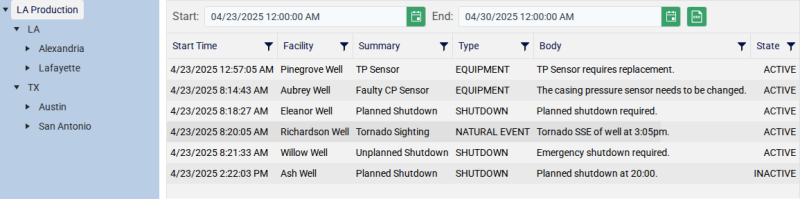
The following image shows a Tag Chooser and Note Grid.
|
Sample Note Grid in the CygNet TWC web view displaying several facilities and their associated notes |
Property Inheritance
Property Inheritance
Property inheritance, or sending and receiving, is a widely used concept in Canvas. The application supports an explicit relationship between screens, objects, and controls, where certain property values, such as facilities and SiteService details, are passed from one element to another via an inheritance framework. Screens, objects, and controls can be configured as property senders or property receivers and provide configuration options where you can explicitly define the source of the facility and SiteService. Depending on how you have your screens, objects, and controls configured, the facility and SiteService may be received from any one of the following sources:
- from itself — indicated by selecting <Self> and then explicitly configuring the property
- received from the screen — indicated by selecting Screen, which is always present as a sender
- received from another control — indicated by selecting the Name of the sending control.
Broadcasting
Screens and objects support an additional notification option to broadcast their facility and SiteService selection changes to other open screens. If configured, a <Broadcast> option is available to source the screen's facility and SiteService properties from another open screen.
For example, a Text Tool can be configured to get its facility from the screen and the screen can be configured to get its facility from a Tag Chooser. Or Screen_A might source its facility from Screen_B, which gets its facility from a Tag Chooser.
Receiver or Sender
The Note Grid control supports property inheritance as a receiver of its facility:
| Receive | Send | ||
|---|---|---|---|
| SiteService | Facility | SiteService | Facility |
| self screen |
self screen other controls |
none |
screen other controls |


