The Donut supports the following properties, which are available via the Properties pane and the Canvas script editor. Click next to any property name in the Properties pane to see a short description for the selected property.
See Accessing Screen Objects for more information about how to view control objects in script in the Canvas application.
Categorizing, Sorting, and Finding Properties
You can click  (Categorize), click
  (Alphabetical within Category) or click
  (Search) within the properties using the features located immediately above the properties list. The search box is useful to help locate a property when an object contains many properties. For clarity, when you enter a search term, items matching your entry string remain displayed and non-matching items are temporarily hidden. Clear the search box to display the full properties list again.
You can expand and collapse each property category by clicking  or
or  next to the group name or simply clicking anywhere in the category heading.
Donut Properties
The following tables describe the property names visible in the Properties pane user interface (UI) and the corresponding script property name.
 Click to see property list in alphabetical order
| UI Property | Script Property | Description |
|---|---|---|
| Name Type Style | ||
|
ControlName |
The Name property specifies the unique identifier for this control. Valid characters are A-Z, 0-9, and underscore (_). Special characters and spaces are not allowed. Names cannot start with a number; an underscore will be prefixed if the control name starts with a number. The default value is the object name and the numeric instance. The control's Name is also displayed on the Controls view of the Screen pane. |
|
|
ControlType |
The read-only Type property displays the type for the control: Button, Chart, CygNet Grid, Edit Box, Object Container, Search Box, Tag Chooser, etc. … The control's Type is also displayed on the Controls view of the Screen pane. |
|
|
|
The Style property defines the style sheet applied to an object on a screen. A style sheet consists of a predetermined list of properties and property values configured for a particular control type.
Styles are created in two ways:
Tip: |
|
Location
|
||
|
Height |
The Height property specifies the height of the control (or screen). Tip: |
|
|
HorizontalResizeMode |
The Horizontal resize mode property specifies whether and how the control dynamically moves or resizes horizontally when the screen is resized in run mode. Options include:
The default value is None. |
|
|
Layer |
The Layer property specifies the name of the layer to which this object is assigned. Layers can be used to show, hide, and edit multiple controls on one layer without affecting controls on another layer.
Tip:
Note: |
|
|
IsLocked |
The Lock property indicates whether the control is locked to the current position. A locked control cannot be moved via click and drag, or nudged with the arrow keys, or resized. Tip: |
|
|
VerticalResizeMode |
The Vertical resize mode property specifies whether and how the control dynamically moves or resizes vertically when the screen is resized in run mode. Options include:
The default value is None. |
|
|
IsVisible |
The Visible check box indicates whether the control is visible in run mode. Tip: |
|
|
Width |
The Width property specifies the width of the control (or screen). Tip: |
|
|
X |
The X property specifies the location of the control along the horizontal axis. Use the up, down, left, and right arrow keys to nudge a control by 1 pixel. Arrow moves a control by 1 pixel. Ctrl+Arrow moves a control by 10 pixels. Ctrl+Shift+Arrow moves a control by 100 pixels. Tip: |
|
|
Y |
The Y property specifies the location of the control along the vertical axis. Use the up, down, left, and right arrow keys to nudge a control by 1 pixel. Arrow moves a control by 1 pixel. Ctrl+Arrow moves a control by 10 pixels. Ctrl+Shift+Arrow moves a control by 100 pixels. Tip: |
|
|
ZIndex |
The Z index property is used to determine the order in which controls are layered on top of each other. Controls with higher values will draw on top of those with lower values. The newest control added to a screen will always have the highest value and will be the top layer. Two or more controls can be on the same index (layer). Tip: |
|
| Script
|
||
|
|
The Include in script check box indicates that the control will appear in the objects collection of the screen (if scripting is enabled). To optimize performance, best practice dictates that you only include the controls you need to manipulate via script. Other controls should be excluded. When you add an event to a control, it will be automatically added to script and the Include in script property (and the In Script check box on the Controls view) will be set to True. Tip: |
|
| Font
|
||
|
FontSizeBottom |
The Font size (bottom) property specifies the font size of the bottom text on the control. Only applies if Font size mode is set to Fixed. |
|
|
FontSizeMain |
The Font size (main) property specifies the font size of the main text on the control. Only applies if Font size mode is set to Fixed. |
|
|
FontSizeTop |
The Font size (top) property specifies the font size of the top text on the control. Only applies if Font size mode is set to Fixed. |
|
|
FontSizeMode |
The Font size mode property specifies the method used to size the text on the control. Options include:
The default value is Auto. The default value for the text tool is Fixed. |
|
|
TextStyle |
The Text style property specifies the style to use for the text that appears on the control or map visual. Options include: Normal, Italic, or Oblique. The default value is Normal. |
|
|
TextWeight |
The Text weight property specifies the weight to use for the text that appears on the control or map visual. Options are: Normal or Bold. The default value is Normal. |
|
| Marker
|
||
|
MarkerHeight |
The Marker height property specifies the height of the triangular marker for the point value on the donut. |
|
|
MarkerWidth |
The Marker width property specifies the width of the triangular marker for the point value on the donut. |
|
|
ShowValueMarker |
The Show value marker check box indicates whether to show a triangular marker for the point value on the donut. The marker's color is configurable: The Marker color property specifies the color used for the value marker on the donut. See Color configuration: Marker color for more information. |
|
| Tooltip
|
||
|
TooltipText |
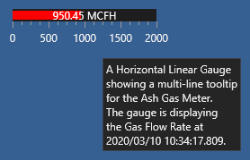
The Tooltip property specifies the text that will appear on the tooltip. The text display a static text string, such as a label, or a dynamic text string based on point or facility attributes. Dynamic text is built using tokens, which can represent real-time CVS point properties, point configuration properties, and facility properties. In run mode, the tokens are replaced with the attribute's value. Click
Type any text, select tokens, and press Enter to separate the lines. If more than five lines are entered, a scroll bar will appear in design mode. The scroll bar does not display in run mode. Also see the Tooltip Opening event for controls that support tooltips. |
|
|
TooltipEnabled TooltipDuration TooltipBetweenShowDelay ToolipInitialShowDelay |
The Tooltip enabled property indicates whether to display a tooltip when the mouse hovers over the control or map visual. |
|
|
TooltipMode |
The Tooltip mode property specifies how the tool will be displayed. Options include:
The default value is Text. |
|
|
TooltipObjectPath TooltipObjectSource |
The Tooltip object path property specifies the path used for the tooltip when Object mode is selected. Click |
|
| Display
|
||
|
BottomInformationText |
The Bottom information text property specifies the text that will appear on the bottom information area on the control. The control can display a static text string, such as a label, or a dynamic text string based on point or facility attributes. Dynamic text is built using tokens, which can represent real-time CVS point properties, point configuration properties, and facility properties. In run mode, the tokens are replaced with the attribute's value. Click |
|
|
Text |
The Text property specifies the text that will appear on the face of the control. The item can
display a static text string, such as a label, or a dynamic text string based on point or facility attributes. Dynamic text is built using tokens, which can represent real-time CVS point properties, point configuration properties, and facility properties. In run mode, the tokens are replaced with the attribute's value. Click |
|
|
TopInformationText |
The Top information text property specifies the text that will appear on the top information area on the control. The control can display a static text string, such as a label, or a dynamic text string based on point or facility attributes. Dynamic text is built using tokens, which can represent real-time CVS point properties, point configuration properties, and facility properties. In run mode, the tokens are replaced with the attribute's value. Click |
|
| Value
|
||
|
ColorConfiguration |
The Color configuration box contains all the options required to specify the color properties of the control. Click |
|
|
Background color |
ColorConfiguration.BackgroundSource ColorConfiguration.BackgroundSelfColor |
The Background color property specifies the color used for the background of the control. The color can be sourced from one of three options provided in the Source drop-down menu:
The default value is Auto. Options include:
Note: |
|
Text color |
ColorConfiguration.TextColorSource ColorConfiguration.TextSelfColor |
The Text color property specifies the color used for the text on the control or map visual. The color can be sourced from one of three options provided in the Source drop-down menu:
The default value is Auto. Options include:
Note: |
|
Ring color |
ColorConfiguration.RingColorSource ColorConfiguration.RingSelfColor |
The Ring color property specifies the color used for the outer ring that represents the point value in the donut. The color can be sourced from one of three options provided in the Source drop-down menu:
The default value is Auto. Options include:
Note: |
|
Empty ring color |
ColorConfiguration.EmptyRingColorSource ColorConfiguration.EmptyRingSelfColor
|
The Empty ring color property specifies the color used for the empty or unused ring in the donut. The color can be sourced from one of three options provided in the Source drop-down menu:
The default value is Auto. Options include:
Note: |
|
Marker color |
ColorConfiguration.MarkerColorSource ColorConfiguration.MarkerSelfColor |
The Marker color property specifies the color used for the value marker on the donut. The color can be sourced from one of three options provided in the Source drop-down menu:
The default value is Auto. Options include:
Note: |
|
Range color: Use point state color? |
ColorConfiguration.UseRangeColor |
The Use point state color? check box indicates whether to use the point state color for the alarm limit range. The default point state colors for a CygNet system are defined by the system’s point scheme. Note:
|
|
CustomContextMenuItems |
The Custom Context Menu Configuration dialog box is where you configure any custom context menu items that will appear in the right-click context menu for the screen or control. Each custom context menu item will call an event into script so that you can customize screen or control behavior. The custom context menu options will appear at the bottom of the fixed context menu options, separated by a line. Each custom context menu item has a title and an event script ID; items can be designated as a separator; and custom context menus support nested menu items. Click |
|
|
Context menu items > Title |
|
The Title property specifies the menu name to be displayed in the runtime context menu. |
|
Context menu items > Is separator |
|
The Is separator check box indicates whether this menu item will be a separator line in the menu at runtime. Once saved the separator has no configuration and no children. Separators do not have event IDs. Any event ID on a menu item when it’s converted to a separator is deleted. You can give it a title of 'Separator" or "----------" if desired. |
|
Context menu items > Script event ID |
|
The Script event ID specifies the event ID that will be called when the menu item is selected from the runtime right-click context menu. The event ID is passed in as a parameter into the Custom Context Menu Action event, along with other relevant information in the context of the click, for example, facility or point tag, as appropriate. |
|
DateTimeFormat |
The Date and time format property specifies the format for a point's timestamp using any of the valid .NET standard or custom numeric format strings. The date and time format applies to a point's Timestamp, Last Verified Change Timestamp, and Last Questionable Change Timestamp properties. Use this property to override the default format, which is configured on the Settings page of the Backstage view. The default format is YYYY/MM/DD HH:MM:SS.fff, which corresponds to 2019/01/01 10:20:30.0001. All timestamps are local client time. Note: |
|
|
DisplayAlarmRanges Ranges |
The Display alarm ranges check box indicates whether to display alarm ranges for the setpoints for the associated point on the donut. The colors depicted for the ranges are randomly chosen from a predefined set of colors. |
|
|
HideInvalidTag |
The Hide invalid tag check box indicates whether to hide the control or map visual if it resolves to an invalid or unknown tag. |
|
|
PointConfiguration |
The Point configuration property is used to configure the CygNet point associated with the control. Click |
|
|
Selection mode |
PointConfiguration.SelectionMode |
The Selection mode property is used to determine how the control will receive CygNet information from other controls. Two options are available; click the desired radio button:
Sending and receiving facility tagsSome controls on the same screen allow for the sending of facility tag information from one control to another.
|
|
Facility tag Point config > Facility |
FacilityID FacilitySender FacilityTag
FacilityTag. properties
FacilityTag.FacilityId FacilityTag.Service FacilityTag.Site FacilityTag.SiteService FacilityTag.SiteService.Service FacilityTag.SiteService.Site IsRelativeFacilityResolutionEnabled PointConfiguration.Facility PointConfiguration.Facility. properties
PointConfiguration.Facility.FacilityID PointConfiguration.Facility.FacilityID.IsBroadcastSourced PointConfiguration.Facility.FacilityID.IsOrderInType PointConfiguration.Facility.FacilityID.IsOrderInTypeAttributeConfigured PointConfiguration.Facility.FacilityID.IsRelative PointConfiguration.Facility.FacilityID.IsSelfSourced PointConfiguration.Facility.FacilityID.OrderInType PointConfiguration.Facility.FacilityID.RelativeFacilityLink PointConfiguration.Facility.FacilityID.ResolveRelativeFacility PointConfiguration.Facility.FacilityID.Source PointConfiguration.Facility.FacilityID.SourceFacilityID PointConfiguration.FacilityTag PointConfiguration.FacilityTag. properties
PointConfiguration.FacilityTag.FacilityId PointConfiguration.FacilityTag.Service PointConfiguration.FacilityTag.Site PointConfiguration.FacilityTag.SiteService PointConfiguration.FacilityTag.SiteService.Service PointConfiguration.FacilityTag.SiteService.Site PointConfiguration.SourceFacilityTag PointConfiguration.SourceFacilityTag. properties
PointConfiguration.SourceFacilityTag.FacilityId PointConfiguration.SourceFacilityTag.Service PointConfiguration.SourceFacilityTag.Site PointConfiguration.SourceFacilityTag.SiteService PointConfiguration.SourceFacilityTag.SiteService.Service PointConfiguration.SourceFacilityTag.SiteService.Site |
The Facility tag or Facility property is where you specify the source of the facility for the control (or screen) to use. The source for the facility can be explicitly configured for this control or it can be inherited from another control on the same screen, or from the screen, or from another screen. Click
|
|
SiteService |
PointConfiguration.SiteService PointConfiguration.SiteService. properties
PointConfiguration.SiteService.DisplayString PointConfiguration.SiteService.DomainSiteService PointConfiguration.SiteService.DomainSiteService.DomainId PointConfiguration.SiteService.DomainSiteService.Service PointConfiguration.SiteService.DomainSiteService.Site PointConfiguration.SiteService.DomainSiteService.SiteService PointConfiguration.SiteService.DomainSiteService.SiteService.Service PointConfiguration.SiteService.DomainSiteService.SiteService.Site PointConfiguration.SiteService.IsBroadcastSourced PointConfiguration.SiteService.IsSelfSourced PointConfiguration.SiteService.SiteService PointConfiguration.SiteService.SiteService.Service PointConfiguration.SiteService.SiteService.Site PointConfiguration.SiteService.Source SiteService SiteServiceSender |
The SiteService property is where you specify the source of the SiteService for the control (or screen) to use. The source for the SiteService can be explicitly configured for this control or it can be inherited from another control on the same screen, or from the screen, or from another screen. Click
|
|
Point |
LongPointID PointConfiguration.LongPointID PointConfiguration.PointSelectionMode PointConfiguration.PointTag PointConfiguration.UDC Points
Points. properties
Points.Comparer Points.Count Points.Keys Points.Subscribe Points.Unsubscribe Points.Values PointTag UDC |
The Point property is used to determine how the CygNet point will be configured. Click the appropriate radio button to reveal the desired field.
|
|
ShowContextMenu |
The Show context menu check box indicates whether a right-click context menu will be available or suppressed in run mode. The default context menu will allow alarm acknowledgment, access to point history and alarm history, point configuration, and facility configuration. |
|
|
ValueFormat |
The Value format property specifies the format for the point's value using any of the valid .NET standard or custom numeric format strings. The value format applies to a point's Value, Primary Value, and Alternate Value properties. The default value format is #,##0.00, which corresponds to 123,456,789.12. Formats use # and 0, with a period (.) as the decimal separator and comma (,) as the thousands separator. Add additional zeros to show more decimal places. |
|
| Bounds
|
||
|
ValueBoundsConfiguration
ValueBoundsConfiguration. properties
ValueBoundsConfiguration.LowerBoundPropertyId ValueBoundsConfiguration.LowerValueBound ValueBoundsConfiguration.LowerValueBoundSet ValueBoundsConfiguration.LowerValueBoundSource ValueBoundsConfiguration.UpperBoundPropertyId ValueBoundsConfiguration.UpperValueBound ValueBoundsConfiguration.UpperValueBoundSet ValueBoundsConfiguration.UpperValueBoundSource |
The Value bounds configuration box contains the options required to specify the lower and upper bound of the control. The source of the bounds can be either hard-coded to an explicit value (using <Self>), or dynamically determined for each facility by sourcing the value from one of the following attributes of the associated point (using Point Attribute):
A control on a templated screen can support different bounds for each source facility. By using a point attribute to store the bounds (for example, Indexed 1 for the lower value bound and Indexed 2 for the upper value bound), you can have a templated screen without having to script the control. Click |
|
|
Lower value bound |
ValueBoundsConfiguration.LowerBoundPropertyId ValueBoundsConfiguration.LowerValueBound ValueBoundsConfiguration.LowerValueBoundSet ValueBoundsConfiguration.LowerValueBoundSource |
The Lower value bound property specifies the lower value to use when filling the control. The value bound can be explicitly configured (by selecting <Self>) or the value can be sourced from an attribute of the associated point (by selecting Point Attribute). The following fields are available to store an attribute that can be used to indicate the value bound. Options include:
|
|
Upper value bound |
ValueBoundsConfiguration.UpperBoundPropertyId ValueBoundsConfiguration.UpperValueBound ValueBoundsConfiguration.UpperValueBoundSet ValueBoundsConfiguration.UpperValueBoundSource |
The Upper value bound property specifies the upper value to use when filling the control. The value bound can be explicitly configured (by selecting <Self>) or the value can be sourced from an attribute of the associated point (by selecting Point Attribute). The following fields are available to store an attribute that can be used to indicate the value bound. Options include:
|
| Generic
|
||
|
String |
The String property specifies a generic string property that can be used when scripting this control. Type a string and reference it in your script as necessary. |
|
|
YesNo |
The Yes/No property specifies a generic Boolean yes/no property that can be used when scripting this control. Click the check box to enable the property and reference it in your script as necessary. |
|
 (Add a new style based on this control) next to the Style property, after you have configured property values in the Properties pane. See
  (Settings) to the right of the control in design mode) or on the
  to configure the static text and/or property tokens using the