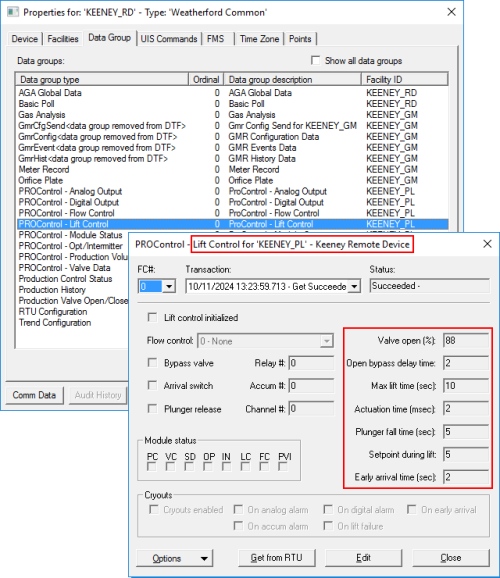
The DDS Text Tool is DDS-aware control that can be used to get data group transaction data (data group element Ids (DEIDs)) from a remote device for display on a Canvas screen.
By default, data group transaction records are saved only in the DDS for a short time, unless you've mapped one or more data group elements from a data group to UDCs and points for retention in the UIS and historicization in the VHS. Canvas supports three DDS-based controls that can read and write data group transactions:
These DDS-based controls are an efficient way to create transaction-based screens for displaying and manipulating data group information for remote devices. Use these controls to implement a scriptless solution for creating screens where data is encapsulated in a transaction, but not mapped to a CygNet point. For example, you could make a lift management screen for plungers or other device types in your CygNet environment.
The DDS Text Tool displays transaction-based data, and receives its source facility and data group information from a DDS Button. The user then configures its transactional elements for display: the device type, data element ID (DEID) and the type of element to show in the DDS Text Tool, either the value or the description.
The DDS-based controls can be used as a template, meaning they are multiple device-type aware. For example, Device Type A may have a data group called "BasicPoll", but Device Type B may have a similar data group called "Status." In the case where the data group "function" is the same, but the name is different, the controls can handle this difference. The normalization process (handled in other controls via UDC specification) is handled via the Device type specification:
- The DDS Button control supports configuration of Device type, Data group type, and Ordinal.
- The DDS Edit Box controls support configuration of Device type, and Data element Id. The display type is assumed to be the DEID Value.
- The DDS Text Tool controls support configuration of Device type, and Data element Id, and Display type (Value or Description).
Several other configurable properties are supported, including:
- The control's color elements can be set to one of the following options: a) automatically follow the selected application theme regardless of the underlying color palette used, b) sourced from the point state color defined for the associated point, or c) be explicitly configured.
- Colors displayed in the control can be overridden when a custom color palette is selected for the screen.
- Font sizing, text alignment, trimming, wrapping, styling, and weighting are also configurable.
- This control supports tooltips, which can be displayed as tokenized text, a Canvas object, or the tooltip can be scripted to retrieve and display values for related points or CygNet notes.
The DDS Text Tool shares many properties, events, and methods with the standard Canvas Text Tool control.
This control is supported in the Canvas Native view and the CygNet TWC web view.
DDS Button and DDS Text Tool Examples
The following images show a sample Plunger Lift Management screen using the DDS-based controls to read data from an associated facility:
|
Sample Plunger Management screen shown in Canvas Native view |
Sample Plunger Management screen shown in CygNet TWC web view |
|
|
|
||
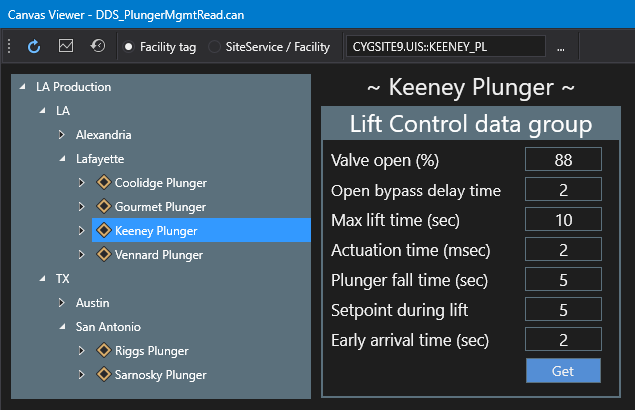
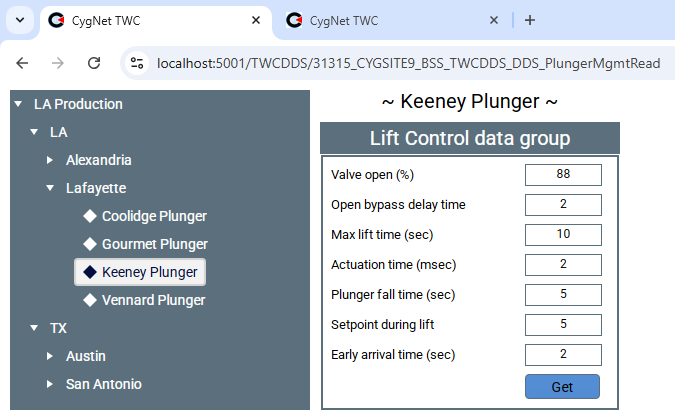
These sample screens above include a Tag Chooser, a DDS Button (Get), and eight DDS Text Tools. Other controls include some regular Text Tools and a Shape.
- The DDS Button is receiving its facility (Keeney Plunger) from the Tag chooser on the left.
- The DDS Button is configured to do a Get transaction (Read) for the Lift Control data group from the associated facility.
- Each DDS Text Tool is configured to receive the data group (LiftCtrl) from the DDS Button and display a specified data element Id (ValveOpen, DelayTime, MaxLift, etc.) and its value when the Get DDS Button is clicked.
|
CygNet Explorer Data group tab and View Data dialog boxes |