Toolbox Pane
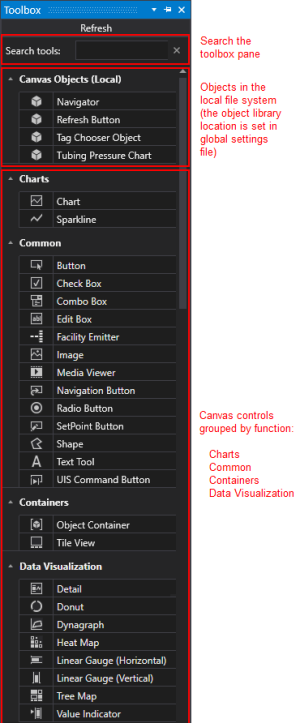
On the Canvas toolbar, click  (Display toolbox) to display a Toolbox pane in your application window, or to hide the currently open pane. The pane contains the various collections of controls and objects available for use on your screens grouped by function, identified by an icon and a small preview image. Any custom or third-party controls managed by Canvas will also appear in the toolbox.
Use the Toolbox to manage and select controls and objects to incorporate onto your screens.
Native vs Web Client Toolbox
The Toolbox options change depending on the Target environment selected for Canvas. To switch between environments, go to the General settings > Application settings > Target environment.
Select the desired target environment where you intend to view and interact with your screens:
- Native — Use this mode to create screens to be viewed in any of the Canvas desktop-based applications: Canvas itself, Canvas.View, or Canvas.View.Lite. All Canvas controls and all Canvas features (including scripting) are available in this mode.
- Web client — Use this mode to create, publish, and interact with screens to be viewed in the browser-based CygNet Thin Web Client. When this mode is selected, a subset of Canvas controls, properties, and features is supported for use in the Thin Web Client mode.
The web client supports BSS-only screens and objects.
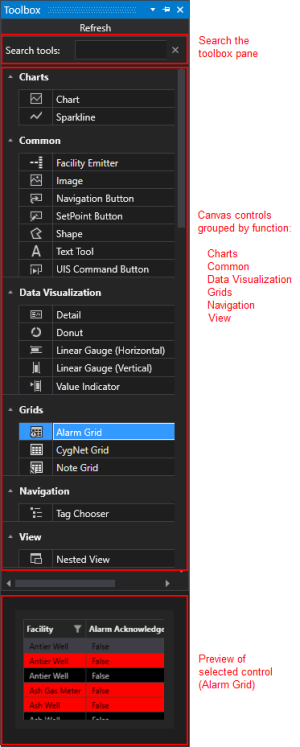
- When the Web client mode is selected, the Canvas toolbox is limited to display only the controls support by the Thin Web Client. Unsupported properties will be hidden in the Properties pane for some controls.
- In addition to selecting a Target environment, you must configure the Web settings for your CygNet Thin Web Client installation.
|
Canvas Web Client Toolbox Pane
|
||||
|
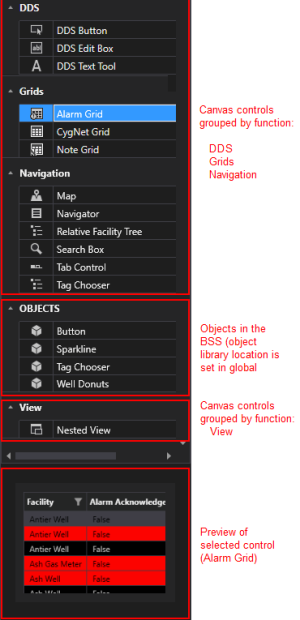
A sample Canvas Native Toolbox pane showing controls, BSS objects, and Local objects. |
A sample Canvas Web Client Toolbox pane showing a subset of controls. |
||||
Choosing How to View the Toolbox Pane
In the pane title bar, you can select how to display the pane by default (whether to float, dock, auto-hide, or hide it), pin the pane in place, or close the pane. Unpinning (or hiding) a pane when not in use gains extra space for viewing your current screen or another open pane. Closing a pane can also occur from the pane title bar. The following icons are available:
- Click
 (menu chooser) to display a context menu from where you can float, dock, auto hide, or hide the pane.
 - Click
 (pin) on the pane title bar to hide the pane (or "pinned" to the edge of the application window).
 - Click
 (x) on the pane title bar to close the pane.
See Customizing the Workspace for more information.
Refresh the Toolbox Pane
Click Refresh to initially load the Toolbox pane, or click Refresh periodically to reload the pane as you work.
Search the Toolbox
A Search tools options is available to search for a controls and objects within the Toolbox.
Search for any word or phrase by typing in the Search box. The search operation is case insensitive. Any matching strings will be shown in red text. There are three additional search operators available:
Quoted strings
When a word or a phrase is typed in quotation marks (""), the found results will contain only the exact same value. For example, "tank level", will yield only instances of tank level.

Additive search
When a word or a phrase is typed after a plus sign (+), the found results will contain both the value before the operator and the one after it. For example, tank +level, will yield all instances of tank, plus all instances of tank level.

Negative search
When a word or a phrase is typed after a minus sign (-), the found results will contain the value before the operator, but not the one after it. For example, tank -level, will yield all instances of tank, but no instances of tank level.

Note that the search operators can be concatenated to yield desired results, for example, string -string -string.
Click  to remove the search term from the Search box.
Objects in the Toolbox
Any objects previously saved in your Object Library will also appear in the toolbox. Objects saved in an APPS or BSS folder or a local or network file-system folder will appear grouped together for quick access.
Drag Control or Object to Your Screen
Once you have found the tool or object you wish to use on a Canvas screen, simply select the control or object, drag it to a new or existing screen (or other objects), and resize and configure as needed. There is no limit to the number of objects you can nest on screens or other objects.
Sample Each Control or Object
Each control or object is sampled in the area at the bottom of the Toolbox.
- Each Canvas control displays a small static sample image.
-
Each Canvas object displays a small dynamic sample image, which updates every time you save the object (.cob) file. You will see a .png file with the same file name stored in the same location as your objects. For example, if you save an object called "Refresh Button.cob", a related "Refresh Button.png" will also be saved in your object library.


