
The Canvas Search Box supports numerous actions on selected search results: facility sender, facility navigation, facility scripted, and custom searches. This topic describes how to script a custom search using the Search Box control.
- See To configure a Search Box as a facility sender
- See To configure a Search Box to navigate to another screen
- See To configure a Search Box to execute a scripted selection action
Custom Searches
|
Custom searching is supported via script to allow you to query whatever you want, for example, a SQL database, a .csv file, even a website. When a full or partial search term is entered in the Search Box, a custom script method is fired to search a specified item or object, and any matching terms are returned in a search results list. Further custom actions can be executed when selecting a search result.
|
|
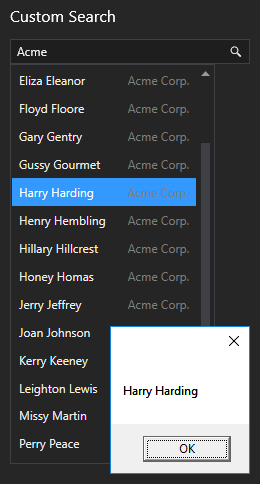
Custom Search Example
The following code example shows how to query a .csv list of meeting attendees to find any results that match a Primary and Secondary value, as shown in the image above.
- The script defines the custom search method
DoCustomSearchwhich is passed as an argument to theObjects.Search2.CustomSearchproperty. - When a full or partial string is entered in the Search Box, the
DoCustomSearchmethod is fired parsing the specified .csv file. - The custom search results
CustomSearchBoxResultare returned in a list, or if the search results are empty, an error message (No results found) is returned. - When one of the search results is selected, a
MessageBoxis popped displaying the Primary value (Name).
CopyCustom Search Examplenamespace Screen
{
public class Attendee
{
public string Name { get; set; }
public string Company { get; set; }
public string Title { get; set; }
}
public class ScreenClass
{
private List<Attendee> Attendees { get; set; } = new List<Attendee>();
public bool DoCustomSearch(string query, out List<CustomSearchBoxResult> results, out string error)
{
error = string.Empty;
results = new List<CustomSearchBoxResult>();
var queryResults = Attendees.Where(x => x.Name.ToUpper().Contains(query.ToUpper()) ||
x.Company.ToUpper().Contains(query.ToUpper()) ||
x.Title.ToUpper().Contains(query.ToUpper()));
foreach (var result in queryResults)
{
results.Add(new CustomSearchBoxResult() { Primary = result.Name, Secondary = result.Company });
}
return true;
}
private void ParseCsvFile(string path)
{
Attendees.Clear();
using (TextFieldParser parser = new TextFieldParser(path))
{
parser.SetDelimiters(new string[] { "," });
// Skip over header line.
parser.ReadLine();
while (!parser.EndOfData)
{
string[] fields = parser.ReadFields();
Attendees.Add(new Attendee()
{
Name = fields[0] + " " + fields[1],
Company = fields[3],
Title = fields[4]
});
}
}
}
public static void Main()
{
ScreenClass c = new ScreenClass();
}
/// <summary>
/// Constructor for screen. Used to hook-up event handlers and for any custom initialization code
/// </summary>
public ScreenClass()
{
// control event handler code goes here -- do not modify
Objects.Search2.Initialize += new EventHandler(this.Search2_Initialize);
Objects.Search2.SearchResultSelected += new EventHandler(this.Search2_SearchResultSelected);
// add your custom initialization code here
}
#region Search2
private void Search2_Initialize(object sender, EventArgs args)
{
Objects.Search2.CustomSearch = DoCustomSearch;
ParseCsvFile(@"C:\Temp\RSVPs.csv");
}
private void Search2_SearchResultSelected(object sender, EventArgs args)
{
var searchResultArgs = args as Canvas.Controls.SearchBox.CanvasSearchBoxSearchResultSelectedEventArgs;
MessageBox.Show(searchResultArgs.Result.Primary);
}
#endregion
}
}


