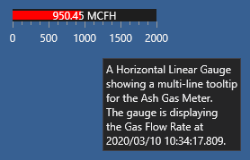
This topic lists all properties, which are available via the Properties pane and the Canvas script editor, for all Canvas controls, tools, and objects.
Browse by letter: [A] [B] [C] [D] [E] [F] [G] [H] [I] [L] [M] [N] [O] [P] [Q] [R] [S] [T] [U] [V] [W] [X] [Y] [Z]
| UI Property | Script Property | Control | Description | ||||||
|---|---|---|---|---|---|---|---|---|---|
A
|
|||||||||
|
Accepts return |
AcceptsReturn |
Edit Box |
The Accepts return check box indicates that the edit box will accept the return key to create a new line in the text block in run mode. |
||||||
|
Alarm attribute |
|
Alarm Grid (Alarm column) |
The Alarm attribute property specifies the alarm attribute that will be displayed in the column. Click
|
||||||
|
Alarm column |
N/A |
An alarm column presents data for a point by an alarm attribute. |
|||||||
|
Alarm filter |
AlarmGrid.AlarmFilter |
The Alarm filter property is used to limit the data that is presented in the alarm grid by configuring alarm filtering rules. Click |
|||||||
|
Alarm icon column |
AlarmGrid.IconColumn AlarmGrid.IconColumn.ColorSource AlarmGrid.IconColumn.Ranges AlarmGrid.IconColumn.ShowIcon |
The Alarm icon column property is used to indicate whether a column and icon will be displayed as the first column of the alarm grid. A customizable icon can be configured to change color based on point state and change image based on alarm priority. Icons will display only when there is an unacknowledged alarm. Click |
|||||||
|
Alarm icon configuration |
ControlName.IconConfiguration ControlName.IconConfiguration.ColorSource ControlName.IconConfiguration.Ranges ControlName.IconConfiguration.Ranges.Count |
The Alarm icon configuration property is used to configure the alarm icon that can optionally be included in the upper right corner of the detail control. If enabled in the Show alarm icon property, a customizable icon can be configured to change color based on point state and change image based on alarm priority. Icons will display only when there is an unacknowledged alarm. Click |
|||||||
|
Animate marker |
ValueIndicator.IsAnimated |
The Animate Marker check box indicates whether to animate the marker movement. When enabled the Value Indicator's marker will move smoothly from one value to the next value. |
|||||||
|
Appearance |
N/A |
Chart (series appearance group) |
The Appearance property group contains properties that configure the appearance of points on the chart series, such as enabling points, color, point size, enabling labels, and label colors. |
||||||
| Arrow size |
Shape.ArrowSize |
The Arrow size property specifies the size of the arrowheads at the end of the line shapes. Select a number using the spin control. The default value is 20. The Shape type must be one of the arrow shapes to take effect. |
|||||||
|
Auto range x-axis |
ControlName.AutoRangeX |
The Auto range x-axis check box indicates whether the sparkline's x-axis is constrained to the range of values for the associated point or fixed to the configured time range (default). Configure the date and time range in the Range properties below. |
|||||||
|
Auto range y-axis |
ControlName.AutoRangeY |
The Auto range y-axis check box indicates whether the sparkline's y-axis is constrained to the range of values for the associated points (default) or fixed to the configured minimum and maximum values. Configure the y-axis scale in the Maximum Y value and Minimum Y value below. |
|||||||
| B
|
|||||||||
|
Background color |
AlarmGrid.ColorConfiguration.BackgroundSelfColor AlarmGrid.ColorConfiguration.BackgroundSource |
Alarm Grid (cell) |
The Background color property specifies the color used for the background of the grid cell. The color can be sourced from one of several options provided in the Source drop-down menu: a) the color will automatically follow the selected application theme regardless of the underlying color palette and cannot be customized (by selecting Auto); b) the color will be sourced from the point state of the associated alarm (by selecting BackgroundColor, ForegroundColor, or SingleColor); or c) the color can be customized (by selecting Self). The default value is BackgroundColor. Options include:
Note: You can override the default point state colors for this element by creating a custom color palette. See Configuring Color Palettes and Color palette for a screen or object for more information. |
||||||
|
Background color |
|
CygNet Grid (column) |
The Background color property specifies the color used for the background of the grid cell. For a Generic and Facility column The color can be sourced from one of two options provided in the Source drop-down menu:
The default value is Auto. Options include:
For a Point column The color can be sourced from one of three options provided in the Source drop-down menu:
The default value is Auto. Options include:
Note: You can override the default point state colors for this element by creating a custom color palette. See Configuring Color Palettes and Color palette for a screen or object for more information. |
||||||
|
Background color |
ControlName.ColorConfiguration.BackgroundSelfColor ControlName.ColorConfiguration.BackgroundSource |
The Background color property specifies the color used for the background of the control. The color can be sourced from one of three options provided in the Source drop-down menu:
The default value is Auto. Options include:
Note: You can override the default point state colors for this element by creating a custom color palette. See Configuring Color Palettes and Color palette for a screen or object for more information. |
|||||||
|
Background color (screen, object, control) |
ControlName.BackgroundColor |
The Background color property specifies the background color of the screen, object, or control. Click Combo Box —
The Background color property specifies the background color of the combo box header. Click |
|||||||
|
Backgound color source |
ControlName.BackgroundColorSource |
The Background color source property specifies the color source for the background color of the screen, object, or control. Two options are available:
The default option is Auto. |
|||||||
|
Bar color |
ControlName.ColorConfiguration.BarSelfColor ControlName.ColorConfiguration.BarSource |
The Bar color property specifies the color used for the bar that represents the point value in the linear gauge control. The color can be sourced from one of three options provided in the Source drop-down menu:
The default value is Auto. Options include:
Note: You can override the default point state colors for this element by creating a custom color palette. See Configuring Color Palettes and Color palette for a screen or object for more information. |
|||||||
|
Base node |
TagChooser.GroupBaseNodeDescription |
The Base node property specifies the group node to use as the base (or bottom) of the hierarchy. Click |
|||||||
|
Start (Chart) Start date (Grid) |
ControlName.DateStart  DateStart. properties DateStart. properties
DateStart.Date DateStart.Day DateStart.DayOfWeek DateStart.DayOfYear DateStart.Hour DateStart.Kind DateStart.Millisecond DateStart.Minute DateStart.Month DateStart.Second DateStart.Ticks DateStart.TimeOfDay DateStart.Year TreeMap.StartingDate StartingDate. properties
StartingDate.Date StartingDate.Day StartingDate.DayOfWeek StartingDate.DayOfYear StartingDate.Hour StartingDate.Kind StartingDate.Millisecond StartingDate.Minute StartingDate.Month StartingDate.Second StartingDate.Ticks StartingDate.TimeOfDay StartingDate.Year |
CygNet Grid (History column) |
The Begin date or Start or Start date property specifies the start date and time for a control (or screen or chart or column) for an absolute date and time view window. The format is MM/DD/YYYY hh:mm:ss AM/PM. The default value is the system date and time at which the control was first added to the screen. Click Tree Map —
The Begin date property specifies the start date and time to use when rolling up historical data. Data between the Begin relative date and the Begin date will be rolled up and displayed in the tree map. The format is MM/DD/YYYY hh:mm:ss AM/PM. The default value is the system date and time at which the control was first added to a screen. Click |
||||||
|
Start (Chart) Relative start date (Grid) |
ControlName.RelativeStart
TreeMap.RelativeStartingDate |
CygNet Grid (History column) |
The Begin relative date or Relative start date or Start property specifies a wildcard string defining the amount of time by which to adjust the start date and time. The space-separated elements in this string must be of the form: "x-#", "x+#", or "x=#" where # is an integer and x is one of the following unit specifiers: y — Year, m — Month, d — Day, H — Hour, M — Minute, S — Second, and # is an integer. T wildcard is also supported and must be in the form: T, T+#, T-#, where T represent today at midnight, T-1 is yesterday at midnight, and T+1 is tomorrow at midnight, etc. Any integer can be used. For example, H-8 represents data from the 8 hours before the current hour, d+3 represents data 3 days after the current day, and d+2 H+1 M+30 represents data 2 days, 1 hour and 30 minutes after the current date and time. d-4 H=6 sets the relative start date and time to four days ago (d-4) at 6:00 a.m. (H=6). See Date and Time Wildcards for more information about adjusting relative time. Tree Map —
The Begin relative date property specifies a wildcard string defining the amount of time by which to adjust the start date and time. The space-separated elements in this string must be of the form: "x-#", "x+#", or "x=#" where # is an integer and x is one of the following unit specifiers: y — Year, m — Month, d — Day, H — Hour, M — Minute, S — Second, and # is an integer. T wildcard is also supported and must be in the form: T, T+#, T-#, where T represent today at midnight, T-1 is yesterday at midnight, and T+1 is tomorrow at midnight, etc. Any integer can be used. For example, H-8 represents data from the 8 hours before the current hour, d+3 represents data 3 days after the current day, and d+2 H+1 M+30 represents data 2 days, 1 hour and 30 minutes after the current date and time. d-4 H=6 sets the relative start date and time to four days ago (d-4) at 6:00 a.m. (H=6). See Date and Time Wildcards for more information about adjusting relative time. |
||||||
|
Blink |
|||||||||
|
Border color |
AlarmGrid.ColorConfiguration.BorderSelfColor AlarmGrid.ColorConfiguration.BorderSource |
Alarm Grid (cell) |
The Border color property specifies the color used for the border of the grid cell. The color can be sourced from one of several options provided in the Source drop-down menu: a) the color will automatically follow the selected application theme regardless of the underlying color palette and cannot be customized (by selecting Auto); b) the color will be sourced from the point state of the associated alarm (by selecting BackgroundColor, ForegroundColor, or SingleColor); or c) the color can be customized (by selecting Self). The default value is Auto. Options include:
Note: You can override the default point state colors for this element by creating a custom color palette. See Configuring Color Palettes and Color palette for a screen or object for more information. |
||||||
|
Border color |
|
CygNet Grid (column) |
The Border color property specifies the color used for the border of the grid cell. For a Generic and Facility column The color can be sourced from one of two options provided in the Source drop-down menu:
The default value is Auto. Options include:
For a Point column The color can be sourced from one of three options provided in the Source drop-down menu:
The default value is Auto. Options include:
Note: You can override the default point state colors for this element by creating a custom color palette. See Configuring Color Palettes and Color palette for a screen or object for more information. |
||||||
|
Border color |
ControlName.ColorConfiguration.BorderSelfColor ControlName.ColorConfiguration.BorderSource |
The Border color property specifies the color used for the border of the control. The color can be sourced from one of three options provided in the Source drop-down menu:
The default value is Auto. Options include:
Note: You can override the default point state colors for this element by creating a custom color palette. See Configuring Color Palettes and Color palette for a screen or object for more information. |
|||||||
|
Border width |
TextTool.BorderWidth |
The Border width property specifies the width of the text tool's border. |
|||||||
|
Bottom information text |
ControlName.BottomInformationText |
The Bottom information text property specifies the text that will appear on the bottom information area on the control, which can be a static label, or dynamic text based on point or facility attributes. Dynamic text is built using tokens, which can represent real-time CVS point properties, point configuration properties, and facility properties. Click |
|||||||
|
Broadcast facilities |
Screen.IsBroadcastingFacilities |
The Broadcast facilities check box indicates whether to notify other screens when this screen's facility selection changes. When enabled, and when a screen's facility selection changes, Canvas will broadcast the list of facilities out to all other screens open in the application that are configured to source their facility from <Broadcast>. |
|||||||
|
Broadcast SiteService |
Screen.IsBroadcastingSiteService |
The Broadcast SiteService check box indicates whether to notify other screens when this screen's SiteService selection changes. When enabled, and when a screen's SiteService selection changes, Canvas will broadcast the SiteService out to all other screens open in the application that are configured to source their SiteService from <Broadcast>. |
|||||||
| C
|
|||||||||
|
Cell padding |
HeatMap.CellPadding |
The Cell padding property specifies the size of the padding around each heat map cell in pixels. |
|||||||
|
Chart drop mode |
Chart.ChartDropFacilityMode |
The Chart drop mode property specifies how the chart should handle the facility from a dropped point. Two options are available:
The default value is Use dropped facility. |
|||||||
|
Checked |
CheckBox.IsChecked |
The Checked property indicates whether the check box initially displays as checked. |
|||||||
|
Color |
|
Chart (series point) |
The Color property specifies the color of the point in the chart series. The Show points property must be enabled to change the point color. Click |
||||||
| Color | CygNet Grid (Sparkline in History column) |
The Sparkline color (or Color) property specifies the color of the sparkline. Click Note: The default colors used for a Sparkline series are drawn from a set palette and are therefore not theme-specific. See themes for more information. |
|||||||
|
Color |
|
Chart (series) |
The Color property specifies the color of the chart series. Click Note: The default colors used for a Chart series are drawn from a set palette and are therefore not theme-specific. See themes for more information. |
||||||
|
Color configuration |
ControlName.ColorConfiguration ControlName.ColorConfiguration.BackgroundSelfColor ControlName.ColorConfiguration.BackgroundSource ControlName.ColorConfiguration.BorderSelfColor ControlName.ColorConfiguration.BorderSource ControlName.ColorConfiguration.TextSelfColor ControlName.ColorConfiguration.TextColorSource
AlarmGrid.ColorConfiguration.BackgroundBlink AlarmGrid.ColorConfiguration.BorderBlink AlarmGrid.ColorConfiguration.TextBlink
Button.ColorConfigurationBlinkBorder Button.ColorConfigurationBlinkText
Donut.ColorConfiguration.EmptyRingColorSource Donut.ColorConfiguration.EmptyRingSelfColor Donut.ColorConfiguration.MarkerColorSource Donut.ColorConfiguration.MarkerSelfColor Donut.ColorConfiguration.RingColorSource Donut.ColorConfiguration.RingSelfColor
ControlName.ColorConfiguration.BarSelfColor ControlName.ColorConfiguration.BarSource ControlName.ColorConfiguration.EmptyBarSelfColor ControlName.ColorConfiguration.EmptyBarSource
Shape.ColorConfiguration.FillSelfColor Shape.ColorConfiguration.FillSource Shape.ColorConfiguration.LineColorSource Shape.ColorConfiguration.LineSelfColor
TextTool.ColorConfiguration.BlinkBackground TextTool.ColorConfigurationBlinkBorder TextTool.ColorConfigurationBlinkText
ValueIndicator.ColorConfiguration.MarkerBorderColorSource ValueIndicator.ColorConfiguration.MarkerBorderSelfColor ValueIndicator.ColorConfiguration.MarkerFillColorSource ValueIndicator.ColorConfiguration.MarkerFillSelfColor ValueIndicator.ColorConfiguration.UseRangeColor |
The Color configuration box contains all the options required to specify the color properties of the control. Click See each control for more information about configuring color properties.
|
|||||||
|
Screen.ColorPalette Screen.ColorPalette.ColorPaletteId Screen.ColorPalette.ColorPaletteDescription |
The Color palette property specifies the color palette to use for the CygNet-aware controls on this screen. Select the desired palette from the drop-down menu. Select None to use the default CygNet point state colors. This is the default value. See Configuring Color Palettes for more information. |
||||||||
|
Column configuration |
ControlName.ColumnDefinitions ControlName.ColumnDefinitions.Count ControlName.ColumnProperties ControlName.ColumnTypes |
Alarm Grid —
The Grid Column Configuration dialog box contains all properties required to configure columns in your grid. There are five types of columns that can be configured in an alarm grid: an Alarm icon column (configured separately), an Alarm column, a Facility column, a Generic column, and a Point column. The number of defined columns is listed on the property label once defined. You can create your own columns or select from 11 default columns: four Alarm columns (Alarm Priority, Alarm Acknowledge, Primary Value, Timestamp), and seven Point columns (Alarm Condition, SiteService, Long Point ID, Primary Units, Description, Facility ID, Uniform Data Code). Notes:
Click CygNet Grid —
The Grid Column Configuration dialog box contains the properties required to configure each column in your grid. There are four types of columns that can be configured in a CygNet grid: a Facility column, a Generic column, a History column, and a Point column. The number of defined columns is listed on the property label once all are configured. Click |
|||||||
|
Configuration |
TagChooser.SiteService TagChooser.FacilityFilter TagChooser.FacilityLevels |
Tag Chooser (Facility) |
The Configuration drop-down box contains the properties required to configure the tag chooser using a Facility hierarchy: a Facility service, an optional Facility filter, and the facility attribute hierarchy levels. |
||||||
|
Configuration |
TagChooser.GroupSiteService TagChooser.GroupBaseNodeDescriptor TagChooser.GroupHierarchyFacilityType |
Tag Chooser (Group) |
The Configuration drop-down box contains the properties required to configure the tag chooser using Group service node hierarchy: a Group service, Base node, and the Facility type filter. |
||||||
|
ControlName.CustomContextMenuItems |
The Custom Context Menu Configuration dialog box is where you configure any custom context menu items that will appear in the right-click context menu for the screen or control. Each custom context menu item will call an event into script so that you can customize screen or control behavior. The custom context menu options will appear at the bottom of the fixed context menu options, separated by a line. Each custom context menu item has a title and an event script ID; items can be designated as a separator; and custom context menus support nested menu items. Click |
||||||||
|
Control margin |
ObjectContainer.ControlMargin |
The Control margin property specifies the size of the whitespace between displayed objects in pixels. |
|||||||
|
Custom line style |
Shape.CustomLineStyle |
The Custom line style property specifies a special abbreviated syntax that defines the line's pattern. If you want to manually modify these values, set the Line style type to Custom. For example, 1 3 1 renders a dot-dash-dot effect. |
|||||||
|
CygNet connection |
ControlName.CygNetConfiguration ControlName.CygNetConfiguration.Facility
CygNetConfiguration.Facility. properties
CygNetConfiguration.Facility.FacilityID CygNetConfiguration.Facility.FacilityID.IsBroadcastSourced CygNetConfiguration.Facility.FacilityID.IsOrderInType CygNetConfiguration.Facility.FacilityID.IsOrderInTypeAttributeConfigured CygNetConfiguration.Facility.FacilityID.IsRelative CygNetConfiguration.Facility.FacilityID.IsSelfSourced CygNetConfiguration.Facility.FacilityID.OrderInType CygNetConfiguration.Facility.FacilityID.RelativeFacilityLink CygNetConfiguration.Facility.FacilityID.ResolveRelativeFacility CygNetConfiguration.Facility.FacilityID.Source CygNetConfiguration.Facility.FacilityID.SourceFacilityID ControlName.CygNetConfiguration.FacilityTag
CygNetConfiguration.FacilityTag. properties
CygNetConfiguration.FacilityTag.FacilityId CygNetConfiguration.FacilityTag.Service CygNetConfiguration.FacilityTag.Site CygNetConfiguration.FacilityTag.SiteService CygNetConfiguration.FacilityTag.SiteService.Service CygNetConfiguration.FacilityTag.SiteService.Site ControlName.CygNetConfiguration.SelectionMode ControlName.CygNetConfiguration.SiteService
CygNetConfiguration.SiteService. properties
CygNetConfiguration.SiteService.DisplayString CygNetConfiguration.SiteService.DomainSiteService CygNetConfiguration.SiteService.DomainSiteService.DomainId CygNetConfiguration.SiteService.DomainSiteService.Service CygNetConfiguration.SiteService.DomainSiteService.Site CygNetConfiguration.SiteService.DomainSiteService.SiteService CygNetConfiguration.SiteService.DomainSiteService.SiteService.Service CygNetConfiguration.SiteService.DomainSiteService.SiteService.Site CygNetConfiguration.SiteService.IsBroadcastSourced CygNetConfiguration.SiteService.IsSelfSourced CygNetConfiguration.SiteService.SiteService CygNetConfiguration.SiteService.SiteService.Service CygNetConfiguration.SiteService.SiteService.Site CygNetConfiguration.SiteService.Source ControlName.CygNetConfiguration.SourceFacilityTag
CygNetConfiguration.SourceFacilityTag. properties
CygNetConfiguration.SourceFacilityTag.FacilityId CygNetConfiguration.SourceFacilityTag.Service CygNetConfiguration.SourceFacilityTag.Site CygNetConfiguration.SourceFacilityTag.SiteService CygNetConfiguration.SourceFacilityTag.SiteService.Service CygNetConfiguration.SourceFacilityTag.SiteService.Site CygNetConfiguration.SourceFacilityTagString |
CygNetConfiguration |
The CygNet connection property is used to configure the facility and SiteService associated with this control or screen. Two selection modes are available: a) by Facility tag or b) by SiteService / Facility. This split configuration allows for the inheritance of these properties from other controls, or the specific configuration of the SiteService or the facility, while dynamically changing the other. This use case may be rare; therefore, the Facility tag option is the default. Click See each control for more information about configuring the CygNetconnection. |
||||||
| D
|
|||||||||
|
Data source |
|
Chart — The Data source property specifies the source of the data used in a selected series. The options are as follows:
|
|||||||
|
Date and time format |
ControlName.DateTimeFormat |
The Date and time format property specifies the format for a point's timestamp using any of the valid .NET standard or custom numeric format strings. The date and time format applies to a point's Timestamp, Last Verified Change Timestamp, and Last Questionable Change Timestamp properties. Use this property to override the default format, which is configured on the Settings page of the Backstage view. The default format is YYYY/MM/DD HH:MM:SS.fff, which corresponds to 2019/01/01 10:20:30.0001. All timestamps are local client time. Note: You can also use the Microsoft .NET Standard Date and Time Format Strings to define the text representation of a date and time value in Canvas. For example, "d" is the short date pattern and corresponds to 1/1/2019, "F" is the full date/time pattern and corresponds to Monday, January 1, 2019 1:45:30 PM. |
|||||||
|
Date range configuration |
ControlName.DateConfig ControlName.RelativeRanges ControlName.SelectedRelativeRange |
The Date range configuration property is used to configure the range of dates to be trended in the chart or sparkline, whether to enable live data updates, the live update rate, the starting time for a trend, whether to use relative or absolute dates, and the actual date range. Click You can change the date and time range settings for any chart in run mode via an icon on the chart toolbar. |
|||||||
|
Default chart file |
Screen.DefaultChartFile |
The Default chart file property specifies the path to the chart file associated with this screen.
|
|||||||
|
Default chart file source |
Screen.DefaultChartFileSource |
This property specifies the source to the file, image, object file, or screen. Options include:
The default file source is Local. |
|||||||
|
Default to first item |
ComboBox.DefaultToFirstItem |
The Default to first item check box indicates whether the first item configured will be the default selected item when starting a screen, instead of showing the Watermark. |
|||||||
|
Delay loading |
ControlName.DelayLoading |
Chart — The Delay loading property indicates whether to delay data loading for the chart. Use this to stop unwanted messaging to the service, for example, if you don't want the chart to load when the screen first opens. This is necessary when using scripted data sources for a series, to give the script time to set the delegates before data retrieval begins. Relative Facility Tree — The Delay loading property indicates whether to delay data loading for the control. Use this to stop unwanted messaging to the service, for example, if you don't want the control to load when the screen first opens. You can turn off the DelayLoading flag via script, then use Refresh to trigger data loading after the delay. Tag Chooser — The Delay loading property indicates whether to delay data loading for the control. Use this to stop unwanted messaging to the service, for example, if you don't want the control to load when the screen first opens. You can turn off the DelayLoading flag via script, then use RefreshTagChooser to trigger data loading after the delay. |
|||||||
|
ControlName.ColorConfiguration.BackgroundBlink ControlName.ColorConfiguration.TextBlink ControlName.ColorConfiguration.BorderBlink
Button.ColorConfiguration.BlinkBorder Button.ColorConfiguration.BlinkText
TextTool.ColorConfiguration.BlinkBackground TextTool.ColorConfiguration.BlinkBorder TextTool.ColorConfiguration.BlinkText |
Alarm Grid, CygNet Grid, Text Tool —
The Display alarm acknowledgment property enables the cell or text tool's background, text, and border to blink when the associated point is in alarm. Check each box to configure the:
If none of these options are selected, no visual indication of a point in alarm will be presented. However, if the point is in alarm, an Acknowledge alarm option will be available from the context menu in run mode. Note: The blink interval is configurable in the Canvas Settings page in the Backstage view. Button — The Display alarm acknowledgment property enables the button's text and border to blink when the associated point is in alarm. Check each box to configure the:
If none of these options are selected, no visual indication of a point in alarm will be presented. However, if the point is in alarm, an Acknowledge alarm option will be available from the context menu in run mode. Note: The blink interval is configurable in the Canvas Settings page in the Backstage view. |
||||||||
|
Display alarm ranges |
Donut.DisplayAlarmRanges Donut.Ranges |
The Display alarm ranges check box indicates whether to display alarm ranges for the setpoints for the associated point on the donut. The colors depicted for the ranges are randomly chosen from a predefined set of colors. |
|||||||
|
Display mode |
Navigator.DisplayMode |
The Display mode property specifies how to display the navigation menu when the screen is in run mode. By default, the navigation menu and the control's contents will adapt depending on the amount of available space. Options include:
The default value is Compact. |
|||||||
|
Display mode |
TileView.DisplayMode |
The Display mode property specifies the method for displaying the data elements in the tile view. Options include:
The default value is Single UDC. |
|||||||
|
Display mode |
TreeMap.DisplayMode |
The Display mode property specifies the method for displaying the data elements in the tree map. Options include:
The default value is Best fit. |
|||||||
|
Drag mode |
Chart.DragMode |
The Drag mode property determines the drag action for the chart in run mode. Setting it to Pan will start panning, instead of zooming when you drag the mouse over the plot area. To forbid any drag actions you can set the Drag mode to None. Options include:
The default value is None. |
|||||||
| E
|
|||||||||
|
Earliest |
ControlName.AutoUpdateEarliestSpan |
The Earliest (span) property specifies the starting date for a trend; that is, the amount of time in the past from when to start the trend. Enter a number in the text box and select a time period from the drop-down menu. For example, 8 Hours ago or 2 Days ago. |
|||||||
|
Earliest |
ControlName.AutoUpdateEarliestUnit |
The Earliest (unit) property specifies the unit of time in the past from when to start the trend. After entering a number in the text box, select a time period from the drop-down menu. The options include: Seconds, Minutes, Hours, Days, and Years. For example, 60 Seconds ago or 2 Hours ago. The default value is Hours. |
|||||||
|
Empty bar color |
ControlName.ColorConfiguration.EmptyBarSelfColor ControlName.ColorConfiguration.EmptyBarSource |
The Empty bar color property specifies the color used for the empty or inner background bar in the linear gauge control. The color can be sourced from one of three options provided in the Source drop-down menu:
The default value is Auto. Options include:
Note: You can override the default point state colors for this element by creating a custom color palette. See Configuring Color Palettes and Color palette for a screen or object for more information. |
|||||||
|
Empty ring color |
Donut.ColorConfiguration.EmptyRingColorSource Donut.ColorConfiguration.EmptyRingSelfColor |
The Empty ring color property specifies the color used for the empty or unused ring in the donut. The color can be sourced from one of three options provided in the Source drop-down menu:
The default value is Auto. Options include:
Note: You can override the default point state colors for this element by creating a custom color palette. See Configuring Color Palettes and Color palette for a screen or object for more information. |
|||||||
|
Enable live updates |
ControlName.AutoUpdate |
The Enable live updates check box indicates whether this chart or sparkline will request new data at a specified interval allowing the chart to trend data at a real-time pace. When live updates are enabled and the next poll occurs, the series line will update to reflect the slope change, if any. The interval at which the trend moves forward is defined in the Update rate. If disabled, a trend is populated once with data from the Value History Service (VHS). You can disable/enable live updates for any chart in run mode via an icon on the chart toolbar. See Live Update Changed for related event. |
|||||||
|
Enabled |
ControlName.IsEnabled |
|
The Enabled check box indicates whether the control is enabled. The default value is True. When set to False, the control is visible in run mode, but grayed out and disabled from use. Image — The Enabled check box indicates whether the image on the control is enabled. The default value is True. |
||||||
|
End End date End date |
ControlName.DateEnd DateEnd. properties
DateEnd.Date DateEnd.Day DateEnd.DayOfWeek DateEnd.DayOfYear DateEnd.Hour DateEnd.Kind DateEnd.Millisecond DateEnd.Minute DateEnd.Month DateEnd.Second DateEnd.Ticks DateEnd.TimeOfDay DateEnd.Year |
Chart (absolute date) CygNet Grid (History column) |
The End date or End property specifies the end date and time for a control (or screen or chart or column) for an absolute date and time view window. The format is MM/DD/YYYY hh:mm:ss AM/PM. The default value is the system date and time at which the control was first added to the screen. Click |
||||||
|
End End relative date |
ControlName.RelativeEnd |
Chart (relative date) |
The End relative date or Relative end date or End property specifies a wildcard string defining the amount of time by which to adjust end date and time. The space-separated elements in this string must be of the form: "x-#", "x+#", or "x=#" where # is an integer and x is one of the following unit specifiers: y — Year, m — Month, d — Day, H — Hour, M — Minute, S — Second, and # is an integer. T wildcard is also supported and must be in the form: T, T+#, T-#, where T represent today at midnight, T-1 is yesterday at midnight, and T+1 is tomorrow at midnight, etc. Any integer can be used. For example, H-8 represents data from the 8 hours before the current hour, d+3 represents data 3 days after the current day, and d+2 H+1 M+30 represents data 2 days, 1 hour and 30 minutes after the current date and time. d-4 H=6 sets the relative end date and time to four days ago (d-4) at 6:00 a.m. (H=6). See Date and Time Wildcards for more information about adjusting relative time. |
||||||
| F
|
|||||||||
|
Facility |
ControlName.CygNetConfiguration.Facility CygNetConfiguration.Facility. properties
CygNetConfiguration.Facility.FacilityID CygNetConfiguration.Facility.FacilityID.IsBroadcastSourced CygNetConfiguration.Facility.FacilityID.IsOrderInType CygNetConfiguration.Facility.FacilityID.IsOrderInTypeAttributeConfigured CygNetConfiguration.Facility.FacilityID.IsRelative CygNetConfiguration.Facility.FacilityID.IsSelfSourced CygNetConfiguration.Facility.FacilityID.OrderInType CygNetConfiguration.Facility.FacilityID.RelativeFacilityLink CygNetConfiguration.Facility.FacilityID.ResolveRelativeFacility CygNetConfiguration.Facility.FacilityID.Source CygNetConfiguration.Facility.FacilityID.SourceFacilityID ControlName.FacilitySender ControlName.PointConfiguration.Facility PointConfiguration.Facility. properties
PointConfiguration.Facility.FacilityID PointConfiguration.Facility.FacilityID.IsBroadcastSourced PointConfiguration.Facility.FacilityID.IsOrderInType PointConfiguration.Facility.FacilityID.IsOrderInTypeAttributeConfigured PointConfiguration.Facility.FacilityID.IsRelative PointConfiguration.Facility.FacilityID.IsSelfSourced PointConfiguration.Facility.FacilityID.OrderInType PointConfiguration.Facility.FacilityID.RelativeFacilityLink PointConfiguration.Facility.FacilityID.ResolveRelativeFacility PointConfiguration.Facility.FacilityID.Source PointConfiguration.Facility.FacilityID.SourceFacilityID CygNetGrid.FacilitySender CygNetGrid.FacilitySource CygNetGrid.FacilityTagListFilter CygNetGrid.FacilityTagListFilterCommand ObjectContainer.GetCygNetFacilitySenders ObjectContainer.GetCygNetFacilitySenders.Method ObjectContainer.GetCygNetFacilitySenders.Target ObjectContainer.GetParentLinkAttribute ObjectContainer.GetParentLinkAttribute.Method ObjectContainer.GetParentLinkAttribute.Target ObjectContainer.GetRelativeFacilityLinks ObjectContainer.GetRelativeFacilityLinks.Method ObjectContainer.GetRelativeFacilityLinksTarget ObjectContainer.RelativeFacilitiesEnabled ObjectContainer.RelativeFacilitiesEnabled.Method ObjectContainer.RelativeFacilitiesEnabled.Target ObjectContainer.RelativeFacilityLinks ObjectContainer.RelativeFacilityLinks.Capacity ObjectContainer.RelativeFacilityLinks.Count ObjectContainer.ResolveRelativeFacilityTag |
CygNetConfiguration
PointConfiguration
Other
|
The Facility property specifies the facility for which the control (or screen) is to display data. Click |
||||||
|
Facility |
CygNetGrid.FacilitySender CygNetGrid.FacilitySource CygNetGrid.FacilityTagListFilter CygNetGrid.FacilityTagListFilterCommand |
The Facility property specifies the source facility for the CygNet grid's rows. Options include:
|
|||||||
|
Facility attribute |
|
Alarm Grid (Facility column) CygNet Grid (Facility column) |
The Facility attribute property specifies the facility attribute that will displayed in the column. Click
Click |
||||||
|
Facility column |
N/A |
A facility column presents data for a point by a facility attribute. You can choose to resolve the facility to a relative facility if desired. |
|||||||
|
Facility filter |
ControlName.FacilityFilter ObjectContainer.FacilityTagListFilter TagChooser.FacilityLevels TagChooser.FacilityLevels.Count
|
CygNet Grid (row) |
CygNet Grid — The Facility filter option is visible only if the Facility Source is <Self>. Use the Facility filter property to limit the data presented in the control (or row or layer) to any CygNet facility attribute set up for your CygNet installation. Click Object Container, Relative Facility Tree, Tag Chooser — Use the Facility filter property to limit the data presented in the control to any CygNet facility attribute set up for your CygNet installation. Click Search Box — Use the Facility filter property to limit the data presented in the control to any CygNet facility attribute set up for your CygNet installation. A search will be executed against the facilities that are described by this filter. Click |
||||||
|
Facility mode |
ObjectContainer.FacilityMode |
The Facility mode property specifies how to handle facilities provided to the object container. Options include:
The default value is Resolve children. |
|||||||
|
Facility navigation mode |
Screen.FacilityNavigationMode |
The Facility navigation mode (FacilityNavigationMode) property is included on the screen object to determine how a screen will handle a request to navigate to another screen via a facility. This property is used with the NavigateByFacility or OpenedViaHyperlink events to link to a facility's associated screen or replace a current screen in a Navigator control with a facility's associated screen. Click
The default value is Hyperlink - Open. See Navigation by Facility for more information about using this property. |
|||||||
|
Facility sender |
ControlName.FacilitySender |
A list of sender controls that have been configured with a facility will be displayed. Select the name of the control that will send its facility to this control. By default, the sender is the Screen control if no other senders have been configured. Once a sender control has been specified its name will display in the Source field. |
|||||||
|
Facility sender mode |
AlarmGrid.FacilitySender AlarmGrid.FacilitySource AlarmGrid.FacilityTagListFilter ControlName.GridFacilitySenderMode |
The Facility sender mode property determines which mouse-click actions will send facilities to other controls. Options include:
The default value is None. Sending and receiving facility tagsSome controls on the same screen allow for the sending of facility tag information from one control to another.
|
|||||||
|
Facility service |
TagChooser.SiteService |
The Facility service property specifies the service to use for this tag chooser. Click |
|||||||
|
Facility tag |
ControlName.CygNetConfiguration.FacilityTag
CygNetConfiguration.FacilityTag. properties
CygNetConfiguration.FacilityTag.FacilityId CygNetConfiguration.FacilityTag.Service CygNetConfiguration.FacilityTag.Site CygNetConfiguration.FacilityTag.SiteService CygNetConfiguration.FacilityTag.SiteService.Service CygNetConfiguration.FacilityTag.SiteService.Site ControlName.CygNetConfiguration.SourceFacilityTag
CygNetConfiguration.SourceFacilityTag. properties
CygNetConfiguration.SourceFacilityTag.FacilityId CygNetConfiguration.SourceFacilityTag.Service CygNetConfiguration.SourceFacilityTag.Site CygNetConfiguration.SourceFacilityTag.SiteService CygNetConfiguration.SourceFacilityTag.SiteService.Service CygNetConfiguration.SourceFacilityTag.SiteService.Site CygNetConfiguration.SourceFacilityTagString ControlName.PointConfiguration.FacilityTag
PointConfiguration.FacilityTag. properties
PointConfiguration.FacilityTag.FacilityId PointConfiguration.FacilityTag.Service PointConfiguration.FacilityTag.Site PointConfiguration.FacilityTag.SiteService PointConfiguration.FacilityTag.SiteService.Service PointConfiguration.FacilityTag.SiteService.Site ControlName.PointConfiguration.SourceFacilityTag
PointConfiguration.SourceFacilityTag. properties
PointConfiguration.SourceFacilityTag.FacilityId PointConfiguration.SourceFacilityTag.Service PointConfiguration.SourceFacilityTag.Site PointConfiguration.SourceFacilityTag.SiteService PointConfiguration.SourceFacilityTag.SiteService.Service PointConfiguration.SourceFacilityTag.SiteService.Site ControlName.PointConfiguration.SourceFacilityTagString ControlName.FacilityTag
FacilityTag. properties
FacilityTag.FacilityId FacilityTag.Service FacilityTag.Site FacilityTag.SiteService FacilityTag.SiteService.Service FacilityTag.SiteService.Site |
CygNetConfiguration
PointConfiguration |
The Facility tag property specifies the full facility tag identifier for which the control (or screen) is to display data. Click |
||||||
|
Facility type filter |
TagChooser.GroupHierarchyFacilityType |
The Facility type filter property specifies the facility type on which to filter the hierarchy, in all UPPERCASE letters. The nodes in the hierarchy will correspond to the Facility Type column in the Facility service. This must be a valid facility type in your system. The types are stored in the SYSFCTYP table in the Table Reference Service (TRS). You can also see a list of types by displaying the properties for a facility and clicking the Type browse button. For example, common facility types include REMDEV, MTRRUN, WELL, PLNGR, TANKS, PUMP, etc. Leave this blank to include all facility types. |
|||||||
|
File path |
ControlName.FilePath ControlName.IsValidImage ControlName.ScreenPath
|
This property specifies the path to the file, image file, object file, or screen file. Depending on the selection in the source property the type of path is different. Click
|
|||||||
|
Fill color |
Shape.ColorConfiguration.FillSource Shape.ColorConfiguration.FillSelfColor |
The Fill color property specifies the color used for the internal body of the shape control. The color can be sourced from one of three options provided in the Source drop-down menu:
The default value is Auto. Options include:
Note: You can override the default point state colors for this element by creating a custom color palette. See Configuring Color Palettes and Color palette for a screen or object for more information. |
|||||||
|
Filter type |
TreeMap.FilterType |
Tree Map |
The Filter Type property allows you to limit the number of facilities displayed in the tree map. By configuring a value in the Items to filter property, and selecting Top or Bottom in this property, only the top or bottom number of facilities will be displayed, no matter how many facilities are sent to the tree map from the sending control. Options include:
The default value is None. Filtering ValuesThe tree map will not display a rectangle for negative, zero, and non-numeric values. These unsupported values are converted to a value of 0.0 prior to being added to the tree map, effectively removing them from the control’s display, but not from the underlying data set. If the facilities in a tree map are driven by another control (such as a Tag Chooser or CygNet Grid) the source control will still display the facilities and their unsupported values, even though the facilities will not be displayed in the tree map. This might lead to some confusion when filtering a tree map by Top or Bottom values because the filter will consider all available values, including those that may not be visible in the control. For example, if a tree map is filtered to show the bottom 5 facilities, and 2 of the facilities have unsupported values, the control will only display 3 facilities. |
||||||
|
Flip enabled |
ControlName.EnableFlip |
The Flip enabled property indicates whether to enable flipping of the detail control when clicked. |
|||||||
|
Font size |
ControlName.FontSize |
The Font size property specifies the font size of the text on the control. |
|||||||
|
Font size |
ControlName.FontSizeBottom |
The Font size (bottom) property specifies the font size of the bottom text on the control. Only applies if Font size mode is set to Fixed. |
|||||||
|
Font size |
ControlName.FontSizeMain |
Detail |
The Font size (main) property specifies the font size of the main text on the control. Only applies if Font size mode is set to Fixed. |
||||||
|
Font size |
ControlName.FontSizeTop |
Detail |
The Font size (top) property specifies the font size of the top text on the control. Only applies if Font size mode is set to Fixed. |
||||||
|
Font size mode |
ControlName.FontSizeMode |
Detail |
The Font size mode property specifies the method used to size the text on the control. Options include:
The default value is Auto. The default value for the text tool is Fixed. |
||||||
| G
|
|||||||||
|
General data field value bound |
See Value bounds, Lower value bound and Upper value bound. | ||||||||
|
Generic column |
N/A |
Alarm Grid —
A generic column can display any kind of scripted data of your choosing using C# or VB.NET at runtime. First configure the column in Canvas and then reference the column by name to pull in CygNet or other values. A generic column can be used to discover data defined in a supporting script. If the column is defined, but no data is defined, then the column is hidden by default. The cells in a generic column can be configured to be editable in run mode, so that, for example, users could make quick data changes to facilities in a grid format. Changed values are not saved anywhere but in the grid, but they can be saved or otherwise manipulated via script. CygNet Grid —
A generic column can display any kind of scripted data of your choosing using C# or VB.NET at runtime. First configure the column in Canvas and then reference the column by name to pull in CygNet or other values. A generic column can be used to discover data defined in a supporting script. If the column is defined, but no data is defined, then the column is hidden by default. The cells in a generic column can be configured to be editable in run mode, so that, for example, users could make quick data changes to facilities in a grid format. Changed values are not saved anywhere but in the grid, but they can be saved or otherwise manipulated via script. Note that when a generic column is set to editable the Color properties are not configurable. |
|||||||
|
Grid color |
Screen.GridColor |
The Grid color property specifies the color of the lines in the layout grid.
Click |
|||||||
|
Grid color source |
Screen.GridColorSource |
The Grid color source property specifies the color source for the layout grid on the screen. Two options are available:
The default options is Auto. |
|||||||
|
Grid height |
Screen.GridHeight |
The Grid height property specifies the height of the layout grid. The default is 10 pixels high. |
|||||||
|
Grid width |
Screen.GridWidth |
The Grid width property specifies the width of the layout grid. The default is 10 pixels wide. |
|||||||
|
Group name |
RadioButton.GroupName |
The Group name property specifies the name of the group that indicates which radio buttons are mutually exclusive. |
|||||||
|
Group service |
TagChooser.GroupSiteService |
The Group service property specifies the service to use for this tag chooser. Click |
|||||||
| H
|
|||||||||
|
Height |
ControlName.Height |
All |
The Height property specifies the height of the control (or screen). Tip: You can also change the height of a control using the Settings pane (click on the |
||||||
|
Hide invalid tag |
ControlName.HideInvalidTag |
The Hide invalid tag check box indicates whether to hide the control if it resolves to an invalid or unknown tag. |
|||||||
| Hierarchy type | TagChooser.HierarchyType | Tag Chooser |
The Hierarchy type property is used to select the service type by which the tag chooser's facilities will be organized: by Facility service or by Group service. |
||||||
|
High range color |
ControlName.HighRangeColor |
The High range color property specifies the color to be used at the high end of the value range. Click Note: The default colors used for the Heat Map and Tree Map range colors are drawn from a set palette and are therefore not theme-specific. See themes for more information. |
|||||||
|
Horizontal alignment |
TextTool.HorizontalAlignment |
The Horizontal alignment property specifies the horizontal position of the text within the boundary of the control. Click |
|||||||
|
Horizontal resize mode |
ControlName.HorizontalResizeMode |
All |
The Horizontal resize mode property specifies whether and how the control dynamically moves or resizes horizontally when the screen is resized in run mode. Options include:
The default value is None. |
||||||
|
HoverMode |
Chart.HoverMode |
The Hover mode property specifies the mode when hovering over a series in the chart. Two options are available:
The default value is None. You can use this setting to highlight a particular series in a chart in run mode. |
|||||||
| I
|
|||||||||
|
Icon path |
See Menu Items |
The Icon path property specifies the icon to display to the left of a top-level menu item. Click |
|||||||
|
Icon preview |
See Menu Items |
The Icon preview property displays a preview of the selected icon. This option is not available for sub-menu items. |
|||||||
|
Icon size |
Navigator.IconSize |
The Icon size property is used to set the dimensions of the menu icon. The range is 8 to 40 pixels. The default is 16 by 16 pixels. |
|||||||
|
Ignore UDCs |
TagChooser.IgnoreUdc |
The Ignore UDCs property specifies a comma-separated list of UDCs to hide when displaying points in the tag chooser. Type any UDCs you wish to hide, e.g. SYFACDESC, SYFACINFO |
|||||||
|
Image |
See Images |
The Image property indicates the file path and file name of the image that will be substituted when the point state changes to the selected point state. Browse and select the desired image file. Click |
|||||||
|
Image file path |
ControlName.FilePath ControlName.IsValidImage |
This property specifies the path to the file, image file, object file, or screen file. Depending on the selection in the source property the type of path is different. Click
Note: If no image is specified or the image is missing, a missing image icon ( |
|||||||
|
Image file source |
ControlName.FileSource |
This property specifies the source to the file, image, object file, or screen. Options include:
The default file source is Local. |
|||||||
|
Image height |
ControlName.ImageHeight |
The read-only Image height property specifies the height of the image used in the control if no point-state-aware image is displayed. |
|||||||
|
Image width |
ControlName.ImageWidth |
The read-only Image width property specifies the width of the source image used in the control if no point-state-aware image is displayed. |
|||||||
| Images |
ControlName.Images ControlName.Images.Capacity ControlName.Images.Count
|
The Image Selection dialog box is where you configure CygNet-aware images that will dynamically change based on the point state of the associated point. The point state preference is configured in the Resolution mode property. A default image is displayed if you configure point-state-aware images and no matching state exists. Click Note: If no image is specified or the image is missing, a missing image icon ( |
|||||||
|
Include in script |
ControlName.IncludeInScript |
The Include in script check box indicates that the control will appear in the objects collection of the screen (if scripting is enabled). To optimize performance, best practice dictates that you only include the controls you need to manipulate via script. Other controls should be excluded. When you add an event to a control, it will be automatically added to script and the Include in script property (and the In Script check box on the Controls view) will be set to True. Tip: You can also change the Include in Script setting on the Controls view of the Screen pane. |
|||||||
|
Indexed field value bound |
See Value bounds, Lower value bound and Upper value bound. | ||||||||
|
Is logarithmic |
ControlName.IsLogarithmic |
The Is logarithmic property indicates whether the gauge scale is linear or logarithmic. |
|||||||
|
Is pan zoom control visible |
Screen.IsPanZoomControlsVisible |
The Is pan zoom control visible check box indicates whether to display the pan and zoom control on the screen in run mode. Pan and zoom are always enabled in design mode; the control is optional in run mode. |
|||||||
|
Screen.IsPanZoomEnabled |
The Is pan/zoom enabled check box indicates whether the user can pan horizontally and vertically or zoom in and out of the screen. Both panning and zooming change the view — the current location and magnification of the screen. Every time you zoom or pan, you establish a new view. Pan and zoom are always enabled in design mode; the control is optional in run mode. Note: Enabling this will negatively impact screen load performance and disable the ability to dynamically add controls via script. Note: The new run mode implemented in Canvas v9.5 does not support panning and zooming. Thus, Canvas has retained the old method of running screens for backwards compatibility. If you need to pan and zoom on a specific screen (configured via the IsPanZoomEnabled property on a screen), you will not be able to take advantage of the performance improvements the new run mode supports. The legacy run mode is accessible from the Run icon on the Canvas toolbar: Run > Run current screen (Legacy). |
||||||||
|
Is separator |
ControlName.CustomContextMenuItems |
The Is separator check box indicates whether this menu item will be a separator line in the menu at runtime. Once saved the separator has no configuration and no children. Separators do not have event IDs. Any event ID on a menu item when it’s converted to a separator is deleted. You can give it a title of 'Separator" or "----------" if desired.
|
|||||||
|
ComboBox.Items Combobox.Items.Count ComboBox.SelectedIndex ComboBox.SelectedItem ComboBox.SelectedItem.Label ComboBox.SelectedItem.Value ComboBox.SelectedLabel ComboBox.SelectedValue |
The Combo Box Items dialog box displays all the item labels that will appear in the combo box and their corresponding values. Click |
||||||||
|
Items to filter |
TreeMap.FilterCount |
Tree Map |
The Items to filter property specifies the number of items to filter if the Filter type is set to Top or Bottom. |
||||||
| L
|
|||||||||
|
Label |
ControlName.Label For the Chart, see Toolbar items For the Combo Box, see Items |
Chart (on quick range button)
|
Chart — The Label property specifies the identifier displayed on the quick range button. Check Box — The Label property specifies the text label to display next to the check box. By default, the label appears to the right of the check box. Combo Box — The Label property specifies the label for an item in the combo box drop-down menu. Radio Button — The Label property specifies the text label to display next to the radio button. |
||||||
|
Label background color |
Screen.DefaultLabelBackgroundColor |
Chart —
The Label background color property specifies the background color of the label associated with the point in the chart series. Click Screen (Default Chart) — The Label background color property specifies the background color of the label associated with the point in the default chart series. Click |
|||||||
|
Label color |
AxisY.LabelColor |
Chart (Y-axis) |
The Y-axis Label color property specifies the color of the y-axis label text. Click Scripting NotePrior to v9.5 the script property name for LabelColor was YAxisLabelColor, which is now obsolete, although it is retained for backwards compatibility. Use Chart.AxisY LabelColor string to manipulate a y-axis in script. For example:
|
||||||
|
Label connector color |
Screen.DefaultLabelConnectorColor |
Chart —
The Label connector color property specifies the color of the label border and the connector line linking the label to the point in the chart series. The Show labels property must be enabled to change the color of the label connector. Click Screen (Default Chart) — The Label connector color property specifies the color of the label border and the connector line linking the label to the point in the default chart series. Click |
|||||||
|
Label on left |
CheckBox.LabelOnLeft |
The Label on Left check box indicates if the label should be shown on the left side of the check box. |
|||||||
|
Label text color |
Screen.DefaultLabelForegroundColor |
Chart —
The Label text color property specifies the color of the text on the label associated with the point in the chart series. The text color is sometimes known as the foreground color. The Show labels property must be enabled to change the text color on the label. Click Screen (Default Chart) — The Label text color property specifies the color of the text on the label associated with the point in the default chart series. The text color is sometimes known as the foreground color. Click |
|||||||
|
ControlName.Layer |
All except Screen/Object |
The Layer property specifies the name of the layer to which this object is assigned. Layers can be used to show, hide, and edit multiple controls on one layer without affecting controls on another layer.
Tip: You can also edit a control's Layer on the Controls view of the Screen pane.
Note: Layer visibility can be controlled at runtime via the AddLayer, HideLayer, SetLayerVisibility, and ShowLayer methods on the Screen object. |
|||||||
|
Legend date format |
Chart.LegendDateFormat |
The Legend date format property specifies the format for the dates used in the chart legend. |
|||||||
|
Legend format |
Chart.LegendFormat |
The Legend format property specifies the format for the text used in the chart legend. Build a dynamic text string, based on real-time CVS point properties, point configuration properties, and facility properties, using text tokens to represent a CygNet point attribute. Click If you leave this property empty, the chart will use the series Name value in the legend. |
|||||||
|
Legend location |
Chart.LegendLocation |
The Legend location property specifies where the chart legend should appear, if it is shown. Options include: Left, Top, Right, or Bottom. The default value is Bottom. |
|||||||
|
Legend value format |
Chart.LegendValueFormat |
The Legend value format property specifies the format for the legend's point value using any of the valid .NET standard or custom numeric format strings. The value format applies to a point's value, primary value, and alternate value properties. |
|||||||
|
Line color |
Shape.ColorConfiguration.LineColorSource Shape.ColorConfiguration.LineSelfColor |
The Line color property specifies the color used for the border line of the shape control. The color can be sourced from one of three options provided in the Source drop-down menu:
The default value is Auto. Options include:
Note: You can override the default point state colors for this element by creating a custom color palette. See Configuring Color Palettes and Color palette for a screen or object for more information. |
|||||||
|
Line style |
Shape.LineStyle |
The Line style property specifies the style of the shape's border line. Click |
|||||||
| Line width | Shape.LineWidth |
The Line width property specifies the width of the shape's border line. |
|||||||
|
ControlName.IsLocked |
All |
The Lock property indicates whether the control is locked to the current position. A locked control cannot be moved via click and drag, or nudged with the arrow keys, or resized. Tip: You can also toggle the lock setting of a control using the Settings pane (click on the |
|||||||
|
Long point ID |
ControlName.LongPointID ControlName.PointConfiguration.LongPointID |
PointConfiguration |
The Long point ID property specifies the long point ID of the CygNet point for which the control is to display data. Type the tag into the field. |
||||||
|
Low range color |
ControlName.LowRangeColor |
The Low range color property specifies the color to be used at the low end of the value range. Click Note: The default colors used for the Heat Map and Tree Map range colors are drawn from a set palette and are therefore not theme-specific. See themes for more information. |
|||||||
|
ControlName.ValueBoundsConfiguration ValueBoundsConfiguration.LowerBoundPropertyId ValueBoundsConfiguration.LowerValueBound ValueBoundsConfiguration.LowerValueBoundSet ValueBoundsConfiguration.LowerValueBoundSource |
The Lower value bound property specifies the lower value to use when filling the control. The value bound can be explicitly configured (by selecting <Self>) or the value can be sourced from an attribute of the associated point (by selecting Point Attribute). The following fields are available to store an attribute that can be used to indicate the value bound. Options include:
See Value bounds and Upper value bounds. |
||||||||
| M
|
|||||||||
|
Main screen path |
TileView.MainScreenPath |
The Main screen path property specifies the path to the Canvas file that will be displayed when you click To configure the screen path click |
|||||||
|
Marker border color |
ValueIndicator.ColorConfiguration.MarkerBorderColorSource ValueIndicator.ColorConfiguration.MarkerBorderSelfColor |
The Marker border color property specifies the color used for the border of the triangular marker in the value indicator. The color can be sourced from one of three options provided in the Source drop-down menu:
The default value is Auto. Options include:
Note: You can override the default point state colors for this element by creating a custom color palette. See Configuring Color Palettes and Color palette for a screen or object for more information. |
|||||||
|
Marker color |
Donut.ColorConfiguration.MarkerColorSource Donut.ColorConfiguration.MarkerSelfColor |
The Marker color property specifies the color used for the value marker on the donut. The color can be sourced from one of three options provided in the Source drop-down menu:
The default value is Auto. Options include:
Note: You can override the default point state colors for this element by creating a custom color palette. See Configuring Color Palettes and Color palette for a screen or object for more information. |
|||||||
|
Marker fill color |
ValueIndicator.ColorConfiguration.MarkerFillColorSource ValueIndicator.ColorConfiguration.MarkerFillSelfColor |
The Marker fill color property specifies the color used for the interior of the triangular marker in the value indicator. The color can be sourced from one of three options provided in the Source drop-down menu:
The default value is Auto. Options include:
Note: You can override the default point state colors for this element by creating a custom color palette. See Configuring Color Palettes and Color palette for a screen or object for more information. |
|||||||
|
Marker height |
Donut.MarkerHeight |
The Marker height property specifies the height of the triangular marker for the point value on the donut. |
|||||||
|
Marker width |
Donut.MarkerWidth |
The Marker width property specifies the width of the triangular marker for the point value on the donut. |
|||||||
|
Maximum setpoint value bound |
See Value bounds, Lower value bound and Upper value bound. | ||||||||
|
Maximum Y value |
ControlName.MaximumYValue |
The Maximum Y value property specifies the maximum value to use on the sparkline's y-axis when the Auto range - y-axis property is set to fixed (disabled). |
|||||||
|
Navigator.Items Navigator.Items.Count Navigator.ActiveItem Navigator.ActiveItem. properties
Navigator.ActiveItem.File Navigator.ActiveItem.IconPath Navigator.ActiveItem.IconPathType Navigator.ActiveItem.IsCanvasFile Navigator.ActiveItem.IsChild Navigator.ActiveItem.IsDefault Navigator.ActiveItem.Isleaf Navigator.ActiveItem.IsStudioFile Navigator.ActiveItem.IsValidFile Navigator.ActiveItem.Items Navigator.ActiveItem.Parent Navigator.ActiveItem.ScreenPath Navigator.ActiveItem.ScreenPathType Navigator.ActiveItem.TempFileDirPath Navigator.Screen |
The Navigator Menu Configuration dialog box displays all the menu items that will appear in the navigator's menu, and each menu item's properties: label, screen path, whether this screen is the start screen, icon path, and an icon preview. Click |
||||||||
|
Menu item label |
See Menu Items |
The Menu item label property specifies the label for an item in the navigator menu. |
|||||||
|
Menu width |
Navigator.MenuWidth |
The Menu width property specifies the width of the main navigator menu in expanded mode. The default value is 150 pixels. The minimum width is 40 pixels. |
|||||||
|
Minimum setpoint value bound |
See Value bounds, Lower value bound and Upper value bound. | ||||||||
|
Minimum Y value |
ControlName.MinimumYValue |
The Minimum Y value property specifies the minimum value to use on the sparkline's y-axis when the Auto range - y-axis property is set to fixed (disabled). |
|||||||
|
ControlName.MouseCursor |
The Mouse cursor property determines which mouse cursor will appear when the mouse hovers over this control. Select an option from the drop-down menu: Arrow ( |
||||||||
| N
|
|||||||||
|
Name |
ControlName.ControlName |
All |
The Name property specifies the unique identifier for this control. Valid characters are A-Z, 0-9, and underscore (_). Special characters and spaces are not allowed. Names cannot start with a number; an underscore will be prefixed if the control name starts with a number. The default value is the object name and the numeric instance. The control's Name is also displayed on the Controls view of the Screen pane. |
||||||
|
Name |
Alarm Grid (column) CygNet Grid (column) |
The Name specifies the name that appears in the column header. |
|||||||
|
Name |
|
Chart (series) |
The Name property specifies the label for the selected chart series, which is displayed in the upper right corner of the chart. |
||||||
| O
|
|||||||||
|
Object limit |
ObjectContainer.ObjectLimit ObjectContainer.ObjectLimitExceeded ObjectContainer.ObjectLimitExceededMessage ObjectContainer.NestedViews ObjectContainer.NestedViews.Capacity ObjectContainer.NestedViews.Count |
The Object limit property specifies the maximum number of objects to be added to each page of the container. Use this value to limit the number of objects and improve performance when loading an unexpectedly large number of objects. |
|||||||
|
Object path |
ControlName.ObjectPath ObjectContainer.ScreenPath |
|
This property specifies the path to the file, image file, object file, or screen file. Depending on the selection in the source property the type of path is different. Click
|
||||||
|
Object source |
Detail.ObjectFileSource ObjectContainer.FileSource |
This property specifies the source to the file, image, object file, or screen. Options include:
The default file source is Local. |
|||||||
|
Override chart dates |
Screen.OverrideChartDates |
The Override chart dates check box indicates whether to use the screen's dates, when displaying charts for this screen. |
|||||||
|
Override chart's facility |
|
Select the Override chart's facility check box to specify a different facility for this chart series. Once checked a facility field is revealed where you can override the facility configured for the chart. The chart's facility is specified in the CygNet Connection property group. If Override chart's facility is selected the Resolve to a relative facility option is removed. |
|||||||
|
Override chart's SiteService |
|
Select the Override chart's SiteService check box to specify a different SiteService for this chart series. Once checked a SiteService field is revealed where you can override the SiteService configured for the chart. The chart's SiteService is specified in the CygNet Connection property group. |
|||||||
|
ControlName. CygNetConfiguration.Facility.IsOrderInType CygNetConfiguration.Facility.IsOrderInTypeAttributeConfigured CygNetConfiguration.Facility.OrderInType
ControlName. PointConfiguration.Facility.IsOrderInType PointConfiguration.Facility.IsOrderInTypeAttributeConfigured PointConfiguration.Facility.OrderInType
TileView.OrderInType
|
CygNetConfiguration
PointConfiguration
Other |
The Order in type property specifies the attribute value used to represent the order in type (facility ordinal) if the relative facility definition is configured for one. It is possible to have multiple relative facility definition sets with the same definition name. In this case, if the specified Relative link is configured for ordinalization, then you need to configure the attribute value in the box. |
|||||||
| P
|
|||||||||
|
Paging enabled |
ObjectContainer.PagingEnabled |
The Paging enabled check box indicates whether to enable a navigation interface to page through the remainder of the objects that exceed the Object limit property.
|
|||||||
|
Pan mode |
Chart.PanMode Chart.PanOffset |
The Pan mode property allows users to pan in the chart plot area when there is a dense area of data points that cannot be seen clearly at the normal chart scale. With Pan enabled you can reduce or expand the area you want to examine using the scroll bars, and then drag the chart within the pan region horizontally, vertically, or in both directions. Options include:
The default value is None. See Pan Offset Changed for related event. |
|||||||
|
Path |
Screen.GlobalSettingsFile |
The Path property specifies the path to the global settings file. Depending on the selection in the source property the type of path is different. Click
|
|||||||
|
Period |
|
Chart (series rollup) |
The Rollup period property works in conjunction with the Rollup unit to define the interval by which a specified Rollup type takes place. For example, if you selected Minutes from the Rollup unit drop-down menu, then typed 3 in the Rollup period field, rollups for the control would occur every three minutes. Enter only whole numbers. |
||||||
|
Point
Point selection mode (UDC or Long point id) |
ControlName.LongPointID ControlName.PointConfiguration.LongPointID ControlName.PointConfiguration.PointSelectionMode ControlName.PointConfiguration.PointTag ControlName.PointConfiguration.UDC ControlName.Points
Points. properties
Points.Comparer Points.Count Points.Keys Points.Subscribe Points.Unsubscribe Points.Values ControlName.PointTag ControlName.UDC |
PointConfiguration |
The Point property is used to determine how the CygNet point will be configured. Click the appropriate radio button to reveal the desired field.
|
||||||
|
Point attribute |
|
Alarm Grid (Point column) CygNet Grid (Point column) |
The Point attribute property specifies the CygNet point attribute that will be displayed in the column. Click
Click |
||||||
|
Point column |
N/A |
Alarm Grid —
A point column presents data for a point by UDC and point attribute. You can choose to resolve the point to a relative facility if desired. The property sheet displays Common and Point properties. Point column types also support a Summary row at the bottom of the grid that can show the following values for the data in the column: a total Count, a Sum, the Min value, the Max value, the Min and Max values, and the Mean value. CygNet Grid —
A point column presents data for a point by UDC and point attribute. You can choose to resolve the point to a relative facility if desired. Point column types also support a Summary row at the bottom of the grid that can show the following values for the data in the column: a total Count, a Sum, the Min value, the Max value, the Min and Max values, and the Mean value. |
|||||||
|
ControlName.PointConfiguration ControlName.PointConfiguration.Facility
PointConfiguration.Facility. properties
PointConfiguration.Facility.FacilityID PointConfiguration.Facility.FacilityID.IsBroadcastSourced PointConfiguration.Facility.FacilityID.IsOrderInType PointConfiguration.Facility.FacilityID.IsOrderInTypeAttributeConfigured PointConfiguration.Facility.FacilityID.IsRelative PointConfiguration.Facility.FacilityID.IsSelfSourced PointConfiguration.Facility.FacilityID.OrderInType PointConfiguration.Facility.FacilityID.RelativeFacilityLink PointConfiguration.Facility.FacilityID.ResolveRelativeFacility PointConfiguration.Facility.FacilityID.Source PointConfiguration.Facility.FacilityID.SourceFacilityID ControlName.PointConfiguration.FacilityTag
PointConfiguration.FacilityTag. properties
PointConfiguration.FacilityTag.FacilityId PointConfiguration.FacilityTag.Service PointConfiguration.FacilityTag.Site PointConfiguration.FacilityTag.SiteService PointConfiguration.FacilityTag.SiteService.Service PointConfiguration.FacilityTag.SiteService.Site ControlName.PointConfiguration.LongPointID ControlName.PointConfiguration.PointSelectionMode ControlName.PointConfiguration.PointTag ControlName.PointConfiguration.SelectionMode ControlName.PointConfiguration.SiteService
PointConfiguration.SiteService. properties
PointConfiguration.SiteService.DisplayString PointConfiguration.SiteService.DomainSiteService PointConfiguration.SiteService.DomainSiteService.DomainId PointConfiguration.SiteService.DomainSiteService.Service PointConfiguration.SiteService.DomainSiteService.Site PointConfiguration.SiteService.DomainSiteService.SiteService PointConfiguration.SiteService.DomainSiteService.SiteService.Service PointConfiguration.SiteService.DomainSiteService.SiteService.Site PointConfiguration.SiteService.IsBroadcastSourced PointConfiguration.SiteService.IsSelfSourced PointConfiguration.SiteService.SiteService PointConfiguration.SiteService.SiteService.Service PointConfiguration.SiteService.SiteService.Site PointConfiguration.SiteService.Source ControlName.PointConfiguration.SourceFacilityTag
PointConfiguration.SourceFacilityTag. properties
PointConfiguration.SourceFacilityTag.FacilityId PointConfiguration.SourceFacilityTag.Service PointConfiguration.SourceFacilityTag.Site PointConfiguration.SourceFacilityTag.SiteService PointConfiguration.SourceFacilityTag.SiteService.Service PointConfiguration.SourceFacilityTag.SiteService.Site ControlName.PointConfiguration.SourceFacilityTagString ControlName.PointConfiguration.UDC |
PointConfiguration |
The Point configuration property is used to configure the CygNet point associated with the control. Click See each control for more information about configuring points. |
|||||||
| Point scheme | See Images |
The point scheme defines the point types, point alarms, point statuses, and default colors for a CygNet domain. |
|||||||
|
Point size |
Screen.DefaultPointSize |
The Point size property specifies the size of the point displayed on the default chart series. The default value is 5. |
|||||||
| Point state | See Images |
Point state is the highest precedented state for a point record as defined for each point scheme. The point state for a point record is based on 48 System, Configuration, and User status bits, which are associated with the four point types (Analog, Digital, String, Enumeration). A point record may contain up to 48 status bits, which are used to provide point status information about the point record in a CVS and the ELSALM. A point can be in multiple states at the same time, for example, in High Warning and High Alarm; however, the state defined to be the most severe is the one that is used for the point state (i.e., High Alarm, in this case). |
|||||||
| Point type | See Images |
The point types are configured for the selected point scheme for your CygNet system. The default CygNet Standard Point Scheme has eight point types: Analog Input & Analog Output, Digital Input & Digital Output, Enumeration Input & Enumeration Output, and String Input & String Output. |
|||||||
|
Position |
AxisY.Position |
Chart (Y-axis) |
The Y-axis Position property specifies the location of the y-axis on the chart. Options include: Left or Right. The default value is Left. Scripting NotePrior to v9.5 the script property name for Position was YAxisLabelPosition, which is now obsolete, although it is retained for backwards compatibility. Use Chart.AxisY Position to manipulate a y-axis in script. For example:
|
||||||
|
Properties to search |
Search.PropertiesToSearch |
Use the Properties to Search property to select the facility properties that will be searched in the search box. Click |
|||||||
| Q
|
|||||||||
|
Quick range buttons |
See Toolbar items |
The Quick range buttons property group contains properties used to configure the quick range buttons that will appear on the chart's toolbar in run mode. In the Quick range buttons section, do the following:
|
|||||||
| R
|
|||||||||
|
Range color |
|
||||||||
|
Read only |
|
The Read only property indicates whether the cells in a Generic column are editable. (Generic column only) |
|||||||
|
Relative end date |
CygNet Grid (History column) |
The End relative date or Relative end date or End property specifies a wildcard string defining the amount of time by which to adjust end date and time. The space-separated elements in this string must be of the form: "x-#", "x+#", or "x=#" where # is an integer and x is one of the following unit specifiers: y — Year, m — Month, d — Day, H — Hour, M — Minute, S — Second, and # is an integer. T wildcard is also supported and must be in the form: T, T+#, T-#, where T represent today at midnight, T-1 is yesterday at midnight, and T+1 is tomorrow at midnight, etc. Any integer can be used. For example, H-8 represents data from the 8 hours before the current hour, d+3 represents data 3 days after the current day, and d+2 H+1 M+30 represents data 2 days, 1 hour and 30 minutes after the current date and time. d-4 H=6 sets the relative end date and time to four days ago (d-4) at 6:00 a.m. (H=6). See Date and Time Wildcards for more information about adjusting relative time. |
|||||||
|
ControlName.CygNetConfiguration.Facility.RelativeFacilityLink ControlName.PointConfiguration.Facility.RelativeFacilityLink
TileView.RelativeFacilityLink
RelativeFacilityTree.RelativeFacilityLink |
CygNetConfiguration
PointConfiguration
Other |
The Relative link property specifies a list of all available relative facility paths. Click Relative Facility Tree — The Relative link property is where you configure the relative facility link for the relative facility tree. Click |
|||||||
|
Relative start date |
CygNet Grid (History column) |
The Begin relative date or Relative start date or Start property specifies a wildcard string defining the amount of time by which to adjust the start date and time. The space-separated elements in this string must be of the form: "x-#", "x+#", or "x=#" where # is an integer and x is one of the following unit specifiers: y — Year, m — Month, d — Day, H — Hour, M — Minute, S — Second, and # is an integer. T wildcard is also supported and must be in the form: T, T+#, T-#, where T represent today at midnight, T-1 is yesterday at midnight, and T+1 is tomorrow at midnight, etc. Any integer can be used. For example, H-8 represents data from the 8 hours before the current hour, d+3 represents data 3 days after the current day, and d+2 H+1 M+30 represents data 2 days, 1 hour and 30 minutes after the current date and time. d-4 H=6 sets the relative start date and time to four days ago (d-4) at 6:00 a.m. (H=6). See Date and Time Wildcards for more information about adjusting relative time. |
|||||||
|
Resolution mode |
ControlName.ImageResolutionMode |
The Resolution mode property determines how a point's status should be used to select images to display. The control will display an image based on the point state or the alarm condition of the associated point. The point state of the associated point is evaluated to determine which image to display. Options include:
The default option is Point state. Point-state-aware images are configured in the Images property. CygNet Help: For information about Point State and Alarm Condition, see the following topic in the CygNet Help:
|
|||||||
|
Resolve filter if no facility |
ObjectContainer.ResolveFilterIfNoFacility |
The Resolve filter if no facility check box indicates whether to use the facility filter to resolve against all facilities if no facility is provided. If a facility is set for the object container, then it will search the child facilities of that facility using the provided facility filter. By enabling Resolve filter if no facility, the object container will use the provided facility filter against all facilities for the specified SiteService. |
|||||||
|
ControlName.CygNetConfiguration.Facility.ResolveRelativeFacility ControlName.PointConfiguration.Facility.ResolveRelativeFacility
ControlName.IsRelativeFacilityResolutionEnabled
TileView.ResolveRelativeFacility |
CygNetConfiguration
PointConfiguration
Other |
The Resolve to a relative facility check box redirects the source of the facility to a relative facility, overriding the configured source facility. Once selected a list of configured Relative links is displayed. See Using Relative Facilities in Canvas for more information about configuring and scripting relative facility links. |
|||||||
|
Ring color |
Donut.ColorConfiguration.RingColorSource Donut.ColorConfiguration.RingSelfColor |
The Ring color property specifies the color used for the outer ring that represents the point value in the donut. The color can be sourced from one of three options provided in the Source drop-down menu:
The default value is Auto. Options include:
Note: You can override the default point state colors for this element by creating a custom color palette. See Configuring Color Palettes and Color palette for a screen or object for more information. |
|||||||
|
Rollup |
N/A |
The Rollup property group contains properties that determine how data is rolled up in the chart series, such as type, units, period, and offset. Note: If rollups are configured for a default chart four labeled rollup series will be added to the chart:
|
|||||||
|
Rollup period |
ControlName.RollupPeriod |
The Rollup period property works in conjunction with the Rollup unit to define the interval by which a specified Rollup type takes place. For example, if you selected Minutes from the Rollup unit drop-down menu, then typed 3 in the Rollup period field, rollups for the control would occur every three minutes. Enter only whole numbers. |
|||||||
|
Rollup type |
ControlName.RollupType |
Chart, Screen, Object — By default, a rollup derives its values from raw data stored in the Value History Service (VHS). The Rollup type drop-down menu enables you to rollup data for the selected point. Using the Rollup type option might be preferable to using the data thinning option because rollup calculations performed by the VHS can provide improved performance and reduced network traffic relative to data thinning. Rollup type options are as follows:
CygNet Help: For Rollup Type definitions and information about how history values are used in rollups, see the History Rollups topic in the CygNet Help:
Heap Map — By default, a rollup derives its values from raw data stored in the Value History Service (VHS). The Rollup type drop-down menu enables you to rollup data for the selected point. Using the Rollup type option might be preferable to using the data thinning option because rollup calculations performed by the VHS can provide improved performance and reduced network traffic relative to data thinning. Rollup type options are as follows:
CygNet Help: For Rollup Type definitions and information about how history values are used in rollups, see the History Rollups topic in the CygNet Help:
Tree Map — By default, a rollup derives its values from raw data stored in the Value History Service (VHS). The Rollup type drop-down menu enables you to rollup data for the selected point. Using the Rollup type option might be preferable to using the data thinning option because rollup calculations performed by the VHS can provide improved performance and reduced network traffic relative to data thinning. Rollup type options are as follows:
CygNet Help: For Rollup Type definitions and information about how history values are used in rollups, see the History Rollups topic in the CygNet Help:
|
|||||||
|
Rollup unit |
ControlName.RollupUnit |
Chart, Screen, Object — The Rollup unit property options define the time units by which a specified Rollup type takes place. The Rollup Unit options are as follows:
For instance, if you select Minutes, rollups occur on a minute basis. The interval is further defined by the Rollup Period setting, which defines how many (in this case) minutes long a rollup period is. Heat Map — The Rollup unit property options define the time units by which a specified Rollup type takes place. The Rollup Unit options are as follows:
For instance, if you select Minutes, rollups occur on a minute basis. The interval is further defined by the Rollup Period setting, which defines how many (in this case) minutes long a rollup period is. Tree Map — The Rollup unit property options define the time units by which a specified Rollup type takes place. Rollup unit options are as follows:
For instance, if you select Minutes, rollups occur on a minute basis. The interval is further defined by the Rollup period setting, which defines how many (in this case) minutes long a rollup period is. |
|||||||
|
Row configuration |
CygNetGrid.FacilitySender CygNetGrid.FacilitySource CygNetGrid.FacilityTagListFilter CygNetGrid.FacilityTagListFilterCommand CygNetGrid.SiteService
SiteService. properties
SiteService.DisplayString SiteService.DomainSiteService SiteService.DomainSiteService.DomainId SiteService.DomainSiteService.Service SiteService.DomainSiteService.Site SiteService.DomainSiteService.SiteService SiteService.DomainSiteService.SiteService.Service SiteService.DomainSiteService.SiteService.Site SiteService.IsBroadcastSourced SiteService.IsSelfSourced SiteService.SiteService SiteService.Source CygNetGrid.SiteServiceSender |
The Row configuration property is where you specify the source of the facility (and maybe the SiteService) for the row of the CygNet grid to use. The source for the facility can be explicitly configured for this row or it can be inherited from the screen or another control. If Row configuration is set to <Self> then you also need to provide a SiteService. This could be manually configured or inherited. |
|||||||
|
Row header font size |
HeatMap.RowHeaderFontSize |
The Row header font size property specifies the font size for the text that lies to the left of each row in the heat map. |
|||||||
|
Row height |
HeatMap.RowHeight |
The Row height property specifies the height of each heat map row. Only applicable if the Row sizing mode is set to Fixed. |
|||||||
|
Row sizing mode |
HeatMap.RowSizingMode |
The Row sizing mode specifies the method used to size the heat map row height. Options include:
The default value is Auto. |
|||||||
|
ControlName.RowSummaryUpdateRate |
Alarm Grid (Point column) CygNet Grid (Point column) |
The Row summary update rate property specifies the rate (in milliseconds) at which the grid will recalculate row summaries after a value changes in a point column. Longer rates will improve performance by not recalculating as often. When a value in a cell is updated, the summary row will be recalculated. However recalculation does not happen immediately or for every update; it is throttled by the Row summary update rate. When a recalculation is requested, Canvas will delay for the duration of the update rate. This allows other updates to come in that may affect the recalculated values. Recalculation requests that come in during that delay will be ignored. In this way, no matter how often values change, Canvas will not recalculate the summary row value more often than the set rate. The default value is 1000 milliseconds (1 second). See Summary properties below for information about configuring grid row summaries. |
|||||||
| S
|
|||||||||
|
Screen file source |
ControlName.FileScreen |
This property specifies the source to the file, image, object file, or screen. Options include:
The default file source is Local. |
|||||||
|
Screen path |
ControlName.IsCanvasFile ControlName.IsStudioFile ControlName.IsValidFile ControlName.Screen ControlName.ScreenPath |
This property specifies the path to the file, image file, object file, or screen file. Depending on the selection in the source property the type of path is different. Click
Linking between Canvas screens, objects, and nested views is quite flexible. You don't need to specify the service or folder information in the path to find related screens, objects, or nested views, although you can if desired. When specifying a path to another file, the following notes apply: If the screen or object file is in the APPS or BSS, you can specify the:
If the screen or object file is in the local file system, you can specify the:
|
|||||||
|
Screen path |
See Menu Items See Tabs
|
Navigator — The Screen path property specifies the screen that will open in the body of the navigator. Click Note: This control only supports Canvas screens in CygNet v9.5 and later. It does not support the display of CygNet Studio screens (.csf). Tab Control — The Screen path property specifies the screen that will open in the body of the tab control. Browse for the screen file. If no screen is specified, the nested view does not display in run mode. Click Note: This control only supports Canvas screens in CygNet v9.5 and later. It does not support the display of CygNet Studio screens (.csf). |
|||||||
|
Script event ID |
ControlName.CustomContextMenuItems |
The Script event ID specifies the event ID that will be called when the menu item is selected from the runtime right-click context menu. The event ID is passed in as a parameter into the Custom Context Menu Action event, along with other relevant information in the context of the click, for example, facility or point tag, as appropriate. |
|||||||
|
Search custom |
Search.SearchCustom Search.CustomSearch |
The Search custom check box indicates whether a custom search will be performed. This property invokes the CustomSearch script property, a delegate that references a custom search method, when a user searches for a string. Example
See Scripting Custom Searches for more information about this property. |
|||||||
|
Search facilities |
Search.SearchFacilities |
The Search facilities check box indicates whether to search for facilities based on facility attributes, filter settings, and SiteService. The default value is True. This property works in conjunction with the Facility filter, Properties to search, and SiteService properties. |
|||||||
|
Selected |
RadioButton.IsSelected |
The Selected check box indicates whether the radio button initially displays as selected. |
|||||||
|
Selected index |
TabControl.SelectedIndex |
The Selected index property specifies a zero-based index for the selected tab. -1 indicates no tab is selected and no nested view will display in run mode. 0 indicates the first tab is selected; 1 indicates the second tab is selected; 2 indicates the third tab is selected; and so on. |
|||||||
|
Selection action |
ControlName.SelectionAction |
Relative Facility Tree —
The Selected action property specifies the action to take when a result is selected. Options include:
The default value is FacilitySender. Search Box —
The Selected action property specifies the action to take when a result is selected. Options include:
The default value is FacilitySender. |
|||||||
|
ControlName.SelectionMode ControlName.SelectionUnit ControlName.SelectedRow ControlName.SelectedRows |
The grid controls offer three selection modes, which determine how many grid units may be selected in run mode. The grid units are determined by the Selection unit property. Options include:
The default value is Single. In script, use SelectionMode with the SelectAll method and SelectedRows property (read-only) to aid in multi-row selection:
|
||||||||
|
Selection mode |
ControlName.CygNetConfiguration.SelectionMode ControlName.PointConfiguration.SelectionMode |
CygNetConfiguration
PointConfiguration |
The Selection mode property is used to determine how the control will receive CygNet information from other controls. Two options are available; click the desired radio button:
Sending and receiving facility tagsSome controls on the same screen allow for the sending of facility tag information from one control to another.
|
||||||
|
Selection unit |
CygNetGrid.SelectionUnit |
The CygNet grid control offers three selection units. The Selection unit property determines the grid units that may be selected in run mode. Options included:
The default value is Full row. |
|||||||
|
Series |
Chart Chart.Series Chart.Series.Count |
The Series Configuration dialog box contains the properties required to configure each series on your chart. Each series is automatically assigned to a y-axis. You can add an unlimited number of y-axes to a chart and an unlimited of series to each y-axis. Although some properties of a series are inherited from the screen or from another object on the current screen, you can define properties specific to a certain series, in some cases overriding the inherited properties. The number of defined series is listed on the property label. Click |
|||||||
|
Series |
N/A |
The Series property group contains properties that configure the primary attributes of the chart series, such as name, UDC, color, SiteService override, facility override, and relative facility resolution. |
|||||||
|
Series type |
Screen.DefaultSeriesType |
The Series type property specifies the style to use for the chart series. Click
Click here to see an example of each type of series. |
|||||||
| Shape geometry | Shape.ShapeGeometry |
The Shape geometry property specifies a special abbreviated syntax that defines the shape's geometry. If you want to manually modify these values, set the Shape type to Custom. |
|||||||
| Shape type | Shape.ShapeType |
Shape —
The Shape type property specifies the type of shape to draw. Click
The default value is Custom shape. Select Custom shape to define your own shape and enter the values in the Shape geometry property. |
|||||||
|
Show alarm icon |
ControlName.IconConfiguration.ShowIcon |
The Show alarm icon indicates whether to show or hide the alarm icon in the detail control. |
|||||||
|
Show alarm notifier |
Screen.ShowAlarmBanner |
The Show alarm notifier property indicates whether the alarm notifier is visible on this screen when opened in Canvas View and Canvas View Lite. This property is set to true (On) by default and the alarm banner will always appear at the top of a screen in run mode, unless you turn it off in design mode. Note: Alarm sounds will still play in the screen, even if Show alarm notifier property is disabled (Off). |
|||||||
|
Show cell labels |
HeatMap.ShowCellLabels |
The Show cell labels check box indicates whether to display the value in each cell. Note that displaying a value may have an impact on performance. |
|||||||
|
Show configuration |
TagChooser.ShowConfig |
The Show configuration check box indicates whether to display the configuration field in run mode. |
|||||||
|
Show context menu |
ControlName.ShowContextMenu |
The Show context menu check box indicates whether a right-click context menu will be available or suppressed in run mode. The default context menu will allow alarm acknowledgment, access to point history and alarm history, point configuration, and facility configuration. |
|||||||
|
Show date range button |
ToolBarDateConfigOptionVisible
See Toolbar items |
The Show date range button check box indicates whether to display a |
|||||||
|
Show export buttons |
ToolBarExportVisible
See Toolbar items |
The Show export buttons check box indicates whether to display a |
|||||||
|
Show grid |
Screen.ShowGrid |
The Show grid property indicates whether to show the grid lines in design mode. By default the layout grid will be displayed. The grid will always be hidden in run mode. |
|||||||
| Show image |
ControlName.ShowImage |
The Show image property indicates whether to display an image on the button or within the text tool's boundaries. |
|||||||
|
Show label |
|
Alarm Grid (Point column) CygNet Grid (Point column) |
The Show label check box indicates whether to display a label providing context for the summary row value. Options include: Sum:, Min:, Max:, MinMax:, Count:, and Mean:. |
||||||
|
Show labels |
|
The Show labels check box indicates whether to display a label corresponding to each data point in the chart series when in run mode. The labels will dynamically reorient their position when you resize or reshape a screen. |
|||||||
|
Show legend |
Chart.IsLegendVisible |
The Show legend check box indicates whether to display the legend on the chart. |
|||||||
|
Show live update button |
ToolbarLiveUpdateVisible
See Toolbar items |
The Show live update button check box indicates whether to display the |
|||||||
|
Show point labels |
Screen.DefaultShowPointLabels |
The Show point labels check box indicates whether the series will display a label associated with each point value in the default chart series when in run mode. The labels will dynamically reorient their position when you resize or reshape a screen. |
|||||||
|
Show points |
Screen.DefaultShowPoints TagChooser.ShowPoints |
Chart (Series) —
The Show points check box indicates whether to display the points on the chart series. Once enabled, several other properties (color, size, and label attributes) become configurable. Screen (Default Chart) — The Show points check box indicates whether the series will display a point at the location of each value on the default chart series. Tag Chooser —
The Show points check box indicates whether to display the points in the tag chooser. Points are designated with a blue circle ( |
|||||||
|
Show primary scale |
ControlName.ShowPrimaryScale |
The Show primary scale property indicates whether to show the primary scale on the linear gauge. The primary scale shows the lower to upper bound values and includes major and minor tick marks.
|
|||||||
|
Show print button |
ToolBarPrintVisible
See Toolbar items |
The Show print button check box indicates whether to display a |
|||||||
|
Show quick range buttons |
ToolBarQuickRangeButtonsVisible
See Toolbar items |
The Show quick range buttons check box indicates whether to display any configured quick range buttons, which are used to view predefined windows of time on the chart. Each button will reset the time range presented in the chart based on the button's configuration. For example, for a button configured for 8 hours, when clicked the chart’s time range will be set so that it begins eight hours from now with the left edge of the chart representing now. For a chart configured to be in live update mode, the chart will update to show this eight-hour window. The quick range only persists for the current runtime session. The default setting for this button is enabled, although buttons must be configured to display on the chart.
See To quickly view different time ranges for the current chart for more information. |
|||||||
|
Show reset button |
ToolBarResetVisible
See Toolbar items |
The Show reset zoom button check box indicates whether to display a |
|||||||
|
Show save and open buttons |
ToolBarSaveOpenOptionVisible
See Toolbar items |
The Show save and open buttons check box indicates whether to display a |
|||||||
|
Show scale |
HeatMap.ShowScale |
The Show scale check box indicates whether to display the color scale beneath the heat map. |
|||||||
|
Show secondary scale |
ControlName.ShowSecondaryScale |
The Show secondary scale property indicates whether to show the secondary scale on the linear gauge. The secondary scale shows the lower to upper bound values.
|
|||||||
|
Show sparkline |
Sparkline.ShowSparkline |
The Show sparkline indicates whether to show or hide a sparkline in the detail control. |
|||||||
|
Show time slice |
Chart.ShowTimeSlice |
|
|||||||
|
Show tooltips |
ControlName.ShowTooltips |
|
|||||||
|
Show top labels |
HeatMap.ShowTopLabels |
The Show top labels check box indicates whether to display the date and time labels along the top of the heat map. |
|||||||
|
Show value marker |
Donut.ShowValueMarker |
The Show value marker check box indicates whether to show a triangular marker for the point value on the donut. The marker's color is configurable: The Marker color property specifies the color used for the value marker on the donut. See Color configuration: Marker color for more information. |
|||||||
|
Show x-axis label |
Chart.XAxisShowLabels |
The Show x-axis label check box indicates whether to display the label text on the x-axis, which is typically the unit of time being displayed in the chart. |
|||||||
|
Show axis label |
AxisY.ShowLabels |
Chart (-axis) |
The Y-axis Show axis label check box indicates whether to display the label text on the y-axis, which is typically the range of units being displayed on the chart. Scripting NotePrior to v9.5 the script property name for ShowLabels was YAxisShowLabels, which is now obsolete, although it is retained for backwards compatibility. Use Chart.AxisY ShowLabels Boolean to manipulate a y-axis in script. For example:
|
||||||
|
SiteService |
ControlName.SiteService ControlName.SiteService.IsBroadcastSourced ControlName.SiteService.IsSelfSourced ControlName.SiteService.SiteService ControlName.SiteService.Source
ControlName.SiteServiceSender ControlName.SiteServiceSender.IsBroadcastSourced ControlName.SiteServiceSender.IsSelfSourced ControlName.SiteServiceSender.SiteService ControlName.SiteServiceSender.Source
ControlName.CygNetConfiguration.SiteService CygNetConfiguration.SiteService. properties
CygNetConfiguration.SiteService.DisplayString CygNetConfiguration.SiteService.DomainSiteService CygNetConfiguration.SiteService.DomainSiteService.DomainId CygNetConfiguration.SiteService.DomainSiteService.Service CygNetConfiguration.SiteService.DomainSiteService.Site CygNetConfiguration.SiteService.DomainSiteService.SiteService CygNetConfiguration.SiteService.DomainSiteService.SiteService.Service CygNetConfiguration.SiteService.DomainSiteService.SiteService.Site CygNetConfiguration.SiteService.IsBroadcastSourced CygNetConfiguration.SiteService.IsSelfSourced CygNetConfiguration.SiteService.SiteService CygNetConfiguration.SiteService.SiteService.Service CygNetConfiguration.SiteService.SiteService.Site CygNetConfiguration.SiteService.Source
ControlName.PointConfiguration.SiteService PointConfiguration.SiteService. properties
PointConfiguration.SiteService.DisplayString PointConfiguration.SiteService.DomainSiteService PointConfiguration.SiteService.DomainSiteService.DomainId PointConfiguration.SiteService.DomainSiteService.Service PointConfiguration.SiteService.DomainSiteService.Site PointConfiguration.SiteService.DomainSiteService.SiteService PointConfiguration.SiteService.DomainSiteService.SiteService.Service PointConfiguration.SiteService.DomainSiteService.SiteService.Site PointConfiguration.SiteService.IsBroadcastSourced PointConfiguration.SiteService.IsSelfSourced PointConfiguration.SiteService.SiteService PointConfiguration.SiteService.SiteService.Service PointConfiguration.SiteService.SiteService.Site PointConfiguration.SiteService.Source
AlarmGrid.SiteService and CygNetGrid.SiteService SiteService. properties
SiteService.DisplayString SiteService.DomainSiteService SiteService.DomainSiteService.DomainId SiteService.DomainSiteService.Service SiteService.DomainSiteService.Site SiteService.DomainSiteService.SiteService SiteService.DomainSiteService.SiteService.Service SiteService.DomainSiteService.SiteService.Site SiteService.IsBroadcastSourced SiteService.IsSelfSourced SiteService.SiteService SiteService.Source SiteServiceSender
ObjectContainer.GetCygNetSiteServiceSenders ObjectContainer.GetCygNetSiteServiceSenders.Method ObjectContainer.GetCygNetSiteServiceSenders.Target |
CygNetConfiguration
PointConfiguration
Other |
The SiteService property specifies the SiteService for which the control (or screen or screen element) is to display data. Click |
||||||
|
SiteServices |
Search.SiteServices Search.SiteServices. properties
Search.SiteServices.DisplayString Search.SiteServices.DomainSiteService Search.SiteServices.DomainSiteService.DomainId Search.SiteServices.DomainSiteService.Service Search.SiteServices.DomainSiteService.Site Search.SiteServices.DomainSiteServices Search.SiteServices.DomainSiteServices.Capacity Search.SiteServices.DomainSiteServices.Count Search.SiteServices.IsBroadcastSource Search.SiteServices.IsSelfSourced Search.SiteServices.SiteService Search.SiteServices.SiteServices Search.SiteServices.SiteServices.Capacity Search.SiteServices.SiteServices.Count Search.SiteServices.Source Search.Search.SiteServices.SiteServices.Capacity Search.SiteServices.SiteServices.Count Search.SiteServices.Source |
The SiteServices property specifies the service(s) for which the search box is to display data. Click |
|||||||
|
Size |
ControlName.ImageSize |
The Size property indicates the size of the image on the control. |
|||||||
|
Size |
See Toolbar items |
Chart (Quick range button units) |
The Size property specifies the length in units of time for the range associated with the quick range button. The size is relative to the unit type specified in the Units property. For example, 60 seconds = 1 minute, 48 hours = 2 days, 30 days = 1 month, etc. |
||||||
|
Size |
|
Chart (Series point) |
The Size property specifies the size of the point displayed on the chart series. The default value is 5. The Show points property must be enabled to change the point size. |
||||||
|
ControlName.ImageSizeMode |
Button — The Size mode property specifies the method used to size the image used on the button so it can scale without distortion. The image will be resized if not square. Options include:
The default value is Auto. Image — The Size mode property specifies the method used to size the image used in the control so it can scale without distortion. Options include:
The default value is Auto. |
||||||||
|
Snap to grid |
Screen.SnapToGrid |
The Snap to grid property indicates whether controls should snap to the grid. The default value is true. |
|||||||
|
Snap to items |
Screen.SnapToItems |
The Snap to items property indicates whether controls should snap to other controls. The default value is true. |
|||||||
|
Sort numerically |
(all columns types except History) |
The Sort numerically property specifies whether this column can be sorted numerically. In run mode, clicking a column header moves between the three states: sort ascending, sort descending, and unsorted. A small arrow indicates the sort order. Note: Any column with mixed string and numeric data (like the Value column of the Alarm Grid) will be sorted as a string. |
|||||||
|
Source |
Screen.GlobalSettingsSource |
The Source property specifies the source of the global settings file. Select from the following options:
The default value is BSS. |
|||||||
|
Sparkline color |
ControlName.SparklineColor Sparkline.Color |
The Sparkline color (or Color) property specifies the color of the sparkline. Click Note: The default colors used for a Sparkline series are drawn from a set palette and are therefore not theme-specific. See themes for more information. |
|||||||
|
Start |
ControlName.DateStart DateStart. properties
DateStart.Date DateStart.Day DateStart.DayOfWeek DateStart.DayOfYear DateStart.Hour DateStart.Kind DateStart.Millisecond DateStart.Minute DateStart.Month DateStart.Second DateStart.Ticks DateStart.TimeOfDay DateStart.Year |
Chart (Absolute date) |
The Begin date or Start or Start date property specifies the start date and time for a control (or screen or chart or column) for an absolute date and time view window. The format is MM/DD/YYYY hh:mm:ss AM/PM. The default value is the system date and time at which the control was first added to the screen. Click |
||||||
|
Start |
ControlName.RelativeStart |
Chart (Relative date) |
The Begin relative date or Relative start date or Start property specifies a wildcard string defining the amount of time by which to adjust the start date and time. The space-separated elements in this string must be of the form: "x-#", "x+#", or "x=#" where # is an integer and x is one of the following unit specifiers: y — Year, m — Month, d — Day, H — Hour, M — Minute, S — Second, and # is an integer. T wildcard is also supported and must be in the form: T, T+#, T-#, where T represent today at midnight, T-1 is yesterday at midnight, and T+1 is tomorrow at midnight, etc. Any integer can be used. For example, H-8 represents data from the 8 hours before the current hour, d+3 represents data 3 days after the current day, and d+2 H+1 M+30 represents data 2 days, 1 hour and 30 minutes after the current date and time. d-4 H=6 sets the relative start date and time to four days ago (d-4) at 6:00 a.m. (H=6). See Date and Time Wildcards for more information about adjusting relative time. |
||||||
|
Start date |
CygNet Grid (History column) |
The Begin date or Start or Start date property specifies the start date and time for a control (or screen or chart or column) for an absolute date and time view window. The format is MM/DD/YYYY hh:mm:ss AM/PM. The default value is the system date and time at which the control was first added to the screen. Click |
|||||||
|
Start date See Begin date |
TreeMap.StartingDate |
The Begin date property specifies the start date and time to use when rolling up historical data. Data between the Begin relative date and the Begin date will be rolled up and displayed in the tree map. The format is MM/DD/YYYY hh:mm:ss AM/PM. The default value is the system date and time at which the control was first added to a screen. Click |
|||||||
|
Start relative date |
TreeMap.RelativeStartingDate |
The Begin relative date property specifies a wildcard string defining the amount of time by which to adjust the start date and time. The space-separated elements in this string must be of the form: "x-#", "x+#", or "x=#" where # is an integer and x is one of the following unit specifiers: y — Year, m — Month, d — Day, H — Hour, M — Minute, S — Second, and # is an integer. T wildcard is also supported and must be in the form: T, T+#, T-#, where T represent today at midnight, T-1 is yesterday at midnight, and T+1 is tomorrow at midnight, etc. Any integer can be used. For example, H-8 represents data from the 8 hours before the current hour, d+3 represents data 3 days after the current day, and d+2 H+1 M+30 represents data 2 days, 1 hour and 30 minutes after the current date and time. d-4 H=6 sets the relative start date and time to four days ago (d-4) at 6:00 a.m. (H=6). See Date and Time Wildcards for more information about adjusting relative time. |
|||||||
|
Start screen |
|
The Start screen check box indicates that this screen will be displayed in the Navigator when first opened. The option is not available for top-level menu items with sub-menu items. |
|||||||
|
Stretch |
Shape.Stretch |
The Stretch property describes how the shape is resized to fill its allocated space. Click
The default value is Fill. |
|||||||
|
String |
ControlName.String | All |
The String property specifies a generic string property that can be used when scripting this control. Type a string and reference it in your script as necessary. |
||||||
|
N/A |
All |
The Style property defines the style sheet applied to an object on a screen. A style sheet consists of a predetermined list of properties and property values configured for a particular control type.
Styles are created in two ways:
Tip: You can also change a control's Style on the Controls view of the Screen pane. |
|||||||
|
Sub-menu width |
Navigator.SubMenuWidth |
The Sub-menu width property specifies the width of the expanded menu when a parent item is selected. The default value is 150 pixels. The minimum width is 40 pixels. |
|||||||
|
(Point column only) |
The Summary type property specifies the type of values presented in the grid summary row at the bottom of the grid. Click
See Row summary update rate above for information about the update rate at which the grid will recalculate row summaries after a value changes. |
||||||||
|
Suppress data retrieval |
ControlName.SuppressDataRetrieval |
The Suppress data retrieval check box indicates whether all CygNet data retrieval is suppressed for this control. Use this if you want to store point information in the control but don't want the control to automatically query services for data. Tokens will not be replaced and point state colors will be ignored. You can configure the control with a valid point configuration but the control will not retrieve any CygNet data. This allows you to display static text for a control, while still allowing CygNet data context available from script. If a control has a point configured, but Suppress data retrieval is enabled, Canvas won’t do much point processing. The one exception is for point validity. If the control is configured to Hide invalid tag, then Canvas will check if the current tag is valid, even if Suppress data retrieval is enabled. This will allow you to configure some static text that will dynamically hide in the case of a templated screen for a facility that doesn’t have that particular point. |
|||||||
| T
|
|||||||||
|
Tab name |
See Tabs |
The Tab name property specifies the label for the tab in the tab control. |
|||||||
|
TabControl.Tabs TabControl.Screen TabControl.SelectedTab TabControl.SelectedTab. properties
TabControl.SelectedTab.IsCanvasFile TabControl.SelectedTab.IsStudioFile TabControl.SelectedTab.IsValidFile TabControl.SelectedTab.Label TabControl.SelectedTab.ScreenFileSource TabControl.SelectedTab.ScreenPath |
The Tab Configuration dialog box displays the tabs that will appear at the top of the tab control, and each tab's properties: the tab name and the path to the screen that will show in the optional nested view. Click If the number of tabs exceeds the width of the tab control container, arrows are added at the left and right side to allow you to navigate to the tabs you can't see.
|
||||||||
|
Text |
ControlName.Text |
The Text property specifies the text that will appear on the face of the control, which can be a static label, or dynamic text based on point or facility attributes. Dynamic text is built using tokens, which can represent real-time CVS point properties, point configuration properties, and facility properties. Click Edit Box — The Text property specifies the text that will be displayed in the edit box in run mode. The edit box supports multi-line text entry in run mode only. A scroll bar will be added if the number of lines exceeds the height of the box. In design mode, the Text property allows unlimited text entry, although the display of multi-line entry is not supported, and any text that exceeds the right side of the edit box will not be visible in run mode. |
|||||||
|
Text alignment |
(common to all column types) |
The Text alignment property specifies the text alignment for the column. The options are Left, Right, Center, and Justify. The default value is Left. |
|||||||
|
Text color |
AlarmGrid.ColorConfiguration.TextColorSource AlarmGrid.ColorConfiguration.TextSelfColor |
Alarm Grid (cell) |
The Text color property specifies the color used for the text of the grid cell. The text color is sometimes known as the foreground color. The color can be sourced from one of several options provided in the Source drop-down menu: a) the color will automatically follow the selected application theme regardless of the underlying color palette and cannot be customized (by selecting Auto); b) the color will be sourced from the point state of the associated alarm (by selecting BackgroundColor, ForegroundColor, or SingleColor); or c) the color can be customized (by selecting Self). The default value is ForegroundColor. Options include:
Note: You can override the default point state colors for this element by creating a custom color palette. See Configuring Color Palettes and Color palette for a screen or object for more information. |
||||||
|
Text color |
|
CygNet Grid (column) |
The Text color property specifies the color used for the text of the grid cell. For a Generic and Facility column The color can be sourced from one of two options provided in the Source drop-down menu:
The default value is Auto. Options include:
For a Point column The color can be sourced from one of three options provided in the Source drop-down menu:
The default value is Auto. Options include:
Note: You can override the default point state colors for this element by creating a custom color palette. See Configuring Color Palettes and Color palette for a screen or object for more information. |
||||||
|
Text color |
ControlName.ColorConfiguration.TextColorSource ControlName.ColorConfiguration.TextSelfColor
ComboBox.TextColor |
|
The Text color property specifies the color used for the text of the control. The color can be sourced from one of three options provided in the Source drop-down menu:
The default value is Auto. Options include:
Combo Box — The Text color property specifies color of the text in the combo box list. Click Note: You can override the default point state colors for this element by creating a custom color palette. See Configuring Color Palettes and Color palette for a screen or object for more information. |
||||||
|
Text color source |
ComboBox.TexColorSource |
The Text color source property specifies the color source for the text color on the screen, object, or control. Two options are available:
The default option is Auto. |
|||||||
|
Text style |
ControlName.TextStyle |
The Text style property specifies the style to use for the text that appears on the control. Options include: Normal, Italic, or Oblique. The default value is Normal. |
|||||||
|
Text trimming |
TextTool.TextTrimming |
The Text trimming property determines the text trimming behavior to use when content overflows the content area. Options include:
The default value is Character ellipsis. |
|||||||
|
Text weight |
ControlName.TextWeight |
The Text weight property specifies the weight to use for the text that appears on the control. Options are: Normal or Bold. The default value is Normal. |
|||||||
|
Text wrapping |
TextTool.TextWrapping |
The Text wrapping property determines whether the text wraps when it reaches the edge of the content area. Options include:
The default value is No wrap. |
|||||||
|
Tick color |
AxisY.TickColor |
Chart (Y-axis) |
The Y-axis Tick color property specifies the color of the tick lines for the y-axis. Click Scripting NotePrior to v9.5 the script property name for TickColor was YAxisTickColor, which is now obsolete, although it is retained for backwards compatibility. Use Chart.AxisY TickColor string to manipulate a y-axis in script. For example:
|
||||||
|
Tile Height |
TileView.TileHeight |
The Tile height property specifies the height of each tiled Detail control. |
|||||||
|
Tile Width |
TileView.TileWidth |
The Tile width property specifies the width of each tiled Detail control. |
|||||||
|
Title |
AxisY.Name |
Chart (Y-axis) |
The Y-axis Title property specifies the text for the y-axis title. The y-axis typically displays increments of data according to the data's relevant unit type. The unit type derives from the associated data type's point record in the Point Service (PNT). The default value is Values. Scripting NotePrior to v9.5 the script property name for Title was YAxisTitleText, which is now obsolete, although it is retained for backwards compatibility. Use Chart.AxisY Name string to manipulate a y-axis in script. For example:
|
||||||
|
Title |
ControlName.CustomContextMenuItems |
The Title property specifies the menu name to be displayed in the runtime context menu. |
|||||||
|
Title |
Screen.Title |
The Title property specifies the title of this screen. |
|||||||
|
Toolbar buttons |
See Toolbar items |
The Toolbar buttons property group contains properties used to show or hide the buttons that will appear on the chart's toolbar in run mode. Click the check box next to the items you want to show in run mode. The buttons are described below. |
|||||||
|
Chart.ToolBarItems |
The ToolBar items configuration box contains the properties required to configure the buttons that will appear on the chart's toolbar in run mode. Buttons include functional Toolbar buttons (live update, date range configuration, save, open, print, export, and reset zoom) and customizable Quick range buttons, which are used to view predefined ranges of time only visible for the current runtime session. The number of defined toolbar items is listed on the property label. All buttons are displayed by default. |
||||||||
|
Toolbar location |
Chart.ToolBarPosition |
The Toolbar location property specifies the location of the toolbar. Options include Top or Bottom. The default location is above the chart (Top). |
|||||||
|
Toolbar visible |
Chart.ToolBarVisible |
The Toolbar visible check box indicates whether the toolbar is visible on the chart. The default value is hidden. |
|||||||
|
ControlName.TooltipText ControlName.TooltipBetweenShowDelay ControlName.TooltipDuration ControlName.ToolipInitialShowDelay |
The Tooltip property specifies the text that will appear on the control's tooltip, which can be a static label, or dynamic text based on point or facility attributes. Dynamic text is built using tokens, which can represent real-time CVS point properties, point configuration properties, and facility properties. Click
Type any text, select tokens, and press Enter to separate the lines. If more than five lines are entered, a scroll bar will appear in design mode. The scroll bar does not display in run mode. Also see the Tooltip Opening event for controls that support tooltips. |
||||||||
|
Tooltip |
See Toolbar items |
Chart (Quick range button) |
The Tooltip property specifies the tooltip displayed on the quick range button. |
||||||
|
Tooltip enabled |
ControlName.TooltipEnabled
ControlName.TooltipBetweenShowDelay ControlName.TooltipDuration ControlName.ToolipInitialShowDelay |
The Tooltip enabled property indicates whether to display a tooltip when the mouse hovers over the control. |
|||||||
|
ControlName.TooltipMode |
The Tooltip mode property specifies how the tool will be displayed. Options include:
The default value is Text. |
||||||||
|
Tooltip object path |
ControlName.TooltipObjectPath ControlName.TooltipObjectSource |
The Tooltip object path property specifies the path used for the tooltip when Object mode is selected. Click |
|||||||
|
Top information text |
ControlName.TopInformationText |
The Top information text property specifies the text that will appear on the top information area on the control, which can be a static label, or dynamic text based on point or facility attributes. Dynamic text is built using tokens, which can represent real-time CVS point properties, point configuration properties, and facility properties. Click |
|||||||
|
Top of subunit |
ControlName.RollupTopSubUnit |
The Rollup top of subunit property enables you to specify the time offset by which a rollup is evaluated with greater precision. Subunit refers to the next smaller unit of time from the time unit defined in the Rollup unit property. So, if Rollup unit is set to hours, the implied rollup subunit would be set to minutes. The numeric value is the number of subunits added to starting time of each cell or series. Using the example of hours and minutes, if the starting time of an item would otherwise have been 09:00 AM, if subunits is set to 15, the starting time of that item would be 09:15 AM. |
|||||||
|
Type |
ControlName.ControlType |
The read-only Type property displays the type for the control: Button, Chart, CygNet Grid, Edit Box, Object Container, Search Box, Tag Chooser, etc. … The control's Type is also displayed on the Controls view of the Screen pane. |
|||||||
|
Type |
(common to all column types) |
The Type property is a read-only text box that shows the column Type: Generic, Facility, Point, or History. |
|||||||
|
Type |
|
Chart (rollup) |
By default, a rollup derives its values from raw data stored in the Value History Service (VHS). The Rollup type drop-down menu enables you to rollup data for the selected point. Using the Rollup type option might be preferable to using the data thinning option because rollup calculations performed by the VHS can provide improved performance and reduced network traffic relative to data thinning. Rollup type options are as follows:
CygNet Help: For Rollup Type definitions and information about how history values are used in rollups, see the History Rollups topic in the CygNet Help:
|
||||||
| U
|
|||||||||
|
UDC |
ControlName.PointConfiguration.UDC ControlName.UDC |
PointConfiguration
Other Chart (series) CygNet Grid (History & Point column) |
The UDC property specifies the UDC for which the control is to display data. Click |
||||||
|
Screen.UniqueName |
The Unique name property specifies a unique name for the screen (corresponding to a globally unique ID (GUID)), which is used when creating an assembly for the screen's script. When a screen is saved, any script assemblies are compiled into a uniquely named .dll file and added to the .can file, so the script does not have to be recompiled every time the screen is run. When a screen is loaded in Canvas preview or Canvas View, the precompiled .dll is extracted to a temporary folder and the script assembly is loaded from disk resulting in faster load times by removing the need to recompile script. This property specifies that unique name. Under most circumstances, this will not need to be changed and can be ignored. See Screen Load Time for more information. |
||||||||
|
Units |
See Toolbar items |
Chart (Quick range button unit) |
The Units property specifies the time unit for the range associated with the quick range button. The options include: Seconds, Minutes, Hours, Days, and Years. The default value is Seconds. |
||||||
|
Units |
|
Chart (series rollup) |
The Rollup unit property options define the time units by which a specified Rollup type takes place. The Rollup Unit options are as follows:
For instance, if you select Minutes, rollups occur on a minute basis. The interval is further defined by the Rollup Period setting, which defines how many (in this case) minutes long a rollup period is. |
||||||
|
Update rate |
ControlName.AutoUpdateRate |
The Update rate property specifies the number of milliseconds to wait before an auto-updated trend refreshes. The default rate is 200 milliseconds. |
|||||||
|
ControlName.ValueBoundsConfiguration ValueBoundsConfiguration.UpperBoundPropertyId ValueBoundsConfiguration.UpperValueBound ValueBoundsConfiguration.UpperValueBoundSet ValueBoundsConfiguration.UpperValueBoundSource |
|
The Upper value bound property specifies the upper value to use when filling the control. The value bound can be explicitly configured (by selecting <Self>) or the value can be sourced from an attribute of the associated point (by selecting Point Attribute). The following fields are available to store an attribute that can be used to indicate the value bound. Options include:
See Value bounds and Lower value bounds. |
|||||||
|
ControlName.ColorConfiguration.UseRangeColor |
The Use point state color? check box indicates whether to use the point state color for the alarm limit range. The default point state colors for a CygNet system are defined by the system’s point scheme. Note: The default colors used for the Donut and Value Indicator alarm range colors are drawn from a set palette and are therefore not theme-specific. See themes for more information. |
||||||||
|
Use relative date |
ControlName.UseRelativeTime |
The Use relative date check box indicates whether to use relative dates and time for the chart. Use the Begin/Start and End properties to specify the relative date ranges to use in the chart. If Use relative date is unchecked all dates and time will be absolute. Use the Begin/Start and End properties to specify the absolute date ranges to use in the chart. |
|||||||
|
Use relative dates |
|
CygNet Grid (History column) |
The Use relative date check box indicates whether to use relative dates and time for the chart. Use the Begin/Start and End properties to specify the relative date ranges to use in the chart. If Use relative date is unchecked all dates and time will be absolute. Use the Begin/Start and End properties to specify the absolute date ranges to use in the chart. |
||||||
| V
|
|||||||||
|
Value |
See Items |
The Value property specifies the value for the item in the combo box drop-down menu. |
|||||||
|
ControlName.ValueBoundsConfiguration ValueBoundsConfiguration. properties
ValueBoundsConfiguration.LowerBoundPropertyId ValueBoundsConfiguration.LowerValueBound ValueBoundsConfiguration.LowerValueBoundSet ValueBoundsConfiguration.LowerValueBoundSource ValueBoundsConfiguration.UpperBoundPropertyId ValueBoundsConfiguration.UpperValueBound ValueBoundsConfiguration.UpperValueBoundSet ValueBoundsConfiguration.UpperValueBoundSource |
The Value bounds configuration box contains the options required to specify the lower and upper bound of the control. The source of the bounds can be either hard-coded to an explicit value (using <Self>), or dynamically determined for each facility by sourcing the value from one of the following attributes of the associated point (using Point Attribute):
A control on a templated screen can support different bounds for each source facility. By using a point attribute to store the bounds (for example, Indexed 1 for the lower value bound and Indexed 2 for the upper value bound), you can have a templated screen without having to script the control. Click See Lower value bounds and Upper value bounds. See each control for more information about configuring value bounds. |
||||||||
|
Value format |
ControlName.ValueFormat |
The Value format property specifies the format for the point's value using any of the valid .NET standard or custom numeric format strings. The value format applies to a point's Value, Primary Value, and Alternate Value properties. The default value format is #,##0.00, which corresponds to 123,456,789.12. Formats use # and 0, with a period (.) as the decimal separator and comma (,) as the thousands separator. Add additional zeros to show more decimal places. |
|||||||
|
Value type |
TreeMap.ValueType |
The Value type property specifies the type of data to use when populating the tree map. Options include Real-time or Historical. The default value is Real-time. Note: The Value type must be Historical to configure rollups for the tree map. |
|||||||
|
Vertical alignment |
ControlName.VerticalAlignment |
The Vertical alignment property specifies the vertical position of the text within the boundary of the control. Click |
|||||||
|
Vertical resize mode |
ControlName.VerticalResizeMode |
All |
The Vertical resize mode property specifies whether and how the control dynamically moves or resizes vertically when the screen is resized in run mode. Options include:
The default value is None. |
||||||
|
Visible |
ControlName.IsVisible |
All |
The Visible check box indicates whether the control is visible in run mode. Tip: You can also change a control's Visible setting on the Controls view of the Screen pane. |
||||||
|
Visible |
(common to all column types) |
The Visible check box indicates whether to display the column in run mode. |
|||||||
| W
|
|||||||||
|
Watermark |
ComboBox.Watermark |
The Watermark property can be used to specify explanatory text that appears in the combo box when no option has been selected. This allows you to give guidance to your screen users on what should be selected. The watermark text appears in light gray and in italic. |
|||||||
|
Watermark |
EditBox.WatermarkText |
The Watermark property can be used to specify explanatory text that appears in the edit box when no other text has been configured. This allows you to give guidance to your screen users on what should be entered in the text input field. The watermark content is displayed when the control is empty and not focused. The text appears in light gray and in italic. |
|||||||
|
Width |
ControlName.Width |
All |
The Width property specifies the width of the control (or screen). Tip: You can also change the width of a control using the Settings pane (click on the |
||||||
|
Width |
(common to all column types) |
The Width property specifies the width of the column in pixels. Set the value to 0 to auto size the width. |
|||||||
| X
|
|||||||||
|
X |
ControlName.X |
All |
The X property specifies the location of the control along the horizontal axis. Use the up, down, left, and right arrow keys to nudge a control by 1 pixel. Arrow moves a control by 1 pixel. Ctrl+Arrow moves a control by 10 pixels. Ctrl+Shift+Arrow moves a control by 100 pixels. Tip: You can also change the location of the control using the Settings pane; click on the |
||||||
|
X-axis label color |
Chart.XAxisLabelColor |
The X-axis label color property specifies the color of the x-axis label text. Click |
|||||||
|
X-axis label position |
Chart.XAxisLabelPosition |
The X-axis label position property specifies the location of the label text on the x-axis. Options include: Top or Bottom. The default value is Bottom. |
|||||||
|
X-axis tick color |
Chart.XAxisTickColor |
The X-axis tick color property specifies the color of the tick lines for the x-axis. Click |
|||||||
|
X-axis title |
Chart.XAxisTitleText |
The X-axis title property specifies the text for the x-axis title. The x-axis typically shows the time frame being displayed on the chart. The default value is Time. |
|||||||
| Y
|
|||||||||
|
Y |
ControlName.Y |
All |
The Y property specifies the location of the control along the vertical axis. Use the up, down, left, and right arrow keys to nudge a control by 1 pixel. Arrow moves a control by 1 pixel. Ctrl+Arrow moves a control by 10 pixels. Ctrl+Shift+Arrow moves a control by 100 pixels. Tip: You can also change the location of the control using the Settings pane; click on the |
||||||
|
Y-axis |
Chart.AxisY |
The Y-axis property group contains properties that configure the attributes of the y-axis, such as title, position, color, tick color, and visibility. |
|||||||
|
(Y-axis) Label color |
Chart.AxisY.LabelColor |
The Y-axis Label color property specifies the color of the y-axis label text. Click Scripting NotePrior to v9.5 the script property name for LabelColor was YAxisLabelColor, which is now obsolete, although it is retained for backwards compatibility. Use Chart.AxisY LabelColor string to manipulate a y-axis in script. For example:
|
|||||||
|
(Y-axis) Position |
Chart.AxisY.Position |
The Y-axis Position property specifies the location of the y-axis on the chart. Options include: Left or Right. The default value is Left. Scripting NotePrior to v9.5 the script property name for Position was YAxisLabelPosition, which is now obsolete, although it is retained for backwards compatibility. Use Chart.AxisY Position to manipulate a y-axis in script. For example:
|
|||||||
|
(Y-axis) Show axis label |
Chart.AxisY.ShowLabels |
The Y-axis Show axis label check box indicates whether to display the label text on the y-axis, which is typically the range of units being displayed on the chart. Scripting NotePrior to v9.5 the script property name for ShowLabels was YAxisShowLabels, which is now obsolete, although it is retained for backwards compatibility. Use Chart.AxisY ShowLabels Boolean to manipulate a y-axis in script. For example:
|
|||||||
|
(Y-axis)Tick color |
Chart.AxisY.TickColor |
The Y-axis Tick color property specifies the color of the tick lines for the y-axis. Click Scripting NotePrior to v9.5 the script property name for TickColor was YAxisTickColor, which is now obsolete, although it is retained for backwards compatibility. Use Chart.AxisY TickColor string to manipulate a y-axis in script. For example:
|
|||||||
|
(Y-axis) Title |
Chart.AxisY.TitleText |
The Y-axis Title property specifies the text for the y-axis title. The y-axis typically displays increments of data according to the data's relevant unit type. The unit type derives from the associated data type's point record in the Point Service (PNT). The default value is Values. Scripting NotePrior to v9.5 the script property name for Title was YAxisTitleText, which is now obsolete, although it is retained for backwards compatibility. Use Chart.AxisY Name string to manipulate a y-axis in script. For example:
|
|||||||
| Yes/No | ControlName.YesNo | All |
The Yes/No property specifies a generic Boolean yes/no property that can be used when scripting this control. Click the check box to enable the property and reference it in your script as necessary. |
||||||
| Z
|
|||||||||
|
Z index |
ControlName.ZIndex |
All |
The Z index property is used to determine the order in which controls are layered on top of each other. Controls with higher values will draw on top of those with lower values. The newest control added to a screen will always have the highest value and will be the top layer. Two or more controls can be on the same index (layer). Tip: You can also change the Z index of a control using the Settings pane (click on the |
||||||
|
Zoom mode |
Chart.ZoomMode Chart.Zoom |
The Zoom mode property allows users to zoom in to the chart plot area when there is a dense area of data points that cannot be seen clearly at the normal chart scale. With Zoom enabled you start dragging on the plot area, a gray zoom rectangle will be created and when the mouse is released the visible area will fit into the rectangle. Options include:
The default value is None. See Zoom Changed for related event. |
|||||||
 to reveal a drop-down menu of available CygNet alarm attributes supported by the alarm grid:
 to open the
  to change the date using the
 ) and all menu items are hidden when clicked
 (Settings) to the right of the control in design mode) or on the
  ) is displayed in both design and run mode.
 (Maximize) to maximize the tile and display a screen at the top of the tile view when in run mode. Click
  (Minimize) again to return to the tiled view.
 ), Hand (
 ), Wait (
 ), or Help (
 ). The default cursor is the Arrow (

 (Delete quick range button) to remove a button from the chart's toolbar as necessary.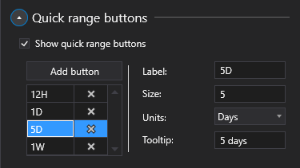
 (Configure date range) button on the chart's toolbar in run mode. This button allows you to change the date and time range to be trended in the chart, whether to enable live data updates, the live update rate, the starting time for a trend, whether to use relative or absolute dates, and the actual date range. The default setting for this button is enabled. See
  (Export as image) button and a
  (Export data to CSV) button on the chart's toolbar in run mode. The default setting for this button is enabled. See
 (Disable/enable live updates) buttons on the chart's toolbar in run mode. This button allows you to stop and start live updates for the chart. The default setting for this button is enabled. See
  ) in the tag chooser hierarchy.
 (Print current view) button on the chart's toolbar in run mode. The default setting for this button is enabled. See
 (Reset to unzoomed state) button on the chart's toolbar in run mode. This button allows you to return the chart to its original state after dragging, panning, or zooming. The default setting for this button is enabled. See
  (Save the chart's configuration to a file) button and a
  (Open a previously saved chart) button on the chart's toolbar in run mode. The default setting for this button is enabled. See
 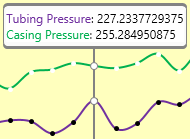 The Show time slice check box indicates whether to display a vertical time slice that will snap to the nearest data point and call out the point value and timestamp for all series in the chart in run mode.
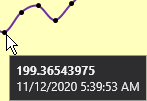 The Show Tooltips check box indicates whether to display tooltips when hovering over a data point or cell. When you hover over a data point or cell in run mode the tooltip displays the point value and timestamp. Only available when a control is showing points.
 (Add a new style based on this control) next to the Style property, after you have configured property values in the Properties pane. See
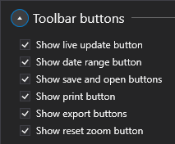 Sample toolbar buttons configuration