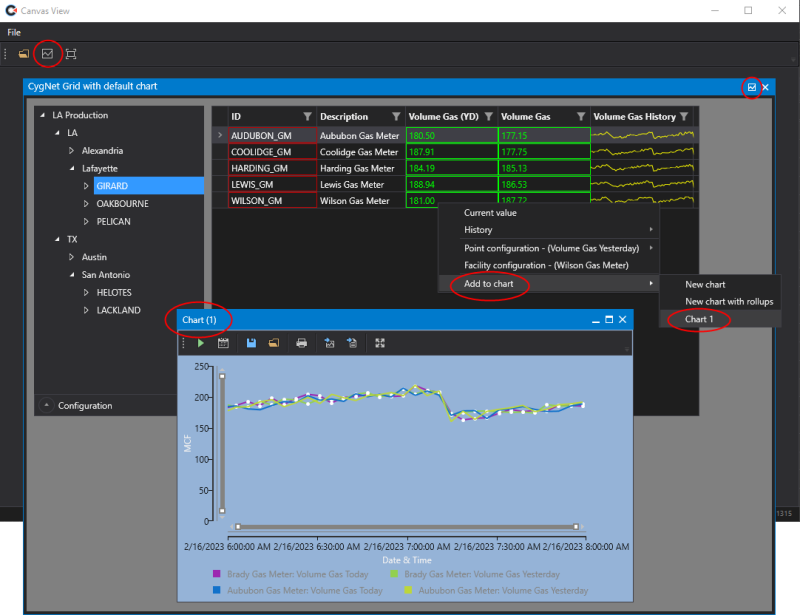
A default or on-demand chart is a pre-configured chart that you can access anytime from a Canvas or Canvas.View screen in design or native run mode in a separate dialog box. The default chart feature provides a customizable means to open multiple default charts from a screen, and to trend selected data from different controls, such as a CygNet Grid or Text Tool control, quickly giving visual context to your data. A default chart can be associated with a Canvas screen or opened on demand from that screen in run mode. Any chart configuration can be saved with a Canvas chart file (.ccf) extension, which can be opened directly, or assigned as the default chart for a specific screen. The series on a default chart supports the following appearance options including: series type (bar line, spline, step, area, etc.), point visibility, point size, point labels, label color and connector color. Default charts also support absolute and relative dates, date overrides, and historical rollups.
|
Sample Default Chart in Canvas.View |
Configure the Default Chart
Any chart configuration can be saved and used as a default chart. The default chart features are identical to those of the Canvas chart control, and support the configuration of one series, point visibility, point size, point labels, label color and connector color, absolute or relative dates, rollups, the CygNet connection, legend, axes, toolbar, and panning and zooming modes to suit your needs. See the following chart topics for more information about general chart configuration:
Save a Default Chart
Once you have configured a suitable chart in design mode, save it as a default chart, then you can assign it to a screen as the default chart, and access it in run mode.
To save a chart as a default chart:
- In run mode click
 (Save the chart's configuration to a file) on the toolbar to open the Save dialog box.
 - Choose the location where you want to save the default chart, either in:
- BSS — Select an APPS or BSS folder, and the desired sub-folder
- Local — Select a local or network file-system folder
- Type a File name and click OK. The chart will be saved as a Canvas chart file (.ccf).
- Assign the Canvas chart file (.ccf) to any screen using the Default Chart properties in the Properties pane.
To open a previously saved default chart:
- Click
 (Open a previously saved chart) on the toolbar to open the Open dialog box.
 - Choose the location where the previously saved chart is stored, either:
- BSS — Select an APPS or BSS folder, and the desired sub-folder
- Local — Select a local or network file-system folder
- Find the desired Canvas chart file (.ccf) and click OK.
Assign a Default Chart to Screen
A default chart can be associated with a Canvas screen or opened on demand from that screen in run mode. Open the Canvas screen in design mode and locate the Default Chart properties in the Properties pane. Configure the following properties to set the default chart file, date range, rollups, and the series appearance:
| UI Property | Script Property | Description |
|---|---|---|
Default Chart
|
||
|
Screen.DateStart  DateStart. properties DateStart. properties
DateStart.Date DateStart.Day DateStart.DayOfWeek DateStart.DayOfYear DateStart.Hour DateStart.Kind DateStart.Millisecond DateStart.Minute DateStart.Month DateStart.Second DateStart.Ticks DateStart.TimeOfDay DateStart.Year |
The Begin date or Start or Start date property specifies the start date and time for a control (or screen or chart or column) for an absolute date and time view window. The format is MM/DD/YYYY hh:mm:ss AM/PM. The default value is the system date and time at which the control was first added to the screen. Click |
|
|
Screen.RelativeStart |
The Begin relative date or Relative start date or Start property specifies a wildcard string defining the amount of time by which to adjust the start date and time. The space-separated elements in this string must be of the form: "x-#", "x+#", or "x=#" where # is an integer and x is one of the following unit specifiers: y — Year, m — Month, d — Day, H — Hour, M — Minute, S — Second, and # is an integer. T wildcard is also supported and must be in the form: T, T+#, T-#, where T represent today at midnight, T-1 is yesterday at midnight, and T+1 is tomorrow at midnight, etc. Any integer can be used. For example, H-8 represents data from the 8 hours before the current hour, d+3 represents data 3 days after the current day, and d+2 H+1 M+30 represents data 2 days, 1 hour and 30 minutes after the current date and time. d-4 H=6 sets the relative start date and time to four days ago (d-4) at 6:00 a.m. (H=6). See Date and Time Wildcards for more information about adjusting relative time. |
|
|
Screen.DefaultChartFile |
|
|
|
Screen.DefaultChartFileSource |
This property specifies the source of the file, object file, screen file, image file, or video file. Options include:
|
|
|
Screen.DateEnd DateEnd. properties
DateEnd.Date DateEnd.Day DateEnd.DayOfWeek DateEnd.DayOfYear DateEnd.Hour DateEnd.Kind DateEnd.Millisecond DateEnd.Minute DateEnd.Month DateEnd.Second DateEnd.Ticks DateEnd.TimeOfDay DateEnd.Year |
The End date or End property specifies the end date and time for a control (or screen or chart or column) for an absolute date and time view window. The format is MM/DD/YYYY hh:mm:ss AM/PM. The default value is the system date and time at which the control was first added to the screen. Click |
|
|
Screen.RelativeEnd |
The End relative date or Relative end date or End property specifies a wildcard string defining the amount of time by which to adjust end date and time. The space-separated elements in this string must be of the form: "x-#", "x+#", or "x=#" where # is an integer and x is one of the following unit specifiers: y — Year, m — Month, d — Day, H — Hour, M — Minute, S — Second, and # is an integer. T wildcard is also supported and must be in the form: T, T+#, T-#, where T represent today at midnight, T-1 is yesterday at midnight, and T+1 is tomorrow at midnight, etc. Any integer can be used. For example, H-8 represents data from the 8 hours before the current hour, d+3 represents data 3 days after the current day, and d+2 H+1 M+30 represents data 2 days, 1 hour and 30 minutes after the current date and time. d-4 H=6 sets the relative end date and time to four days ago (d-4) at 6:00 a.m. (H=6). See Date and Time Wildcards for more information about adjusting relative time. |
|
|
Screen.OverrideChartDates |
|
|
|
Screen.RollupPeriod |
Note: If rollups are configured for a default chart four labeled rollup series will be added to the chart:
|
|
|
Screen.RollupUnit |
For instance, if you select Minutes, rollups occur on a minute basis. The interval is further defined by the Rollup Period setting, which defines how many (in this case) minutes long a rollup period is. |
|
|
Screen.RollupTopSubUnit |
Using the example of hours and minutes, if the starting time of an item would otherwise have been 09:00 AM, if subunits is set to 15, the starting time of that item would be 09:15 AM. |
|
|
Screen.UseRelativeTime |
The Use relative date check box indicates whether to use relative dates and time for the chart. Use the Begin/Start and End properties to specify the relative date ranges to use in the chart. If Use relative date is unchecked all dates and time will be absolute. Use the Begin/Start and End properties to specify the absolute date ranges to use in the chart. |
|
| Default Series
|
||
|
Screen.DefaultLabelBackgroundColor |
|
|
|
Screen.DefaultLabelConnectorColor |
|
|
|
Screen.DefaultLabelForegroundColor |
|
|
|
Screen.DefaultPointSize |
|
|
|
Screen.DefaultSeriesType |
The Series type property specifies the style to use for the chart series. Click
Click here to see an example of each type of series. |
|
|
Screen.DefaultShowPointLabels |
|
|
|
Screen.DefaultShowPoints |
|
|
 to change the date using the
  to access the Open dialog box and select either:
 to select an option from the drop-down menu. Options include:
 Accessing the Default Chart in Canvas
Once configured a default chart is accessible from several places in Canvas, Canvas Viewer, or Canvas.View:
- from the Canvas toolbar
- from the Canvas Viewer toolbar
- from the Canvas.View toolbar
- from any screen in run mode (in Canvas or Canvas View)
If no default chart is configured, Canvas will allow you to select the location where the default chart is saved from the Open dialog box, either in an APPS or BSS folder or a local or network file-system folder.
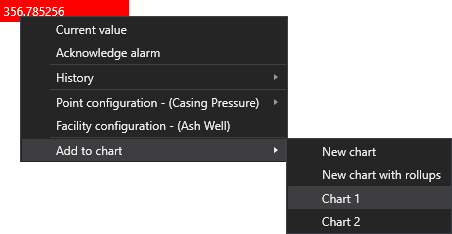
You can also trend selected data from different controls, quickly giving visual context to your data. The default chart is accessible from the right-click context menu for any control that shows single point values.
Add Trend Data to a Default Chart
Several controls support the option to add point values as a new series to a default chart, providing additional visual context for trended data:
|
Grid cell context menu |