The Chart supports the following properties, which are available via the Properties pane and the Canvas script editor. Click next to any property name in the Properties pane to see a short description for the selected property.
See Accessing Screen Objects for more information about how to view control objects in script in the Canvas application.
Categorizing, Sorting, and Finding Properties
You can click  (Categorize), click
  (Alphabetical within Category) or click
  (Search) within the properties using the features located immediately above the properties list. The search box is useful to help locate a property when an object contains many properties. For clarity, when you enter a search term, items matching your entry string remain displayed and non-matching items are temporarily hidden. Clear the search box to display the full properties list again.
You can expand and collapse each property category by clicking  or
or  next to the group name or simply clicking anywhere in the category heading.
Chart Properties
The following table describes the property names visible in the Properties pane user interface (UI) and the corresponding script property name.
 Click to see property list in alphabetical order
|
|
|
| UI Property | Script Property | Description | ||||
|---|---|---|---|---|---|---|
| Name Type Style | ||||||
|
ControlName |
The Name property specifies the unique identifier for this control. Valid characters are A-Z, 0-9, and underscore (_). Special characters and spaces are not permitted. Names cannot start with a number; an underscore will be prefixed if the control name starts with a number. The default value is the object name and the numeric instance. The control's Name is also displayed on the Controls view of the Screen pane. |
|||||
|
ControlType |
The read-only Type property displays the type for the control: Button, Chart, CygNet Grid, Edit Box, Object Container, Search Box, Tag Chooser, etc. … The control's Type is also displayed on the Controls view of the Screen pane. |
|||||
|
|
Styles are created in two ways:
Tip: You can also change a control's Style on the Controls view of the Screen pane. |
|||||
Location
|
||||||
|
Height |
The Height property specifies the height of the control (or screen). Tip: You can also change the height of a control using the Settings pane (click on the |
|||||
|
HorizontalResizeMode |
The Horizontal resize mode property specifies whether and how the control dynamically moves or resizes horizontally when the screen is resized in run mode. Options include:
The default value is None. |
|||||
|
Layer |
Tip: You can also edit a control's Layer on the Controls view of the Screen pane. Note: Layer visibility can be controlled at runtime via the AddLayer, HideLayer, SetLayerVisibility, and ShowLayer methods on the Screen object. |
|||||
|
IsLocked |
Tip: You can also toggle the lock setting of a control using the Settings pane (click on the |
|||||
|
VerticalResizeMode |
The Vertical resize mode property specifies whether and how the control dynamically moves or resizes vertically when the screen is resized in run mode. Options include:
The default value is None. |
|||||
|
IsVisible |
Tip: You can also change a control's Visible setting on the Controls view of the Screen pane. |
|||||
|
Width |
The Width property specifies the width of the control (or screen). Tip: You can also change the width of a control using the Settings pane (click on the |
|||||
|
X |
The X property specifies the location of the control along the horizontal axis. Use the up, down, left, and right arrow keys to nudge a control by 1 pixel. Arrow moves a control by 1 pixel. Ctrl+Arrow moves a control by 10 pixels. Ctrl+Shift+Arrow moves a control by 100 pixels. Tip: You can also change the location of the control using the Settings pane; click on the |
|||||
|
Y |
The Y property specifies the location of the control along the vertical axis. Use the up, down, left, and right arrow keys to nudge a control by 1 pixel. Arrow moves a control by 1 pixel. Ctrl+Arrow moves a control by 10 pixels. Ctrl+Shift+Arrow moves a control by 100 pixels. Tip: You can also change the location of the control using the Settings pane; click on the |
|||||
|
ZIndex |
The Z index property is used to determine the order in which controls are layered on top of each other. Controls with higher values will draw on top of those with lower values. The newest control added to a screen will always have the highest value and will be the top layer. Two or more controls can be on the same index (layer). Tip: You can also change the Z index of a control using the Settings pane (click on the |
|||||
| Script
|
||||||
|
Tip: You can also change the Include in Script setting on the Controls view of the Screen pane. |
||||||
| Chart
|
||||||
|
BackgroundColor |
The Background color property specifies the background color of the screen, object, or control. Click |
|||||
|
BackgroundColorSource |
The Background color source property specifies the color source for the background color of the screen, object, or control. Two options are available:
The default option is Auto. |
|||||
|
ChartDropFacilityMode |
The default value is Use dropped facility. |
|||||
|
DelayLoading |
|
|||||
|
AreUnreliablePointsHidden |
The Hide unreliable points property indicates whether to hide a point in the chart series based on its unreliable point state. The UNRELIABLE status bit is set when a point is deemed unreliable. When enabled data points marked as unreliable will be hidden in the chart. When disabled, unreliable data points will be shown in the chart. |
|||||
|
HoverMode |
The default value is None. You can use this setting to highlight a particular series in a chart in run mode. |
|||||
|
AxisY Series |
The Series Configuration dialog box contains the properties required to configure each series on your chart. Each series is automatically assigned to a y-axis. You can add an unlimited number of y-axes to a chart and an unlimited of series to each y-axis. Although some properties of a series are received from the screen or from another object on the current screen, you can define properties specific to a certain series, in some cases overriding the inherited properties. The number of defined series is listed on the property label. Click The Y-axis properties are grouped into the Y-axis property group. The Series properties are organized into four property groups: |
|||||
|
AxisY |
The Y-axis property group contains properties that configure the attributes of the y-axis, such as title, position, color, tick color, and visibility. Click |
|||||
|
Title |
Name |
The Y-axis Title property specifies the text for the y-axis title. The y-axis typically displays increments of data according to the data's relevant unit type. The unit type derives from the associated data type's point record in the Point Service (PNT). The set Title is Values, which cannot be changed. Scripting NotePrior to v9.5 the script property name for Title was YAxisTitleText, which is now obsolete, although it is retained for backwards compatibility. Use Chart.AxisY Name string to manipulate a y-axis in script. For example: Copy
AxisY Name property
Note that |
||||
|
Position |
Position |
The Y-axis Position property specifies the location of the y-axis on the chart. Options include: Left or Right. The default value is Left. Scripting NotePrior to v9.5 the script property name for Position was YAxisLabelPosition, which is now obsolete, although it is retained for backwards compatibility. Use Chart.AxisY Position to manipulate a y-axis in script. For example: Copy
AxisY Position property
Note that |
||||
|
Label color |
LabelColor |
The Y-axis Label color property specifies the color of the y-axis label text. Click Scripting NotePrior to v9.5 the script property name for LabelColor was YAxisLabelColor, which is now obsolete, although it is retained for backwards compatibility. Use Chart.AxisY LabelColor string to manipulate a y-axis in script. For example: Copy
AxisY LabelColor property
Note that |
||||
|
Tick color |
TickColor |
Scripting NotePrior to v9.5 the script property name for TickColor was YAxisTickColor, which is now obsolete, although it is retained for backwards compatibility. Use Chart.AxisY TickColor string to manipulate a y-axis in script. For example: Copy
AxisY TickColor property
Note that |
||||
|
Show axis label |
ShowLabels |
The Y-axis Show axis label check box indicates whether to display the label text on the y-axis, which is typically the range of units being displayed on the chart. Scripting NotePrior to v9.5 the script property name for ShowLabels was YAxisShowLabels, which is now obsolete, although it is retained for backwards compatibility. Use Chart.AxisY ShowLabels Boolean to manipulate a y-axis in script. For example: Note that |
||||
|
Series |
The Series property group contains properties that configure the primary attributes of the chart series, such as name, UDC, color, SiteService override, facility override, and relative facility resolution. Click
|
|||||
|
Name |
|
The Name property specifies the label for the selected chart series, which is displayed in the upper right corner of the chart. |
||||
|
UDC |
|
The UDC property specifies the UDC for which the control is to display data. Click |
||||
|
Color |
|
The Color property specifies the color of the chart series. Click Note: The default colors used for a Chart series are drawn from a set palette and are therefore not theme-specific. See themes for more information. |
||||
|
|
The Series type property specifies the style to use for the chart series. Click
Click here to see an example of each type of series. |
|||||
|
Override chart's SiteService |
|
|||||
|
(override) SiteService |
The SiteService property specifies the SiteService for which the control (or screen or screen element) is to display data. Click |
|||||
|
Override chart's facility |
Select the Override chart's facility check box to specify a different facility for this chart series. Once checked a facility field is revealed where you can override the facility configured for the chart. The chart's facility is specified in the CygNet Connection property group. If Override chart's facility is selected the Resolve to a relative facility option is removed. |
|||||
|
(override) Facility |
The Facility property specifies the facility for which the control (or screen) is to display data. Click |
|||||
|
Resolve to a relative facility |
The Resolve to a relative facility check box redirects the source of the facility to a relative facility, overriding the configured source facility. Once selected a list of configured Relative links is displayed. See Using Relative Facilities in Canvas for more information about configuring and scripting relative facility links. |
|||||
|
Relative link |
The Relative link property specifies a list of all available relative facility paths. Click |
|||||
|
Order in type |
The Order in type property specifies the attribute value used to represent the order in type (facility ordinal) if the relative facility definition is configured for one. It is possible to have multiple relative facility definition sets with the same definition name. In this case, if the specified Relative link is configured for ordinalization, then you need to configure the attribute value in the box. |
|||||
|
Click |
||||||
|
Show points |
|
|
||||
|
Color |
|
|
||||
|
Size |
|
|
||||
|
Show labels |
|
|
||||
|
Label background color |
|
|||||
|
Label text color |
|
|||||
|
Label connector color |
|
|||||
|
Click |
||||||
|
Type |
|
Additional Resources For more information about Rollup Type definitions and about how history values are used in rollups, see History > History Data > History Rollups. |
||||
|
Units |
|
For instance, if you select Minutes, rollups occur on a minute basis. The interval is further defined by the Rollup Period setting, which defines how many (in this case) minutes long a rollup period is. |
||||
|
Period |
|
|
||||
|
Top of subunit |
|
Using the example of hours and minutes, if the starting time of an item would otherwise have been 09:00 AM, if subunits is set to 15, the starting time of that item would be 09:15 AM. |
||||
|
Click |
||||||
|
Data source |
GetCustomSeriesData GetCustomSeriesAutoUpdateData |
|
||||
|
ShowTimeSlice |
|
|||||
|
ShowTooltips |
|
|||||
| X-Axis
|
||||||
|
XAxisShowLabels |
|
|||||
|
XAxisLabelColor |
|
|||||
|
XAxisLabelPosition |
|
|||||
|
XAxisTickColor |
|
|||||
|
XAxisTitleText |
|
|||||
| Range
|
||||||
|
DateConfig RelativeRanges SelectedRelativeRange |
The Date range configuration property is used to configure the range of dates to be trended in the chart or sparkline, whether to enable live data updates, the live update rate, the starting time for a trend, whether to use relative or absolute dates, and the actual date range. Click |
|||||
|
Enable live updates |
AutoUpdate |
The Enable live updates check box indicates whether this chart or sparkline will request new data at a specified interval allowing the chart to trend data at a real-time pace. When live updates are enabled and the next poll occurs, the series line will update to reflect the slope change, if any. The interval at which the trend moves forward is defined in the Update rate. If disabled, a trend is populated once with data from the Value History Service (VHS). You can disable live updates /enable live updates for any chart in run mode via an icon on the chart toolbar. See Live Update Changed for related event. |
||||
|
Update rate |
AutoUpdateRate |
The Update rate property specifies the number of milliseconds to wait before an auto-updated trend refreshes. The default rate is 200 milliseconds. |
||||
|
Earliest (span) |
AutoUpdateEarliestSpan |
The Earliest (span) property specifies the starting date for a trend; that is, the amount of time in the past from when to start the trend. Enter a number in the text box and select a time period from the drop-down menu. For example, 8 Hours ago or 2 Days ago. |
||||
|
Earliest (units) |
AutoUpdateEarliestUnit |
The Earliest (unit) property specifies the unit of time in the past from when to start the trend. After entering a number in the text box, select a time period from the drop-down menu. The options include: Seconds, Minutes, Hours, Days, and Years. For example, 60 Seconds ago or 2 Hours ago. The default value is Hours. |
||||
|
Use relative date |
UseRelativeTime |
The Use relative date check box indicates whether to use relative dates and time for the chart. Use the Begin/Start and End properties to specify the relative date ranges to use in the chart. If Use relative date is unchecked all dates and time will be absolute. Use the Begin/Start and End properties to specify the absolute date ranges to use in the chart. |
||||
|
Start (relative date) |
RelativeStart |
The Begin relative date or Relative start date or Start property specifies a wildcard string defining the amount of time by which to adjust the start date and time. The space-separated elements in this string must be of the form: "x-#", "x+#", or "x=#" where # is an integer and x is one of the following unit specifiers: y — Year, m — Month, d — Day, H — Hour, M — Minute, S — Second, and # is an integer. T wildcard is also supported and must be in the form: T, T+#, T-#, where T represent today at midnight, T-1 is yesterday at midnight, and T+1 is tomorrow at midnight, etc. Any integer can be used. For example, H-8 represents data from the 8 hours before the current hour, d+3 represents data 3 days after the current day, and d+2 H+1 M+30 represents data 2 days, 1 hour and 30 minutes after the current date and time. d-4 H=6 sets the relative start date and time to four days ago (d-4) at 6:00 a.m. (H=6). See Date and Time Wildcards for more information about adjusting relative time. |
||||
|
End (relative date) |
RelativeEnd |
The End relative date or Relative end date or End property specifies a wildcard string defining the amount of time by which to adjust end date and time. The space-separated elements in this string must be of the form: "x-#", "x+#", or "x=#" where # is an integer and x is one of the following unit specifiers: y — Year, m — Month, d — Day, H — Hour, M — Minute, S — Second, and # is an integer. T wildcard is also supported and must be in the form: T, T+#, T-#, where T represent today at midnight, T-1 is yesterday at midnight, and T+1 is tomorrow at midnight, etc. Any integer can be used. For example, H-8 represents data from the 8 hours before the current hour, d+3 represents data 3 days after the current day, and d+2 H+1 M+30 represents data 2 days, 1 hour and 30 minutes after the current date and time. d-4 H=6 sets the relative end date and time to four days ago (d-4) at 6:00 a.m. (H=6). See Date and Time Wildcards for more information about adjusting relative time. |
||||
|
Start (absolute date) |
DateStart DateStart. properties
DateStart.Date DateStart.Day DateStart.DayOfWeek DateStart.DayOfYear DateStart.Hour DateStart.Kind DateStart.Millisecond DateStart.Minute DateStart.Month DateStart.Second DateStart.Ticks DateStart.TimeOfDay DateStart.Year |
The Begin date or Start or Start date property specifies the start date and time for a control (or screen or chart or column) for an absolute date and time view window. The format is MM/DD/YYYY hh:mm:ss AM/PM. The default value is the system date and time at which the control was first added to the screen. Click |
||||
|
End (absolute date) |
DateEnd DateEnd. properties
DateEnd.Date DateEnd.Day DateEnd.DayOfWeek DateEnd.DayOfYear DateEnd.Hour DateEnd.Kind DateEnd.Millisecond DateEnd.Minute DateEnd.Month DateEnd.Second DateEnd.Ticks DateEnd.TimeOfDay DateEnd.Year |
The End date or End property specifies the end date and time for a control (or screen or chart or column) for an absolute date and time view window. The format is MM/DD/YYYY hh:mm:ss AM/PM. The default value is the system date and time at which the control was first added to the screen. Click |
||||
| CygNet
|
||||||
|
CygNetConfiguration |
The CygNet connection property is used to configure the facility and SiteService associated with this control or screen. Two selection modes are available: a) by Facility tag or b) by SiteService / Facility. This split configuration allows for the inheritance of these properties from other controls, or the specific configuration of the SiteService or the facility, while dynamically changing the other. This use case may be rare; therefore, the Facility tag option is the default. Click |
|||||
|
Selection mode |
CygNetConfiguration.SelectionMode |
The Selection mode property is used to determine how the control will receive CygNet information from other controls or from itself. Two options are available; click the desired radio button:
Sending and receiving facility tagsSome controls on the same screen allow for the sending of facility information from one control to another.
ExampleAdd a control to a screen (e.g., a Tag Chooser or Grid) and configure it as a facility sender to send a facility to the screen. Add another control to the screen (e.g., a Text Tool or Donut) and configure it to receive the facility from the screen. In this scenario the Tag Chooser or Grid will send a facility to the screen and the screen will then send the facility to a Text Tool or the Donut. |
||||
|
CygNet conn > Facility |
CygNetConfiguration.Facility
CygNetConfiguration.Facility. properties
CygNetConfiguration.Facility.FacilityID CygNetConfiguration.Facility.FacilityID.IsBroadcastSourced CygNetConfiguration.Facility.FacilityID.IsOrderInType CygNetConfiguration.Facility.FacilityID.IsOrderInTypeAttributeConfigured CygNetConfiguration.Facility.FacilityID.IsRelative CygNetConfiguration.Facility.FacilityID.IsSelfSourced CygNetConfiguration.Facility.FacilityID.OrderInType CygNetConfiguration.Facility.FacilityID.RelativeFacilityLink CygNetConfiguration.Facility.FacilityID.ResolveRelativeFacility CygNetConfiguration.Facility.FacilityID.Source CygNetConfiguration.Facility.FacilityID.SourceFacilityID CygNetConfiguration.FacilityTag
CygNetConfiguration.FacilityTag. properties
CygNetConfiguration.FacilityTag.FacilityId CygNetConfiguration.FacilityTag.Service CygNetConfiguration.FacilityTag.Site CygNetConfiguration.FacilityTag.SiteService CygNetConfiguration.FacilityTag.SiteService.Service CygNetConfiguration.FacilityTag.SiteService.Site CygNetConfiguration.SourceFacilityTag
CygNetConfiguration.SourceFacilityTag. properties
CygNetConfiguration.SourceFacilityTag.FacilityId CygNetConfiguration.SourceFacilityTag.Service CygNetConfiguration.SourceFacilityTag.Site CygNetConfiguration.SourceFacilityTag.SiteService CygNetConfiguration.SourceFacilityTag.SiteService.Service CygNetConfiguration.SourceFacilityTag.SiteService.Site CygNetConfiguration.SourceFacilityTagString FacilitySender IsRelativeFacilityResolutionEnabled |
The Facility tag or Facility property is where you specify the source of the facility for the control (or screen) to use. The source for the facility can be explicitly configured for this control or it can be received from another control on the same screen, or from the screen, or from another screen. Click
|
||||
|
SiteService |
CygNetConfiguration.SiteService CygNetConfiguration.SiteService. properties
CygNetConfiguration.SiteService.DisplayString CygNetConfiguration.SiteService.DomainSiteService CygNetConfiguration.SiteService.DomainSiteService.DomainId CygNetConfiguration.SiteService.DomainSiteService.Service CygNetConfiguration.SiteService.DomainSiteService.Site CygNetConfiguration.SiteService.DomainSiteService.SiteService CygNetConfiguration.SiteService.DomainSiteService.SiteService.Service CygNetConfiguration.SiteService.DomainSiteService.SiteService.Site CygNetConfiguration.SiteService.IsBroadcastSourced CygNetConfiguration.SiteService.IsSelfSourced CygNetConfiguration.SiteService.SiteService CygNetConfiguration.SiteService.SiteService.Service CygNetConfiguration.SiteService.SiteService.Site CygNetConfiguration.SiteService.Source SiteServiceSender |
The SiteService property is where you specify the source of the SiteService for the control (or screen) to use. The source for the SiteService can be explicitly configured for this control or it can be received from another control on the same screen, or from the screen, or from another screen. Click
|
||||
| Legend
|
||||||
|
LegendDateFormat |
The Legend date format property specifies the format for the dates used in the chart legend. Use this property to override the Default date format, which is configured in the Application settings page of the Backstage view. The default date format is YYYY/MM/DD HH:MM:SS.fff, which corresponds to 2024/01/01 10:20:30.0001. |
|||||
|
LegendFormat |
The Legend format property specifies the format for the text used in the chart legend. The text can display a static text string, such as a label, legend, tooltip, or a dynamic text string based on point or facility attributes. Dynamic text is built using tokens, which can represent real-time CVS point properties, point configuration properties, and facility properties. In run mode, the tokens are replaced with the attribute's value. Click Note: If you leave this property empty, the chart will use the series Name value as the legend. Thin Web ClientThis is the only chart legend property supported by TWC. If configured (to use a dynamic text string), or left empty (to use the series Name), the other legend properties will apply their default values: Legend date format: YYYY/MM/DD HH:MM:SS.fff; Legend location: bottom; Legend value format: #,##0.00; and Show legend: Yes. |
|||||
|
LegendLocation |
|
|||||
|
LegendValueFormat |
The Legend value format property specifies the format for the legend's point value using any of the valid .NET standard or custom numeric format strings. The value format applies to a point's value, primary value, and alternate value properties. The default value format is #,##0.00, which corresponds to 123,456,789.12. Formats use # and 0, with a period (.) as the decimal separator and comma (,) as the thousands separator. Add additional zeros to show more decimal places. |
|||||
|
IsLegendVisible |
The Show legend check box indicates whether to display the legend on the chart. The default option is to show the legend. |
|||||
| Toolbar
|
||||||
|
ToolBarItems |
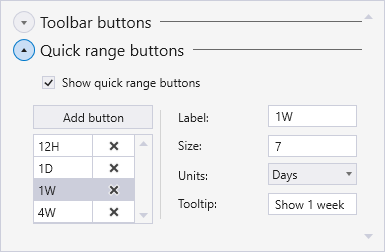
The ToolBar items configuration box contains the properties required to configure the buttons that will appear on the chart's toolbar in run mode. Buttons include several functional Toolbar buttons (live update, date range configuration, save, open, print, export, and reset zoom) and any number of customizable Quick range buttons, which are used to view predefined ranges of time only visible for the current runtime session. The number of defined toolbar items is listed on the property label. All buttons are displayed by default if the toolbar is set to visible.
See Using a Chart in Run Mode for a description of the chart toolbar icons. |
|||||
|
|
||||||
|
Show save and open buttons |
ToolBarSaveOpenOptionVisible |
|
||||
|
Show reset zoom button |
ToolBarResetVisible |
|
||||
|
The next set of check boxes show buttons that are supported both in the Canvas Native view and in the CygNet TWC web view . |
||||||
|
Show live update button |
ToolBarLiveUpdateVisible |
The Show live update button check box indicates whether to display the |
||||
|
Show date range button |
ToolBarDateConfigOptionVisible |
The Show date range button check box indicates whether to display a |
||||
|
Show print button |
ToolBarPrintVisible |
The Show print button check box indicates whether to display a |
||||
|
Show export buttons |
ToolBarExportVisible |
The Show export buttons check box indicates whether to display a |
||||
|
|
||||||
|
Show quick range buttons |
ToolBarQuickRangeButtonsVisible |
The Show quick range buttons check box indicates whether to display any configured quick range buttons, which are used to view predefined windows of time on the chart. Each button will reset the time range presented in the chart based on the button's configuration. For example, for a button configured for 8 hours, when clicked the chart’s time range will be set so that it begins eight hours from now with the left edge of the chart representing now. For a chart configured to be in live update mode, the chart will update to show this eight-hour window. The quick range only persists for the current runtime session. The default setting for this button is enabled, although buttons must be configured to display on the chart. See To quickly view different time ranges for the current chart for more information. |
||||
|
Units |
|
The Units property specifies the time unit for the range associated with the quick range button. The options include: Seconds, Minutes, Hours, Days, and Years. The default value is Seconds. |
||||
|
Size |
|
The Size property specifies the length in units of time for the range associated with the quick range button. The size is relative to the unit type specified in the Units property. For example, 60 seconds = 1 minute, 48 hours = 2 days, 30 days = 1 month, etc. |
||||
|
Label |
|
The Label property specifies the identifier displayed on the quick range button. |
||||
|
Tooltip |
|
The Tooltip property specifies the tooltip to be displayed under the quick range button. |
||||
|
ToolBarPosition |
The Toolbar location property specifies the location of the toolbar. Options include Top or Bottom. The default location is above the chart (Top). Note: The Toolbar location property is |
|||||
|
ToolBarVisible |
The Toolbar visible check box indicates whether the toolbar is visible on the chart. The default value is hidden. |
|||||
| Zooming and Panning
|
||||||
|
DragMode |
The default value is None. |
|||||
|
PanMode PanOffset |
The default value is None. See Pan Offset Changed for related event. |
|||||
|
ZoomMode Zoom |
The default value is None. See Zoom Changed for related event. |
|||||
| Generic
|
||||||
|
String |
|
|||||
|
YesNo |
|
|||||
 The Style property defines the style sheet applied to an object on a screen. A style sheet consists of a predetermined list of properties and property values configured for a particular control type.
  (Add a new style based on this control) next to the Style property, after you have configured property values in the Properties pane. See
  (Settings) to the right of the control in design mode) or on the
  The Include in script check box indicates that the control will appear in the objects collection of the screen (if scripting is enabled). To optimize performance, best practice dictates that you only include the controls you need to manipulate via script. Other controls should be excluded. When you add an event to a control, it will be automatically added to script and the Include in script property (and the In Script check box on the Controls view) will be set to True.
  to open
  to expand each property group as necessary. Click
  to collapse each property group as necessary.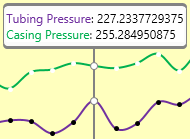
 to change the date using the


 (Save the chart's configuration to a file) button and a
  (Open a previously saved chart) button on the chart's toolbar in run mode. The default setting for this button is enabled. See
  (Reset to unzoomed state) button on the chart's toolbar in run mode. This button allows you to return the chart to its original state after dragging, panning, or zooming. The default setting for this button is enabled. See
 (Disable live updates / Enable live updates) toggle buttons on the chart's toolbar in run mode. These buttons allow you to stop and start live updates for the chart. The default setting for this button is enabled. See
  (Configure date range) button on the chart's toolbar in run mode. This button allows you to change the date and time range to be trended in the chart, whether to enable live data updates, the live update rate, the starting time for a trend, whether to use relative or absolute dates, and the actual date range. The default setting for this button is enabled. See
  (Print current view) button on the chart's toolbar in run mode. The default setting for this button is enabled. See
  (Export as image) button and a
  (Export data to CSV) button on the chart's toolbar in run mode. The default setting for this button is enabled. See
  (Delete quick range button) to remove a button from the chart's toolbar as necessary.