The CygNet Grid has numerous run-mode options:
- A load indicator will let you know that Canvas is processing and loading data to your grid(s).
-
You can dynamically resize your screen and any controls within. See Resizing Screens for more information about resizing Canvas screens.
- Other run-mode options are list below:
 To sort a CygNet Grid
- If a column has been configured to Sort numerically, click that column header to sort the grid. Clicking the column header moves between the three states: sort ascending, sort descending, and unsorted. A small arrow indicates the sort order.
-
In the TWC Web view, if a cell in a numeric column contains a non-numeric value, a placeholder ({non-numeric}) will be shown in its place.
To filter a CygNet Grid
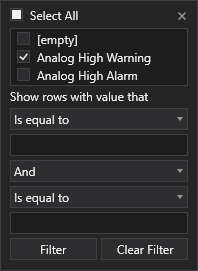
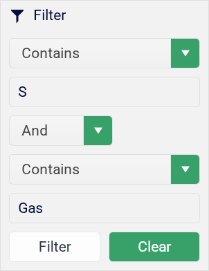
All grid headers contain a filtering tool to limit the rows displayed in the grid. Click  /
/  to the right of a column header to filter the rows displayed in a grid based on values within the selected column. Two sets of qualifying filter criteria can be specified, and the criteria can be compounded (use all rules by selecting And or use either rule by selecting Or). The options in the filter tool are described below.
Filter in Canvas Native view
|
Filter in CygNet TWC web view
|
 To edit cells in a generic column in a CygNet Grid

- If a generic column allows editing, click any cell and type a new value. Edited values are not saved anywhere but in the grid, but they can be saved or otherwise manipulated via script.
To send single or multiple facilities to another control on the current screen or to another screen
The Alarm Grid and CygNet Grid can be configured to send a single facility or multiple facilities to other controls using the Facility sender mode property settings. This property determines what data to pass from grid to grid, from a grid to other controls on your current screen, or from a grid to other controls on a hyperlinked screen.
Facility Sender Mode
The Facility sender mode property determines how facilities are sent to other controls. There are four options:
- None — No facilities are sent. This is the default value.
- Single click — A single click on a row will send a single facility to a receiving control on the same screen.
- Double click — A double click on a row will send a single facility to a receiving control on the same screen. This option supports two actions when a row is double-clicked: 1. Sending a facility to anther control on the same screen; and 2. Sending a facility to another screen. See the note below.
- All facilities — As soon as all facilities are received they will be sent to the receiving control on the screen. No click is required.
Note:
If Double click is selected for the Facility sender mode property, and Hyperlink is selected for the Double click mode property, and a Hyperlink mode and Screen path are configured, two actions will be performed when a row is double-clicked:
-
the selected facility will be sent to any control(s) on the screen configured to receive its facility from the grid
- and -
-
the selected facility will be sent to the screen configured in the Screen path property.
Script Event
If Double click is selected for the Facility sender mode property, and Script is selected for the Double click mode property, the selected facility will be sent to any control(s) on the screen configured to receive its facility from the grid, and the script event Double Click Cell will fire using the facility received from the grid. 
Usage Notes
- An Alarm Grid and a CygNet Grid can act as a facility receiver, or a facility sender, or both.
- An Alarm Grid and a CygNet Grid will send a single facility on a single or double-click.
- Since the Alarm Grid is point-based it can have multiple rows representing a single facility. During facility sending (on either a single or double-click), the Alarm Grid will send only one facility to the receiving control. When sending facilities in All facilities mode, only the unique list of facilities is sent.
- An Alarm Grid and a CygNet Grid will send All facilities to other controls as soon as they are received by the grid.
- An Alarm Grid will send All facilities only if new facilities have been received.
- A CygNet Grid can have one facility per cell, however during facility sending to an Alarm Grid, the receiving Alarm Grid will show all the alarm rows that belong to the single facility.
To hyperlink to another screen in the Canvas Native view and the CygNet TWC web view
The grid supports hyperlinking to another screen via a double-click action. The Facility sender mode must be set to Double click. The Double click mode must be set to Hyperlink. Set the desired mode in the Hyperlink mode property. Set the destination Screen file source and Screen path.
Double click a row in the grid to open another screen. Depending on the Hyperlink mode selected, the following will happen:
- Open — Open a designated screen in a new window (default).
- Modal open — Open a designated screen in a new modal window. A modal window is a type of popup that is subordinate to a parent window that appears in front of the parent and usurps the parent’s control. You cannot interact with the parent window until the modal window has been closed. This type of window is used when you want a user to focus on or interact with information in the popup.
- Open and close — Open a designated screen in a new window and close the current screen.
- Replace — Replace the current screen with the designated screen.
- Replace with navigation — Replace the current screen with the specified screen and add a navigation toolbar to the top of the screen.
- Close — Close the current screen.
Note: Grid cells can display a different facility from that configured for a grid row. The double-click hyperlink action will pass the cell or row’s facility to other controls on the screen configured to receive it AND to the receiving screen.
To acknowledge an alarm via the context menu in the Canvas Native view
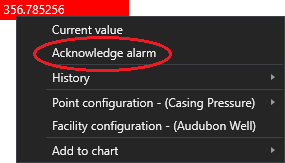
When an alarm is reported to the CAS, its state is "unacknowledged", meaning that the alarm is new and that a user or the system has not acknowledged its presence. An unacknowledged alarm may be identified by the color settings for the control (background, text, border, ring, bar, fill, or marker color), if configured to represent the point state of the associated point. Additionally, some controls may blink to warn of a point in alarm, if configured to do so.
|
Acknowledge the alarm from the context menu:
See the control properties for more information about configuring alarm acknowledgment options. |
Canvas Native view |
 To access current value, history, and configuration information via the context menu in the Canvas Native view
Right-click the context menu to access several CygNet system dialog boxes for information about the point and facility associated with the object, where you can modify properties and values as needed. The associated point/UDC and facility is identified in the context menu, so you know what you are viewing.
|
Grid cell context menu |

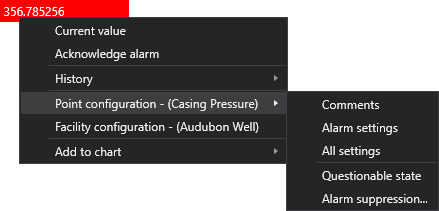
Note: The context menu options change depending on the point configuration:
- If the control is configured to display long point ID, the Facility configuration menu option is hidden.
- If the facility description is blank, then the menu will show the facility ID in the Facility configuration option.
- If the point description is blank, then the menu will show the UDC/long point ID (based on configuration).
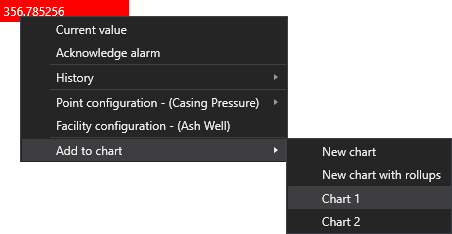
To add values to a default chart via the context menu in the Canvas Native view
Several controls support the option to add point values as a new series to a default chart, providing additional visual context for trended data:
|
Grid cell context menu |
 To access other custom context menu items in the Canvas Native view
-
If any custom context menu items have been configured for the CygNet Grid, select the item from the menu.
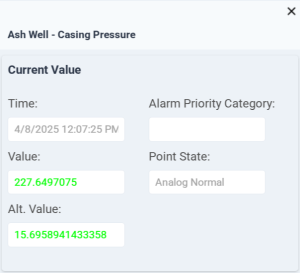
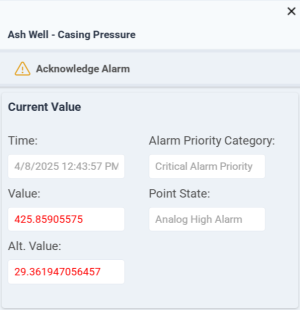
To view current value, acknowledge alarm, and view a chart via the context menu in the CygNet TWC web view
|
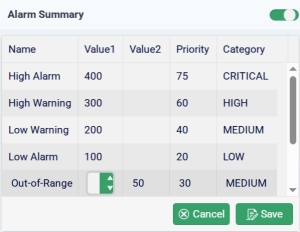
The CygNet Thin Web Client supports its own context menu visible in the web view. Perform the following actions from the TWC context menu:
See Using the Thin Web Client Context Menu for more information. |
|
 (Edit) then click on the Value or Priority you want to edit.
  (Cancel) to abort and return to the read-only mode.
 (
( (Close) to close the context menu and return to the TWC page that launched the menu.