The Alarm Grid has numerous properties available for configuration in the Properties pane. The following topic describes a basic workflow for configuring this control. The specific appearance and functionality of the object you create depends on your needs and implementation of the control's properties, each of which is described below.
 To configure an Alarm Grid
- In design mode, create a new Canvas screen.
- Find the Alarm Grid on the Toolbox pane and drag a desired object to your screen.
-
Use the Settings pane to apply common settings (sizing, grouping, alignment, etc.) to this object (and others) on your screen.
- Optionally, use the Name property to rename the object if you plan to reference it in another screen or control, or plan to script this control.
- Configure the Style property:
- Style —
 The Style property defines the style sheet applied to an object on a screen. A style sheet consists of a predetermined list of properties and property values configured for a particular control type.
 - Click
 to reveal a drop-down menu of predetermined styles configured for the selected control.
 - Select a desired style and its properties will be applied to the control.
- Alternately, you can create a new style based on other property values configured for the control.
- Or you can select <None> to remove subscription to any style.
Styles are created in two ways:
- In the control's Properties pane. Click
 (Add a new style based on this control) next to the Style property, after you have configured property values in the Properties pane. See Add a new style based on a control for more information.
 - In the Canvas Settings in the Backstage view. The default style for any control is configured in the Backstage view. See Manage style sheets in the Backstage view for more information.
Tip: You can also change a control's Style on the Controls view of the Screen pane.
- Click
- Configure the Location properties. See To configure location, size, resizing, layer, and visibility properties below.
- Configure the Script property:
- Include in script —
 The Include in script check box indicates that the control will appear in the objects collection of the screen (if scripting is enabled). To optimize performance, best practice dictates that you only include the controls you need to manipulate via script. Other controls should be excluded. When you add an event to a control, it will be automatically added to script and the Include in script property (and the In Script check box on the Controls view) will be set to True.
 Tip: You can also change the Include in Script setting on the Controls view of the Screen pane.
- Configure the Grid properties to define specific grid options. See To configure grid properties below.
- Configure the Hyperlink properties to indicate what to do when the cell or row is double-clicked. See To configure the hyperlink properties below.
- Configure the Generic properties:
- String — The String property specifies a generic string property that can be used when scripting this control. Type a string and reference it in your script as necessary.
- Yes/No — The Yes/No property specifies a generic Boolean yes/no property that can be used when scripting this control. Click the check box to enable the property and reference it in your script as necessary.
- Configure other grid properties.
- Save the screen.
- Run the screen to test your configuration.
To configure location, size, resizing, layer, and visibility properties
- Find the Location properties and configure the size and location properties for the control:
- Height —
The Height property specifies the height of the control (or screen).
Tip: You can also change the height of a control using the Settings pane (click on the
 (Settings) to the right of the control in design mode) or on the Controls view of the Screen pane.
 - Horizontal resize mode —
The Horizontal resize mode property specifies whether and how the control dynamically moves or resizes horizontally when the screen is resized in run mode. Options include:
- None — No resizing occurs.
- Shift — The object will shift horizontally.
- Expand — The object will expand or shrink horizontally the same number of pixels as the screen.
- Proportional — The object expands or shrinks proportionally to the screen.
The default value is None.
- Layer — The Layer property specifies the name of the layer to which this object is assigned. Layers can be used to show, hide, and edit multiple controls on one layer without affecting controls on another layer.
- Type the name of the layer into the Layer field (the name can be a previously created layer or a new layer).
- All layers are listed on the Layers pane, where you can manage the layers for the screen in design mode and run mode.
Tip: You can also edit a control's Layer on the Controls view of the Screen pane.
Note: Layer visibility can be controlled at runtime via the AddLayer, HideLayer, SetLayerVisibility, and ShowLayer methods on the Screen object.
- Lock — The Lock property indicates whether the control is locked to the current position. A locked control cannot be moved via click and drag, or nudged with the arrow keys, or resized.
Tip: You can also toggle the lock setting of a control using the Settings pane (click on the
(Settings) to the right of the control in design mode). - Vertical resize mode —
The Vertical resize mode property specifies whether and how the control dynamically moves or resizes vertically when the screen is resized in run mode. Options include:
- None — No resizing occurs.
- Shift — The object will shift vertically.
- Expand — The object will expand or shrink vertically the same number of pixels as the screen.
- Proportional — The object expands or shrinks proportionally to the screen.
The default value is None.
- Visible — The Visible check box indicates whether the control is visible in run mode.
Tip: You can also change a control's Visible setting on the Controls view of the Screen pane.
- Width —
The Width property specifies the width of the control (or screen).
Tip: You can also change the width of a control using the Settings pane (click on the
(Settings) to the right of the control in design mode) or on the Controls view of the Screen pane. - X —
The X property specifies the location of the control along the horizontal axis. Use the up, down, left, and right arrow keys to nudge a control by 1 pixel. Arrow moves a control by 1 pixel. Ctrl+Arrow moves a control by 10 pixels. Ctrl+Shift+Arrow moves a control by 100 pixels.
Tip: You can also change the location of the control using the Settings pane; click on the
(Settings) to the right of the control in design mode. - Y —
The Y property specifies the location of the control along the vertical axis. Use the up, down, left, and right arrow keys to nudge a control by 1 pixel. Arrow moves a control by 1 pixel. Ctrl+Arrow moves a control by 10 pixels. Ctrl+Shift+Arrow moves a control by 100 pixels.
Tip: You can also change the location of the control using the Settings pane; click on the
(Settings) to the right of the control in design mode. - Z index —
The Z index property is used to determine the order in which controls are layered on top of each other. Controls with higher values will draw on top of those with lower values. The newest control added to a screen will always have the highest value and will be the top layer. Two or more controls can be on the same index (layer).
Tip: You can also change the Z index of a control using the Settings pane (click on the
(Settings) to the right of the control in design mode) or on the Controls view of the Screen pane.
- Configure other grid properties.
- Save the screen.
- Run the screen to test your configuration.
To configure grid properties
The Grid set of properties is where you configure specific grid options, including: alarm filter rules, the alarm icon column, point state color, columns, rows, custom context menu items, facility sender mode, row summary update rate, and the selection mode.
-
Find the Grid properties and define the following properties for the Alarm Grid:
- Alarm filter — The Alarm filter property is used to limit the data that is presented in the Alarm Grid by configuring alarm filtering rules. Click
 to open the Alarm Filter dialog box, where you can create a custom alarm filter rule. The filter rule is displayed in the property label; you do need to open the Alarm Filter dialog box to edit the rule.
 - Alarm icon column — See To configure an alarm icon column and alarm priority ranges below.
- Alarm toolbar filters — See To configure dynamic toolbar filters below.
- Color configuration —
The Color configuration property is a control-level property that governs all color settings for the columns in the Alarm Grid. Click
to reveal a set of color options where you can specify the source of the color to be used for the background, text, border, header background, header text, grid background, and the alarm acknowledgment options for all columns. The Color configuration box consists of the following options, which are described below:- Background color
- Text color
- Border color
- Header background color
- Header text color
- Grid background color
- Display alarm acknowledgment
- Background color — The Background color property specifies the color source and actual color used for the background of the grid cell.
- Text color — The Text color property specifies the color source and actual color used for the text of the grid cell. The text color is sometimes known as the foreground color.
- Border color — The Border color property specifies the color source and actual color used for the border of the grid cell.
For each color property select the Source and Color:
- Source — Click to reveal five options:
- Auto — The color will automatically follow the selected client theme regardless of the underlying color palette (by selecting Auto). Where applicable, color-related properties will default to this configuration, allowing them to automatically follow the theme of the current client rather than fixing them to the one used when the screen was created. By using Auto for the color configuration, a screen developer can work in their preferred theme without affecting the presentation of the final screen when displayed by the user—avoiding display problems such as white text over a very light background, etc.
Note:
Auto is not supported as a color source in TWC screens. If a property specifies Auto for color configuration, the screen will use the <Self> color that is specified in the Canvas file during the publishing process. See Color on TWC Screens. - BackgroundColor — Select BackgroundColor to specify that the source of the grid cell's color corresponds to the alarm's point state background color (%pointstatebackcolor%).
- ForegroundColor — Select ForegroundColor to specify that the source of the grid cell's color corresponds to the alarm's point state foreground color (%pointstateforecolor%)
- Self — Select Self to explicitly configure the color. When Self is selected a Color field is automatically displayed beneath the Source field and must be configured.
- SingleColor — Select SingleColor to specify that the source of the grid cell's color corresponds to the alarm's point state single color (%pointstatesinglecolor%)
- Auto — The color will automatically follow the selected client theme regardless of the underlying color palette (by selecting Auto). Where applicable, color-related properties will default to this configuration, allowing them to automatically follow the theme of the current client rather than fixing them to the one used when the screen was created. By using Auto for the color configuration, a screen developer can work in their preferred theme without affecting the presentation of the final screen when displayed by the user—avoiding display problems such as white text over a very light background, etc.
- Color — Only displays if the Source is Self. Click to customize the color using the color picker.
- Source — Click
- Header background color — The Header background color property specifies the color used for the background of the grid's header row.
- Header text color — The Header text color property specifies the color used for the text on the grid's header row.
- Grid background color — The Grid background color property specifies the color used for grid's background.
For each color property select the Source and Color:
- Source — Click to reveal two options:
- Auto — The color will automatically follow the selected client theme regardless of the underlying color palette (by selecting Auto). Where applicable, color-related properties will default to this configuration, allowing them to automatically follow the theme of the current client rather than fixing them to the one used when the screen was created. By using Auto for the color configuration, a screen developer can work in their preferred theme without affecting the presentation of the final screen when displayed by the user—avoiding display problems such as white text over a very light background, etc.
Note:
Auto is not supported as a color source in TWC screens. If a property specifies Auto for color configuration, the screen will use the <Self> color that is specified in the Canvas file during the publishing process. See Color on TWC Screens. - Self — Select Self to explicitly configure the color. When Self is selected a Color field is automatically displayed beneath the Source field and must be configured.
- Auto — The color will automatically follow the selected client theme regardless of the underlying color palette (by selecting Auto). Where applicable, color-related properties will default to this configuration, allowing them to automatically follow the theme of the current client rather than fixing them to the one used when the screen was created. By using Auto for the color configuration, a screen developer can work in their preferred theme without affecting the presentation of the final screen when displayed by the user—avoiding display problems such as white text over a very light background, etc.
- Color — Only displays if the Source is Self. Click to customize the color using the color picker.
- Source — Click
- Display alarm acknowledgment —
The Display alarm acknowledgment property enables the cell or Text Tool's background, text, and border to blink when the associated point is in alarm. Check each box to configure the:
- Background — The background of the cell or Text Tool will blink when the associated point is in alarm.
- Text — The text in the cell or Text Tool will blink when the associated point is in alarm.
- Border — The border of the cell or Text Tool will blink when the associated point is in alarm.
If none of these options are selected, no visual indication of a point in alarm will be presented. However, if the point is in alarm, an Acknowledge alarm option will be available from the context menu in run mode.
Note: The blink interval is configurable in the Canvas Settings page in the Backstage view.
- Column configuration —
The Grid Column Configuration dialog box contains all properties required to configure columns in your grid. There are five types of columns that can be configured in an Alarm Grid: an Alarm icon column (configured separately), an Alarm column, a Facility column, a Generic column, and a Point column. The number of defined columns is listed on the property label once defined.
You can create your own columns or select from 11 default columns: four Alarm columns (Alarm Priority, Alarm Acknowledge, Primary Value, Timestamp), and seven Point columns (Alarm Condition, SiteService, Long Point ID, Primary Units, Description, Facility ID, Uniform Data Code).
Notes:
- Color configuration for all types of Alarm Grid columns is handled in the Color configuration property.
- Alarm icon column configuration is handled in the Alarm icon column property.
Click
to open Grid Column Configuration dialog box.- See To configure an alarm column below
- See To configure a facility column below
- See To configure a generic column below
- See To configure a point column below
- Context menu items — See To configure custom context menu items below.
- Double click mode —
-
Hyperlink — A double click will link to a screen in a new window via the hyperlink navigation option selected in the Hyperlink mode property. This control supports hyperlinking to other screens via configuration or scripting. A single click or double-click action will send any configured facility to the receiving screen. Hyperlink supports the following operational modes: Open, Modal open (a subordinate popup window), Open and close, Replace, Replace with navigation, and Close. Any configured script is disabled.
-
Script — A double click will disable hyperlink navigation and run any specified script.
- Grid cells can display a different facility from that configured for a grid row. The double-click hyperlink action will pass the cell or row’s facility to other controls on the screen configured to receive it AND to the receiving screen.
-
If Double click is selected for the Facility sender mode property, and Hyperlink is selected for the Double click mode property, and a Hyperlink mode and Screen path are configured, two actions will be performed when a row is double-clicked:
-
the selected facility will be sent to any control(s) on the screen configured to receive its facility from the grid
- and -
-
the selected facility will be sent to the screen configured in the Screen path property.
Script Event
If Double click is selected for the Facility sender mode property, and Script is selected for the Double click mode property, the selected facility will be sent to any control(s) on the screen configured to receive its facility from the grid, and the script event Double Click Cell will fire using the facility received from the grid.
-
- The script property for Double click mode is DoubleClickBehavior.
- Facility sender mode — Configure the Facility sender mode property to determine the mode for sending a facility to other controls:
The Facility sender mode property determines how facilities are sent to other controls. There are four options:
- None — No facilities are sent. This is the default value.
- Single click — A single click on a row will send a single facility to a receiving control on the same screen.
- Double click — A double click on a row will send a single facility to a receiving control on the same screen. This option supports two actions when a row is double-clicked: 1. Sending a facility to anther control on the same screen; and 2. Sending a facility to another screen. See the note below.
- All facilities — As soon as all facilities are received they will be sent to the receiving control on the screen. No click is required.
Note:
If Double click is selected for the Facility sender mode property, and Hyperlink is selected for the Double click mode property, and a Hyperlink mode and Screen path are configured, two actions will be performed when a row is double-clicked:
the selected facility will be sent to any control(s) on the screen configured to receive its facility from the grid
- and -
the selected facility will be sent to the screen configured in the Screen path property.
Script Event
If Double click is selected for the Facility sender mode property, and Script is selected for the Double click mode property, the selected facility will be sent to any control(s) on the screen configured to receive its facility from the grid, and the script event Double Click Cell will fire using the facility received from the grid.
Sending and receiving facility tags
Some controls on the same screen allow for the sending of facility information from one control to another.
- On the sending control configure the Facility sender mode property to send facility tag information to another control on the same screen.
- On the receiving control configure the Selection mode property (in either CygNet connection or Point configuration section) to Facility tag and select the Facility Source to the sending control.
- On the receiving control configure a display tag that associates to a facility property, e.g., %FacilityTag%.
Example
Add a control to a screen (e.g., a Tag Chooser or Grid) and configure it as a facility sender to send a facility to the screen. Add another control to the screen (e.g., a Text Tool or Donut) and configure it to receive the facility from the screen. In this scenario the Tag Chooser or Grid will send a facility to the screen and the screen will then send the facility to a Text Tool or the Donut.
-
Row configuration —
The Row configuration property is where you specify the source of the data to use in the rows of the Alarm Grid: either by SiteService or by facilities. The source for the SiteService can be the Screen or <Self>, where you can specify the Common Alarm Service (CAS) providing the alarm data. The source for the facilities can be from the screen or another control. Click
See To configure the source of row data below. to reveal a drop-down area where you can configure the source SiteService or the source Facilities for the grid's rows. - Row summary update rate — The Row summary update rate property specifies the rate (in milliseconds) at which the grid will recalculate row summaries after a value changes in a point column. Longer rates will improve performance by not recalculating as often. When a value in a cell is updated, the summary row will be recalculated. However recalculation does not happen immediately or for every update; it is throttled by the Row summary update rate. When a recalculation is requested, Canvas will delay for the duration of the update rate. This allows other updates to come in that may affect the recalculated values. Recalculation requests that come in during that delay will be ignored. In this way, no matter how often values change, Canvas will not recalculate the summary row value more often than the set rate. The default value is 1000 milliseconds (1 second). Note: The Row summary update rate property does not apply to the CygNet TWC web view and is hidden in the Properties pane in Web client mode. The summary row data is recalculated every time there is a data update for the configured column. Also see To configure a point column below.
- Selection mode —
The grid controls offer three selection modes, which determine how many grid units may be selected in run mode. The grid units are determined by the Selection unit property. Options include:
- Single — Only one item can be selected at a time.
- Multiple — Items are added to the selection when they get clicked and get removed when they get clicked again.
- Extended — Items are added to the selection only by combining mouse clicks with the Ctrl key or Shift key.
The default value is Single.
In script, use SelectionMode with the SelectAll method and SelectedRows property (read-only) to aid in multi-row selection:
- SelectAll method — If the SelectionMode property is Multiple or Extended, SelectAll will select all rows in a grid and SelectedRows will return the matching DataRow objects. SelectAll will not obviously change the selection if SelectionMode is Single.
- SelectedRows property (read-only) — SelectedRows will be restricted to a single row if SelectionMode is Single. Otherwise SelectedRows can contain multiple rows to be retrieved via script.
The Double click mode property determines the action to take when you double-click a row in run mode. The Facility sender mode must be set to Double click. Options are:
The default value is Hyperlink.
Notes:
- Configure other grid properties.
- Save the screen.
- Run the screen to test your configuration.
To configure an alarm icon column and alarm priority ranges
The Alarm icon column property is used to indicate whether a column and icon will be displayed as the first column of the Alarm Grid. A customizable icon can be configured to change color based on point state and change image based on alarm priority. Icons will display only when there is an unacknowledged alarm. Click to configure the column, the icon color source, the associated priority ranges, and the icon image used for each priority in the Alarm Priority Icon Ranges dialog box.
Configure Icon Color Source, Alarm Priority Ranges, and Custom Icon
- To enable the alarm icon, do the following depending on the control you are configuring:
- Alarm Grid — Click Show Alarm Icon Column on the Alarm Priority Icon Ranges dialog box, accessible from the Alarm icon column property
- Detail Control — Click Show alarm icon in the Properties pane
- Tile View — Click Show alarm icon in the Properties pane
- Alarm Grid — Click Show Alarm Icon Column on the Alarm Priority Icon Ranges dialog box, accessible from the Alarm icon column property
- Select the source of the icon's color from the Icon color source drop-down menu, which lists the point states of the associated alarm. Options include:
- BackgroundColor — Specifies that the source of the icon's color corresponds to the alarm's point state background color (%pointstatebackcolor%)
- ForegroundColor — Specifies that the source of the icon's color corresponds to the alarm's point state foreground color (%pointstateforecolor%)
- SingleColor — Specifies that the source of the icon's color corresponds to the alarm's point state single color (%pointstatesinglecolor%). This is the default value.
- Click New icon to add a new icon to the list of priorities. Configure the desired priority and associated icon for each range:
- Lowest Priority — Type a value to represent the lower end of the priority range. If you are using the CygNet Standard Point Scheme, the total valid range is 0 to 99, with 0 being the lowest and 99 the highest.
- Priority Range — This read-only column will automatically update to display the range based on the low value you entered, up to the bottom of the next configured range. For example, 0-24, 25-49, 50-74, 75-99 to represent four ranges from 0 to 99.
- Icon — There are three options for icon usage:
- Default icon — Use the default icon provided in Canvas.
- Custom icon without dynamic alarm color — Optionally, supply a custom icon that does not display alarm color. This could be as simple as different shapes and colors that represent the different alarm priority ranges. For example, a blue circle for 0-49, a yellow warning triangle for 50-74, and a red octagon for 75-99, etc. The custom icon must be a Scalable Vector Graphics (.svg) file.
- Custom icon with dynamic alarm color — Optionally, supply a custom icon that will also include a substituted alarm color somewhere inside the image.
To create a customized alarm
- Create (or purchase) your own icon. The icon must be a Scalable Vector Graphics (.svg) file. The properties of the SVG image are defined its XML definition.
- Edit the SVG XML in a text editor and add the string "
alarm-highlight" to the XML class defining the element of your custom icon that you want to have filled using the color specified in the Icon color source from above. For example,<circle id="Alarm" class="st2 alarm-highlight" cx="8" cy="8" r="5.5"/> - Save the file to a known location where it can be accessed by Canvas.
- Browse for the icon file. Click to select a path and file from the Open / Open File / Select File dialog box, where you can access:
- Or click
 (Delete row) to remove a selected row as necessary.
 - Click New icon again to add another priority range and repeat the steps described above.
- Click OK to accept the priority order, ranges, icon and close the dialog box. Click Cancel to close the dialog box without modification.
Note: You can override the default point state colors for this element by creating a custom color palette. See Configuring Color Palettes and Color palette for a screen or object for more information.
Additional Resources
- For more information about alarm priority, see Alarms > Alarms Overview > Alarm Priority, Alarm Priority Category, and Alarm Category
- For more information about point state attributes, see Points > Points Overview > CVS Metadata File > PointStateDefinitions
To configure dynamic toolbar filters
|
The Alarm toolbar filters property is used to configure filters that appear in the Alarm Grid's toolbar and can be used to dynamically filter the alarms presented in the grid in run mode. Click |
|
|

Perform the following steps to configure toolbar filters and separators for the Alarm Grid.
|
Sample Configure Alarm Filters dialog box |

- Click to open Configure Alarm Filters dialog box.
- Click Add filter to add a filter.
- For each filter click on <New filter> to reveal the properties:
- Name — The Name property specifies the name of the alarm filter that appears on the Alarm Grid's toolbar.
- Alarm filter —
The Alarm filter property specifies the filter rules for each toolbar filter. Configure the filter rule using the standard CygNet Alarm Filter dialog box.
- Tooltip — The Tooltip property specifies a tooltip that will display when your hover over the alarm filter in the Alarm Grid's toolbar.
- Click Add separator to add a vertical bar between filters to provide logical separation as necessary.
- Or click (Delete item) to remove a selected filter or separator as necessary.
- Once the filters are configured, click OK to save.
- Or click Cancel to abort and close the Configure Alarm Filters dialog box.
To configure an alarm column
An alarm column presents data for a point by an alarm attribute.
- In design mode, create a new Canvas screen and add an Alarm Grid.
- Click to open Grid Column Configuration dialog box.
- Click Add column to add a new, blank alarm column to your grid. A <default> item is added to the list of columns. Complete the column configuration to suit your needs using the properties described below.
- Click on the <default> column name to reveal the Common and Alarm property groups for the column.
- Configure the Common properties for each alarm column:
- Name — The Name specifies the name that appears in the column header.
- Type — The Type property is a read-only text box that shows the column Type for the grid.
- Visible — The Visible check box indicates whether to display the column in run mode.
- Width — The Width property specifies the width of the column in pixels. Set the value to 0 to auto size the width. If the column width is not configured (i.e., the width is set to 0), the column will be auto sized. If the column width is configured with a fixed column width, no resizing will occur.
- Text alignment — The Text alignment property specifies the horizontal alignment of the text in the column (all column types except Image). The options are Left, Right, Center, and Justify. The default value is Left. When published to TWC the Justify option is indistinguishable from the Left option.
- Sort numerically —
The Sort numerically property specifies whether this column can be sorted numerically (all column types except History and Image). In run mode, clicking a column header moves between the three states: sort ascending, sort descending, and unsorted. A small arrow indicates the sort order.
Note: Any column with mixed string and numeric data (like the Value column of the Alarm Grid) will be sorted as a string.
The Sort numerically property is
by the Alarm Grid.The Sort numerically property does not apply to a History column of the CygNet Grid.
- Configure the Alarm properties for each alarm column:
- Alarm attribute —
The Alarm attribute property specifies the alarm attribute that will be displayed in the column. Click
to reveal a drop-down menu of available CygNet alarm attributes supported by the Alarm Grid:- Alarm Condition
- Set / Reset State
- Alarm Hidden
- Alarm Suppression State
- Point State
- Reported Time
- Alarm Priority Highest
- Alarm Priority Highest Since Ack
- Alarm Priority Highest Category
- Alarm Priority Highest Category Desc.
- Alarm Priority Highest Since Ack Cat.
- Alarm Priority Highest Since Ack Cat. Desc.
- Facility Tag (CAS)
- Alarm Priority
- Primary Value
- Secondary Value
- Alarm Acknowledgment Status
- Value format — The Value format property specifies the format for the point's value using any of the valid .NET standard or custom numeric format strings. The value format applies to a point's Value, Primary Value, and Alternate Value properties. The default value format is #,##0.00, which corresponds to 123,456,789.12. Formats use # and 0, with a period (.) as the decimal separator and comma (,) as the thousands separator. Add additional zeros to show more decimal places.
- Date and time format —
The Date and time format property specifies the format for a point's timestamp using any of the valid .NET standard or custom numeric format strings. The date and time format applies to any point's timestamp property. Use this property to override the Default date format, which is configured in the Application settings page of the Backstage view. The default date format is YYYY/MM/DD HH:MM:SS.fff, which corresponds to 2024/01/01 10:20:30.0001. All timestamps are local client time.
If an invalid format is configured for the Date and time format, the control will automatically use the format configured for the Default date format saved in the global settings file, and configured in the Backstage view.
Note: You can also use the Microsoft .NET Standard Date and Time Format Strings to define the text representation of a date and time value in Canvas. For example, "d" is the short date pattern and corresponds to 1/1/2024, "F" is the full date/time pattern and corresponds to Monday, January 1, 2024 1:45:30 PM.
- Configure other grid properties.
- Save the screen.
- Run the screen to test your configuration.
To configure a facility column
A facility column presents data for a point by a facility attribute. You can choose to resolve the facility to a relative facility if desired.
- In design mode, create a new Canvas screen and add an Alarm Grid.
- Click to open Grid Column Configuration dialog box.
- Click Add column to add a new, blank facility column to your grid. A <default> item is added to the list of columns. Complete the column configuration to suit your needs using the properties described below.
- Click on the <default> column name to reveal the Common, and Facility property groups for the column.
- Configure the Common properties for each facility column:
- Name — The Name specifies the name that appears in the column header.
- Type — The Type property is a read-only text box that shows the column Type for the grid.
- Visible — The Visible check box indicates whether to display the column in run mode.
- Width — The Width property specifies the width of the column in pixels. Set the value to 0 to auto size the width. If the column width is not configured (i.e., the width is set to 0), the column will be auto sized. If the column width is configured with a fixed column width, no resizing will occur.
- Text alignment — The Text alignment property specifies the horizontal alignment of the text in the column (all column types except Image). The options are Left, Right, Center, and Justify. The default value is Left. When published to TWC the Justify option is indistinguishable from the Left option.
- Sort numerically —
The Sort numerically property specifies whether this column can be sorted numerically (all column types except History and Image). In run mode, clicking a column header moves between the three states: sort ascending, sort descending, and unsorted. A small arrow indicates the sort order.
Note: Any column with mixed string and numeric data (like the Value column of the Alarm Grid) will be sorted as a string.
The Sort numerically property is
by the Alarm Grid.The Sort numerically property does not apply to a History column of the CygNet Grid.
- Configure the Facility properties for each facility column:
- Facility attribute —
The Facility attribute property specifies the facility attribute that will displayed in the column. Click
to reveal a drop-down menu of all available CygNet facility attributes categorized by type:- Facility: General Attributes (The default value is Facility Description.)
- Facility: Text Attributes
- Facility: Table-driven Attributes
- Facility: Yes/No Attributes
Click
to expand each category and select the desired facility attribute.
- Configure other grid properties.
- Save the screen.
- Run the screen to test your configuration.
To configure a generic column
A generic column can display any kind of scripted data of your choosing using C# or VB.NET at runtime. First configure the column in Canvas and then reference the column by name to pull in CygNet or other values. A generic column can be used to discover data defined in a supporting script. If the column is defined, but no data is defined, then the column is hidden by default.
The cells in a generic column can be configured to be editable in run mode, so that, for example, users could make quick data changes to facilities in a grid format. Changed values are not saved anywhere but in the grid, but they can be saved or otherwise manipulated via script.
- In design mode, create a new Canvas screen and add an Alarm Grid.
- Click to open Grid Column Configuration dialog box.
- Click Add column to add a new, blank generic column to your grid. A <default> item is added to the list of columns. Complete the column configuration to suit your needs using the properties described below.
- Click on the <default> column name to reveal the Common properties for the column.
- Configure the Common properties for each generic column:
- Name — The Name specifies the name that appears in the column header.
- Type — The Type property is a read-only text box that shows the column Type for the grid.
- Visible — The Visible check box indicates whether to display the column in run mode.
- Width — The Width property specifies the width of the column in pixels. Set the value to 0 to auto size the width. If the column width is not configured (i.e., the width is set to 0), the column will be auto sized. If the column width is configured with a fixed column width, no resizing will occur.
- Text alignment — The Text alignment property specifies the horizontal alignment of the text in the column (all column types except Image). The options are Left, Right, Center, and Justify. The default value is Left. When published to TWC the Justify option is indistinguishable from the Left option.
- Sort numerically —
The Sort numerically property specifies whether this column can be sorted numerically (all column types except History and Image). In run mode, clicking a column header moves between the three states: sort ascending, sort descending, and unsorted. A small arrow indicates the sort order.
Note: Any column with mixed string and numeric data (like the Value column of the Alarm Grid) will be sorted as a string.
The Sort numerically property is
by the Alarm Grid.The Sort numerically property does not apply to a History column of the CygNet Grid.
- Read only — The Read only property indicates whether the cells in a Generic column are editable. (Generic column only)
- Configure other grid properties.
- Save the screen.
- Run the screen to test your configuration.
To configure a point column
A point column presents data for a point by UDC and point attribute. You can choose to resolve the point to a relative facility if desired. The property sheet displays Common and Point properties. Point column types also support a Summary row at the bottom of the grid that can show the following values for the data in the column: a total Count, a Sum, the Min value, the Max value, the Min and Max values, and the Mean value.
- In design mode, create a new Canvas screen and add an Alarm Grid.
- Click to open Grid Column Configuration dialog box.
- Click Add column to add a new, blank point column to your grid. A <default> item is added to the list of columns. Complete the column configuration to suit your needs using the properties described below.
- Click on the <default> column name to reveal the Common and Point property groups for the column.
- Configure the Common properties for each point column:
- Name — The Name specifies the name that appears in the column header.
- Type — The Type property is a read-only text box that shows the column Type for the grid.
- Visible — The Visible check box indicates whether to display the column in run mode.
- Width — The Width property specifies the width of the column in pixels. Set the value to 0 to auto size the width. If the column width is not configured (i.e., the width is set to 0), the column will be auto sized. If the column width is configured with a fixed column width, no resizing will occur.
- Text alignment — The Text alignment property specifies the horizontal alignment of the text in the column (all column types except Image). The options are Left, Right, Center, and Justify. The default value is Left. When published to TWC the Justify option is indistinguishable from the Left option.
- Sort numerically —
The Sort numerically property specifies whether this column can be sorted numerically (all column types except History and Image). In run mode, clicking a column header moves between the three states: sort ascending, sort descending, and unsorted. A small arrow indicates the sort order.
Note: Any column with mixed string and numeric data (like the Value column of the Alarm Grid) will be sorted as a string.
The Sort numerically property is
by the Alarm Grid.The Sort numerically property does not apply to a History column of the CygNet Grid.
- Configure the Point properties for each point column:
- Point attribute —
The Point attribute property specifies the CygNet point attribute that will be displayed in the column. Click
to reveal a drop-down menu of all available CygNet point attributes categorized by type:- Current Values (The default value is Value.)
- Point: General
- Point: Alarm
- Point: Point Reference
- Point: Application
- Point: Scaling
- Point: Hyperpoint
- Point: Alarm (Scheme 0)
- Point: History
- Current Value Status Bits
Click
to expand each category and select the desired point attribute. - Value format — The Value format property specifies the format for the point's value using any of the valid .NET standard or custom numeric format strings. The value format applies to a point's Value, Primary Value, and Alternate Value properties. The default value format is #,##0.00, which corresponds to 123,456,789.12. Formats use # and 0, with a period (.) as the decimal separator and comma (,) as the thousands separator. Add additional zeros to show more decimal places.
- Date and time format —
The Date and time format property specifies the format for a point's timestamp using any of the valid .NET standard or custom numeric format strings. The date and time format applies to any point's timestamp property. Use this property to override the Default date format, which is configured in the Application settings page of the Backstage view. The default date format is YYYY/MM/DD HH:MM:SS.fff, which corresponds to 2024/01/01 10:20:30.0001. All timestamps are local client time.
If an invalid format is configured for the Date and time format, the control will automatically use the format configured for the Default date format saved in the global settings file, and configured in the Backstage view.
Note: You can also use the Microsoft .NET Standard Date and Time Format Strings to define the text representation of a date and time value in Canvas. For example, "d" is the short date pattern and corresponds to 1/1/2024, "F" is the full date/time pattern and corresponds to Monday, January 1, 2024 1:45:30 PM.
- Configure the Summary properties for each point column:
in an Alarm Grid.- Summary type —
The Summary type property specifies the type of values presented in the grid summary row at the bottom of the grid. Click
to select from one of the following options: - Sum — The sum of the values
- Min — The minimum value
- Max — The maximum value
- MinMax — The minimum and maximum values
- Count — The total number of rows
- Mean — The mean value
- Show label — The Show label check box indicates whether to display a label providing context for the grid summary row value. Options include: Sum:, Min:, Max:, MinMax:, Count:, and Mean:.
- Row summary update rate — The Row summary update rate property specifies the rate (in milliseconds) at which the grid will recalculate row summaries after a value changes in a point column. Longer rates will improve performance by not recalculating as often. When a value in a cell is updated, the summary row will be recalculated. However recalculation does not happen immediately or for every update; it is throttled by the Row summary update rate. When a recalculation is requested, Canvas will delay for the duration of the update rate. This allows other updates to come in that may affect the recalculated values. Recalculation requests that come in during that delay will be ignored. In this way, no matter how often values change, Canvas will not recalculate the summary row value more often than the set rate. The default value is 1000 milliseconds (1 second). Note: The Row summary update rate property does not apply to the CygNet TWC web view and is hidden in the Properties pane in Web client mode. The summary row data is recalculated every time there is a data update for the configured column.
- Configure other grid properties.
- Save the screen.
- Run the screen to test your configuration.
To configure custom context menu items
The Custom Context Menu Configuration dialog box is where you configure any custom context menu items that will appear in the right-click context menu for the screen or control. Each custom context menu item will call an event into script so that you can customize screen or control behavior.
The custom context menu options will appear at the bottom of the fixed context menu options, separated by a line.
Each custom context menu item has a title and an event script ID; items can be designated as a separator; and custom context menus support nested menu items.
Click to open the Custom Context Menu Configuration dialog box.
Perform the following steps to configure a custom context menu.
|
Sample Custom Context Menu Configuration dialog box |
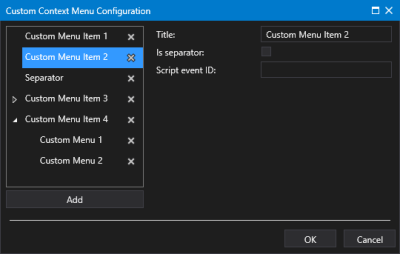
- Click to open Custom Context Menu Configuration dialog box.
- Click Add to add a menu item.
- To add child menu items, select the parent menu item and click Add. You can add multiple nested menu items if desired.
- Click
 to expand the menu items.
 - For each menu item click on <New> to reveal the properties:
- Title — The Title property specifies the menu name to be displayed in the runtime context menu.
- Is separator — The Is separator check box indicates whether this menu item will be a separator line in the menu at runtime. Once saved the separator has no configuration and no children. Separators do not have event IDs. Any event ID on a menu item when it’s converted to a separator is deleted. You can give it a title of 'Separator" or "----------" if desired.
- Script event ID — The Script event ID specifies the event ID that will be called when the menu item is selected from the runtime right-click context menu. The event ID is passed in as a parameter into the Custom Context Menu Action event, along with other relevant information in the context of the click, for example, facility or point tag, as appropriate.
- Title —
- Menu items can be easily reordered by dragging and dropping an item to a new location in the list.
- Or click (Delete this item and its children) to remove a selected menu item as necessary.
- Once the context menu items are configured, click OK to save.
- Or click Cancel to abort and close the Custom Context Menu Configuration dialog box.
To configure the source of row data
The Row configuration property is where you specify the source of the data to use in the rows of the Alarm Grid: either by SiteService or by facilities. The source for the SiteService can be the Screen or <Self>, where you can specify the Common Alarm Service (CAS) providing the alarm data. The source for the facilities can be from the screen or another control. Click to reveal a drop-down area where you can configure the source SiteService or the source Facilities for the grid's rows.
- Find the Grid properties and configure the desired source of the SiteService and facility for the rows of the grid.
- Click to reveal the Row source mode selector. The Row source mode property specifies the source of the SiteService or the source of the facilities for the Alarm Grid row data. Select one of the radio buttons to indicate whether the rows' data is received from a SiteService or from facilities.
- Sourced by SiteService — The Sourced by SiteService option specifies the source SiteService for the Alarm Grid's rows.
- Source — Options include <Self> or Screen.
- <Self> — Select <Self> to explicitly configure the SiteService for this control or screen element. A SiteService selector is displayed:
- CAS SiteService — The SiteService property specifies the Common Alarm Service (CAS) for which the Alarm Grid is to display data. Click to select a service using the Select Service dialog box.
- CAS SiteService — The SiteService property specifies the Common Alarm Service (CAS) for which the Alarm Grid is to display data. Click
- Screen — Select Screen to receive the SiteService from the screen for this control or screen element. By default, the sender is the Screen control if no other senders have been configured.
- <Self> — Select <Self> to explicitly configure the SiteService for this control or screen element. A SiteService selector is displayed:
- Source — Options include <Self> or Screen.
-
Sourced by facilities — The Sourced by facilities option specifies the source facilities for the Alarm Grid's rows.
- Source — Options include the Screen or a list of Sender controls.
- Screen — Select Screen to inherit the facility from the screen for this control. By default, the sender is the Screen control if no other senders have been configured. Once Screen is selected Inherited from Screen will display for the Facility property.
- Sender — A list of sender controls that have been configured with a facility will be displayed. Select the name of the control that will send its facility to this control. By default, the sender is the Screen control if no other senders have been configured. Once a sender control has been specified its name will display in the Source field.
- Source — Options include the Screen or a list of Sender controls.
- Configure other grid properties.
- Save the screen.
- Run the screen to test your configuration.
To configure a hyperlink to another screen
The Alarm Grid supports several operational modes to open a new window via hyperlink. Configure the facility sender mode, the double-click mode, the hyperlink mode, and add the screen that will be opened.
Note: Grid cells can display a different facility from that configured for a grid row. The double-click hyperlink action will pass the cell or row’s facility to other controls on the screen configured to receive it AND to the receiving screen.
- Find the Hyperlink properties and configure hyperlinking to another screen via a double-click action:
- Facility sender mode — Select Double click to send facilities to other controls on the screen and send the facility to the configured screen. See Facility sender mode for more detail.
- Double click mode — Hyperlink to link to a screen in a new window. See Double click mode for more detail.
- Hyperlink mode —
The Hyperlink mode property specifies how to handle navigation when clicking an element (e.g., row in a grid, Navigation Button, Shape, or Text Tool). Specify the Screen file source to open in the Screen path property. Several hyperlink navigation options are available:
- Open — Open a designated screen in a new window (default).
- Modal open — Open a designated screen in a new modal window. A modal window is a type of popup that is subordinate to a parent window that appears in front of the parent and usurps the parent’s control. You cannot interact with the parent window until the modal window has been closed. This type of window is used when you want a user to focus on or interact with information in the popup.
- Open and close — Open a designated screen in a new window and close the current screen.
- Replace — Replace the current screen with the designated screen.
- Replace with navigation — Replace the current screen with the specified screen and add a navigation toolbar to the top of the screen.
- Close — Close the current screen.
The default value is Open.
See Hyperlinking Screens for more information about this functionality.
- Screen file source —
This property specifies the source of the file, object file, screen file, image file, or video file. Options include:
- BSS — Indicates that the file is stored in an APPS or BSS folder
- Local — Indicates that the file is stored in a local or network file-system folder.
- Screen path —
The Screen path property specifies the screen that will open when an element (e.g., a row in a Grid, Image or Shape on a Map, Navigation Button, Shape, or Text Tool) is clicked. Browse for the screen file.
Click
to select a path and file from the Open / Open File / Select File dialog box, where you can access: - BSS — Indicates that the file is stored in an APPS or BSS folder
- Local — Indicates that the file is stored in a local or network file-system folder.
- Configure other grid properties.
- Save the screen.
- Run the screen to test your configuration.


